


Interior/Exterior New R56 gauge faces?


OVERDRIVE
Joined: May 2005
Posts: 8,233
Likes: 127
From: San Francisco
I'm a bit confused about your situation. The original topic was gauge faces, but you are NOT using a new gauge face and only trying to tint the lens?
Alliance Member

Joined: Apr 2009
Posts: 661
Likes: 24
From: Port Orchard, WA.
Originally I tried tinting the gauge face lenses but the glare on the tint made the gauges more difficult to read during daylight hours when the sun hit them. So now I am thinking about changing the gauge faces to blacken them and possibly tint the lens to darken the numbers for night driving. I would rather be able to darken the number back lighting but that does not seem possible.
I have considered changing to JCW speedo & tach but that might not be possible. Another thought is to change the JCW gauge faces with the standard R-56 faces.
I have considered changing to JCW speedo & tach but that might not be possible. Another thought is to change the JCW gauge faces with the standard R-56 faces.


OVERDRIVE
Joined: May 2005
Posts: 8,233
Likes: 127
From: San Francisco
- Take the gauge apart (pull the needle and remove the face plate) and apply a tint film to the back side of the plate.
- The back lighting is powered by a separate wire in the connector. Insert a resistor into the path (you'll have to cut the wire).

4th Gear
Joined: Sep 2007
Posts: 482
Likes: 0
From: Ephrata Washington
Try this http://www.heiler-tachodesign.de/Spe...R56-MPH-to-KMH
You can pick what you want it to read in.
You can pick what you want it to read in.
Alliance Member
Joined: Apr 2009
Posts: 661
Likes: 24
From: Port Orchard, WA.
There are a couple of possibilities.
- Take the gauge apart (pull the needle and remove the face plate) and apply a tint film to the back side of the plate.
- The back lighting is powered by a separate wire in the connector. Insert a resistor into the path (you'll have to cut the wire).
The resistor is also a thought I had, but I know that there is a minimum voltage for the LED's to trigger to on. It sure would have been simple if MINI/BMW had put a rheostat in the circuit instead of a push button!
The tint behind the faceplate has my vote so far. Once I get everything apart I will know!
OVERDRIVE
Joined: May 2005
Posts: 8,233
Likes: 127
From: San Francisco
LED's don't suddenly trigger on at some minimum voltage. They are actually analog circuits and you can dim them with a resistor. The button isn't connected to the illumination circuit. The instrument lighting is connected to the computer, which controls the brightness with pulse code modulation. The computer detects that the button is pressed and performs the appropriate action.
Alliance Member
Joined: Apr 2009
Posts: 661
Likes: 24
From: Port Orchard, WA.
In retrospect, I don't feel comfortable recommending to completely remove the faceplate, because removing the needle takes a truly scary amount of force, and then you have to deal with realigning it when you put it back. However, the faceplate is quite flexible and you can easily pull it away from the base and apply something behind it.
LED's don't suddenly trigger on at some minimum voltage. They are actually analog circuits and you can dim them with a resistor. The button isn't connected to the illumination circuit. The instrument lighting is connected to the computer, which controls the brightness with pulse code modulation. The computer detects that the button is pressed and performs the appropriate action.
LED's don't suddenly trigger on at some minimum voltage. They are actually analog circuits and you can dim them with a resistor. The button isn't connected to the illumination circuit. The instrument lighting is connected to the computer, which controls the brightness with pulse code modulation. The computer detects that the button is pressed and performs the appropriate action.
OVERDRIVE
Joined: May 2005
Posts: 8,233
Likes: 127
From: San Francisco
I don't have a recommendation for a resistor value. If I were doing it myself, I'd have to use trial and error. I was thinking the illumination wire at the connector where the gauge connects to the wiring harness. As I said earlier, the button itself isn't even connected to the lighting circuit and there isn't anything you can do there.
Before you try that, I suggest that you open your tach and look at putting a sheet of tinted vinyl behind the gauge plate. The plate is flexible and you'll have plenty of room to work with, even without pulling the needle. The speedo is the same situation but you can quickly examine the tach first and decide whether you want to take this approach.
Before you try that, I suggest that you open your tach and look at putting a sheet of tinted vinyl behind the gauge plate. The plate is flexible and you'll have plenty of room to work with, even without pulling the needle. The speedo is the same situation but you can quickly examine the tach first and decide whether you want to take this approach.
Alliance Member
Joined: Apr 2009
Posts: 661
Likes: 24
From: Port Orchard, WA.
I don't have a recommendation for a resistor value. If I were doing it myself, I'd have to use trial and error. I was thinking the illumination wire at the connector where the gauge connects to the wiring harness. As I said earlier, the button itself isn't even connected to the lighting circuit and there isn't anything you can do there.
Before you try that, I suggest that you open your tach and look at putting a sheet of tinted vinyl behind the gauge plate. The plate is flexible and you'll have plenty of room to work with, even without pulling the needle. The speedo is the same situation but you can quickly examine the tach first and decide whether you want to take this approach.
Before you try that, I suggest that you open your tach and look at putting a sheet of tinted vinyl behind the gauge plate. The plate is flexible and you'll have plenty of room to work with, even without pulling the needle. The speedo is the same situation but you can quickly examine the tach first and decide whether you want to take this approach.
Alliance Member
Joined: Apr 2009
Posts: 661
Likes: 24
From: Port Orchard, WA.
This may help: http://www.fes-auto.com/productsinvisilens.php. Disclaimer: I created the InvisiLens product, which is sold through FES Auto (a NAM vendor).
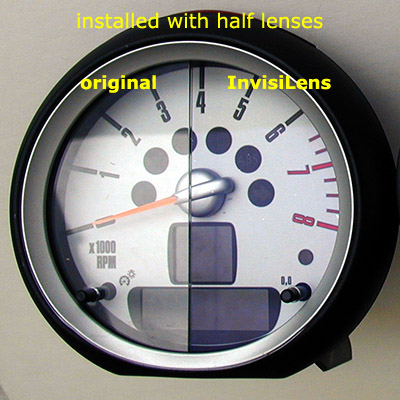
Note: the FES website is out of date and says the speedo lens is only available with the 2007-2010 silver trim. The 2011+ black trim is now also available.

Note: the FES website is out of date and says the speedo lens is only available with the 2007-2010 silver trim. The 2011+ black trim is now also available.
OVERDRIVE
Joined: May 2005
Posts: 8,233
Likes: 127
From: San Francisco
InvisiLens works by using an anti-reflective coating similar to the type used in eyeglasses and camera lenses.

If you could eliminate lens reflections 100%, you'd have a completely clear view of the gauge and the effect would be like the lens wasn't there. InvisiLens takes it most of the way, eliminating about 98% of light reflection.
Last edited by rkw; Mar 25, 2012 at 03:04 PM.
Alliance Member
Joined: Apr 2009
Posts: 661
Likes: 24
From: Port Orchard, WA.
InvisiLens doesn't affect polarization. If you have an issue with polarized sunglasses blacking out LCD displays, it's because the polarization angle in your sunglasses happens to be perpendicular to the polarization angle in the LCD. Different sunglasses don't all use exactly the same polarization angle. If it's an issue, you might try a different pair of sunglasses.
Alliance Member
Joined: Apr 2009
Posts: 661
Likes: 24
From: Port Orchard, WA.
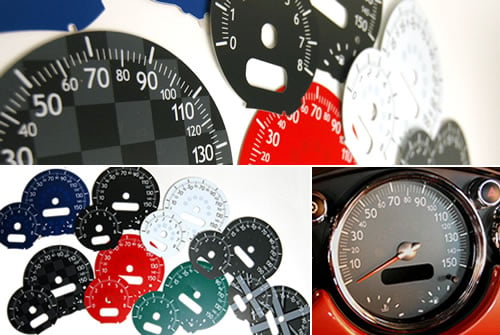
They say that they do not have the gauge face for the R-56 "S" 2011+ but these R-55 gauge faces show the same increments and top speed as my R-56 2011 MCS.
I ordered a set to see how they will work. BTW, I ordered the carbon fiber, black w/metallic silver numbers and will post photos once I get them and install them.
Alliance Member
Joined: Apr 2009
Posts: 661
Likes: 24
From: Port Orchard, WA.
Gauge Faces
Steer well clear of these people! The grief and hassle they caused is beyond belief!!!!
Even though they say they accept PayPal it appears that they do not and PayPal says they are NOT registered with them.
Even though they say they accept PayPal it appears that they do not and PayPal says they are NOT registered with them.

Thread
Thread Starter
Forum
Replies
Last Post
igzekyativ
MINIs & Minis for Sale
34
Jul 16, 2020 12:54 PM
dchang0
Stock Problems/Issues
2
Aug 10, 2015 03:37 PM