


Interior/Exterior Venting the Bonnet - A Unique Design


Banned
iTrader: (1)
Joined: Feb 2005
Posts: 4,054
Likes: 0
From: As far away from Florida as I can get.
Not right now. But I reserve the right for any future forum verbal abuse...  Me and the California Fire Chiefs Association... and the guys who telimarket for the California Sheriffs...
Me and the California Fire Chiefs Association... and the guys who telimarket for the California Sheriffs...

Banned
Joined: Nov 2006
Posts: 4,862
Likes: 3
From: Fresno Ca.
 .
.
Banned
iTrader: (1)
Joined: Feb 2005
Posts: 4,054
Likes: 0
From: As far away from Florida as I can get.
Yes they are. But they do have an amazing talent for calling when I am either having sex, or eating dinner... it is freakish, really...

 .
. Out doing SID is a very worthy goal!!
and you have done just that 
sorry Sid.

But they do have an amazing talent for calling when I am either having sex, or eating dinner...
it is freakish, really...

OVERDRIVE


Joined: May 2003
Posts: 7,926
Likes: 41
From: Greensboro, NC
Look for a lump of coal in your stocking...
new this would generate a post from you - SID
I can use the coal - I'm working on a coal fired mini project. So far the analysis shows it will blow Jan's efforts away !! I just have to figure out how to eliminate the coal car (think trains) because it does slow things down.
I can use the coal - I'm working on a coal fired mini project. So far the analysis shows it will blow Jan's efforts away !! I just have to figure out how to eliminate the coal car (think trains) because it does slow things down.

I look forward to hearing more about your tuning options BahamaBart. Are they any cheaper than Jan's? heh heh
About the NACA ducting mentioned earlier:
From Wikipedia, the free encyclopedia
The NACA duct or NACA scoop is a common form of low-drag intake design, originally developed by the National Advisory Committee for Aeronautics (the precursor to NASA) in 1945. When properly implemented, it allows air to be drawn into an internal duct, often for cooling purposes, with a minimal disturbance to the flow. The design was originally called a "submerged inlet," since it consists of a shallow ramp with curved walls recessed into the exposed surface of a streamlined body, such as an aircraft. It is especially favored in racing car design.
Prior submerged inlet experiments showed poor pressure recovery due to the slow-moving boundary layer entering the intake. This design is believed to work because the combination of the gentle ramp angle and the curvature profile of the walls creates counter-rotating vortices which deflect the boundary layer away from the intake and draws in the faster moving air, while avoiding the form drag and flow separation that can occur with protruding inlet designs. This type of flush inlet generally cannot achieve the larger ram pressures and flow volumes of an external design, and so is rarely used for the jet engine intake application for which it was originally designed, (the North American YF-93 and Short Sherpa being exceptions.) It is, however, common for engine and ventilation intakes.
end wiki quote
EDIT: After a google search, it turns out you can buy NACA ducts of various sizes from racer parts wholesale. But money is a big issue right now.
About the NACA ducting mentioned earlier:
From Wikipedia, the free encyclopedia
The NACA duct or NACA scoop is a common form of low-drag intake design, originally developed by the National Advisory Committee for Aeronautics (the precursor to NASA) in 1945. When properly implemented, it allows air to be drawn into an internal duct, often for cooling purposes, with a minimal disturbance to the flow. The design was originally called a "submerged inlet," since it consists of a shallow ramp with curved walls recessed into the exposed surface of a streamlined body, such as an aircraft. It is especially favored in racing car design.
Prior submerged inlet experiments showed poor pressure recovery due to the slow-moving boundary layer entering the intake. This design is believed to work because the combination of the gentle ramp angle and the curvature profile of the walls creates counter-rotating vortices which deflect the boundary layer away from the intake and draws in the faster moving air, while avoiding the form drag and flow separation that can occur with protruding inlet designs. This type of flush inlet generally cannot achieve the larger ram pressures and flow volumes of an external design, and so is rarely used for the jet engine intake application for which it was originally designed, (the North American YF-93 and Short Sherpa being exceptions.) It is, however, common for engine and ventilation intakes.
end wiki quote
EDIT: After a google search, it turns out you can buy NACA ducts of various sizes from racer parts wholesale. But money is a big issue right now.
Last edited by nabeshin; Nov 27, 2007 at 03:17 AM. Reason: google, it is standard procedure.
We looked at NACA ducts for this project. One reason they were rejected was the desire to retain the curves of the Mini hood. When combined with the fact they a duct to bring airflow in and we were looking for a out concept they didn't fit the bill.

Getting closer!!!
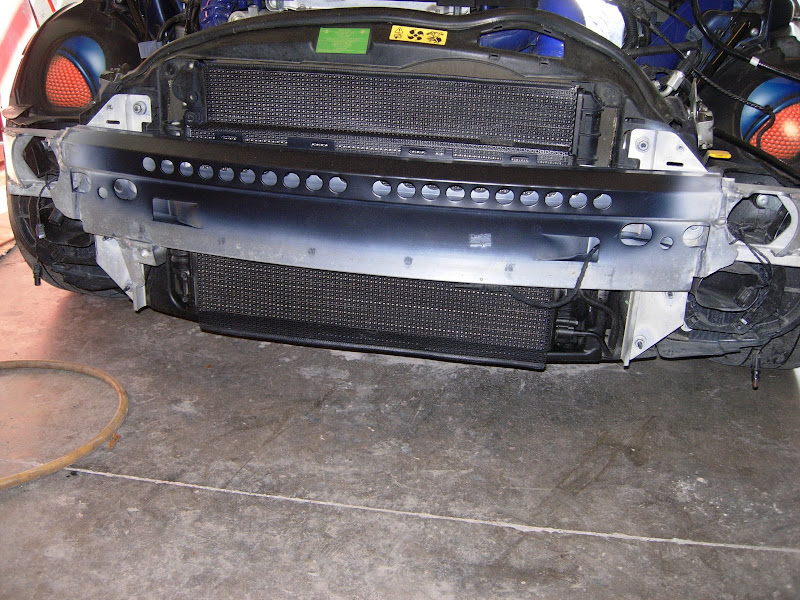
Note the attention to detail. Primed and painted all the bits that can be seen through the grills matte black and have the bug guard from Bug guards for Beemers.
Bonnet is on, most of the trim in place. Another day of cleanup and the like... but for now.
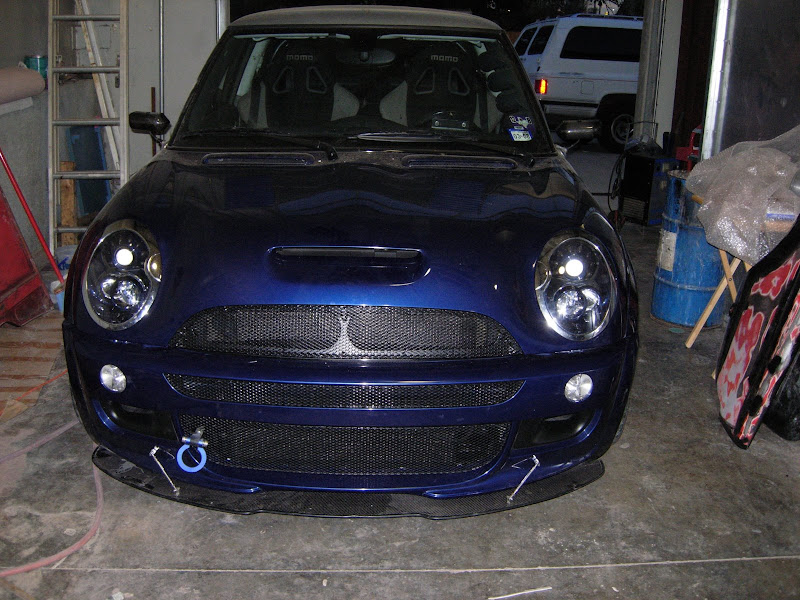
A proper photo shoot will be forthcoming..have some other tricks up my sleeve first.
Note the attention to detail. Primed and painted all the bits that can be seen through the grills matte black and have the bug guard from Bug guards for Beemers.
Bonnet is on, most of the trim in place. Another day of cleanup and the like... but for now.
A proper photo shoot will be forthcoming..have some other tricks up my sleeve first.


that is pure sex. can't wait to see more...
btw. I keep forgetting to send out the sprayer. I swear i'll get it sent out monday. I've been on the road from mon-friday each week for the last 10 weeks... so im a little out of sorts.
btw. I keep forgetting to send out the sprayer. I swear i'll get it sent out monday. I've been on the road from mon-friday each week for the last 10 weeks... so im a little out of sorts.

I was just giving you a hard time - thought you were griping about the pricing... that was my point... 
Sorry - end of threadjack.
Gnat - you should send your pic to the bug guard guy - cause your pic is MUCH better than the one on his site...
Sorry - end of threadjack.
Gnat - you should send your pic to the bug guard guy - cause your pic is MUCH better than the one on his site...


6th Gear
Joined: Jun 2004
Posts: 1,216
Likes: 18
Looks sick Nate.
Don't know if you answered it already but any concerns on water (I was mostly focusing on all the nice pics)?
Does it ever rain in Texas? Up here in the NE we have to worry about these kinds of things.
Don't know if you answered it already but any concerns on water (I was mostly focusing on all the nice pics)?
Does it ever rain in Texas?
Up here in the NE we have to worry about these kinds of things.


Wow. You front end really does look amazing. Although the molded hood scoop just doesn't do it for me. It might just be the lack of the MINI logo though. Either way, I really love your car and hope mine can be that nice some day.
I never did any testing of underhood temps before the change so in the spirit of NAM I'm going to claim that it lowers the IAT's to ambient at all speeds, makes hair grow on bald men and chicks dig it.
Bob, frankly, this is a bling mod and any extra cooling is just a good thing. In theory that location is a low pressure spot on the hood and hot air should be drawn from under the hood.
If it was the bug guard you meant...well the water temps in day to day running around are teh same with or without. I did note that the water does reach it's high a little quicker, but not so much faster that it may just be a statistical anomaly. Running full bore on track on 100+ degree days the temp was on avg 7 degrees higher with the bug guard then without. But given the gauge has a an advertised +/- 2% range that may be just minor sensor fluctuation.