


The age-old question... break-in process?


Neutral
Joined: Oct 2008
Posts: 9
Likes: 0
Thanks Red Bull for your reply. I understand that it is engine RPM that is at issue, but I still don't understand how the load on a cam bearing at 2400 RPM is any different than say 3000. Yes, it is greater, but is there any other change? I could understand something like needing a certain RPM to generate a minimum load necessary for seating, but I am still unsure how simply altering the speed/load periodically makes any real difference in a modern engine.

Thanks Red Bull for your reply. I understand that it is engine RPM that is at issue, but I still don't understand how the load on a cam bearing at 2400 RPM is any different than say 3000. Yes, it is greater, but is there any other change? I could understand something like needing a certain RPM to generate a minimum load necessary for seating, but I am still unsure how simply altering the speed/load periodically makes any real difference in a modern engine.
The engine produces diffrent loads at diffrent RPM, especially on a crank that is carrying the load and mass of a connecting rod, piston and rings. The higher the RPM the more stress/load it will have on the parts. So during breakin it is important to vary RPM to change the load.
When an engine is new eveything must wear properly. All the parts are new with sharp and contrasting surfaces. As the engine runs these parts start to seat a pattern, like a mirror they are opposite. The parts will start to seat together.
The heating cycle is also important. If you understand heat treating steel, the parts are brought up to temp then cooled off, this changes the molecular structure of the material making it stronger.
I don't know if any of this helps, or I am explaining it correctly.
Neutral
Joined: Oct 2008
Posts: 9
Likes: 0
"The higher the RPM the more stress/load it will have on the parts. So during breakin it is important to vary RPM to change the load."
Respectfully, I just don't get the logic or the "therefore" of sentence two above in relation to sentence one. I am not trying to be argumentative, simply trying to grasp the answer.
Respectfully, I just don't get the logic or the "therefore" of sentence two above in relation to sentence one. I am not trying to be argumentative, simply trying to grasp the answer.
"The higher the RPM the more stress/load it will have on the parts. So during breakin it is important to vary RPM to change the load."
Respectfully, I just don't get the logic or the "therefore" of sentence two above in relation to sentence one. I am not trying to be argumentative, simply trying to grasp the answer.
Respectfully, I just don't get the logic or the "therefore" of sentence two above in relation to sentence one. I am not trying to be argumentative, simply trying to grasp the answer.


2nd Gear
Joined: Aug 2008
Posts: 77
Likes: 0
From: Blue Ridge Mountains of North Carolina, USA
Being an older driver, having 4 German cars in my "garage", and a mechanic that works on the older three (04 Audi A8L, 03 BMW X5 4.4i, 71 Porsche 911T) -- I say change the oil early, 1000 or 5000 miles that is up to you. What harm is it? After the first change, unless you are driving 1000 miles a week on the interstate, change it at half the recommended mileage, how much more will it cost you? On another side of this discussion, I say drive it from the beginning like you intend to drive it after you have had it for years; no need to do something stupid, though.

4th Gear
Joined: Oct 2005
Posts: 392
Likes: 1
From: San Antonio
My German BMW tech says you limit rpms during the break-in period to keep oil temps lower as high oil temps can damage a new engine. It matters not there's a bit of metal in the oil. I tend to think that even metal in the oil aids break-in due to synthetic oils prolonging break-in.
People can do what they want. To me it's stupid to not break it in like the manufacturer recommends. Just shows how little discipline one has and an arrogance to think they know more than the manufacturer. Varying the load helps too, just as varying rpms. The first 100 miles is critical to really baby it. That's mainly to seat the rings properly and bed-in the clutch and brakes, and wear off the preservative on the tires.
People can do what they want. To me it's stupid to not break it in like the manufacturer recommends. Just shows how little discipline one has and an arrogance to think they know more than the manufacturer. Varying the load helps too, just as varying rpms. The first 100 miles is critical to really baby it. That's mainly to seat the rings properly and bed-in the clutch and brakes, and wear off the preservative on the tires.


4th Gear
Joined: Oct 2005
Posts: 392
Likes: 1
From: San Antonio
Of course, there's a big difference here in Germany vs. the States. Driving hard in the States is like driving easy here.
Additionally, if you place a new motor under heavy load, as in hard WFO throttle...well, you're just stupid.
I remember a motorcycle mag a few decades ago testing the the heat tolerance difference between two identical pistons. One piston was brand new. The other had been broken in properly with many heating and cooling cycles. I don't remember the temp of the oven, but the new piston melted and the "cured" piston was perfectly within design limits.
Stupid is as stupid does...
Additionally, if you place a new motor under heavy load, as in hard WFO throttle...well, you're just stupid.
I remember a motorcycle mag a few decades ago testing the the heat tolerance difference between two identical pistons. One piston was brand new. The other had been broken in properly with many heating and cooling cycles. I don't remember the temp of the oven, but the new piston melted and the "cured" piston was perfectly within design limits.
Stupid is as stupid does...
Of course, there's a big difference here in Germany vs. the States. Driving hard in the States is like driving easy here.
Additionally, if you place a new motor under heavy load, as in hard WFO throttle...well, you're just stupid.
I remember a motorcycle mag a few decades ago testing the the heat tolerance difference between two identical pistons. One piston was brand new. The other had been broken in properly with many heating and cooling cycles. I don't remember the temp of the oven, but the new piston melted and the "cured" piston was perfectly within design limits.
Stupid is as stupid does...
Additionally, if you place a new motor under heavy load, as in hard WFO throttle...well, you're just stupid.
I remember a motorcycle mag a few decades ago testing the the heat tolerance difference between two identical pistons. One piston was brand new. The other had been broken in properly with many heating and cooling cycles. I don't remember the temp of the oven, but the new piston melted and the "cured" piston was perfectly within design limits.
Stupid is as stupid does...
 PLEASE..make it stop........

1st Gear
Joined: Dec 2007
Posts: 47
Likes: 0
My question is with the use of sythetic oil during break-in. I have a Dodge hemi and my mechanic told me not to use sythetic oil till 20 thousand. The use of sythetic oil will never allow the engine to fully break-in. Would this not apply for all engines?

5th Gear
Joined: Apr 2008
Posts: 609
Likes: 1
From: Woodbridge VA
4th Gear
Joined: Oct 2005
Posts: 392
Likes: 1
From: San Antonio
Interestingly, here in Germany all oil changes are at a cost to the owner, regardless of whether still under warranty. The increments are far more "normal" such as every 6,000 miles (10,000 kilometers). Luckily they let us bring in our own oil, which saves quite a bit on the bill.
Also, you can't get the average American to follow any instructions to save their own lives (as evidenced in this thread), so I'm sure BMW NA defalted to something more conservative and to their advantage.
 TO SAVE OUR LIVES..
What a bunch of crap...Go American bashing somewhere else...Give me a break. You think because you drive on the autobahn you know more!!!! Please.........what a joke.
Is there a Germanmotering.com where you can be with your own know it all kind...
5th Gear
Joined: Apr 2008
Posts: 609
Likes: 1
From: Woodbridge VA
<snip>
I wrote "Break-In Secrets" after successfully applying this method
to approximately 300 new engines, all without any problems whatsoever.
Links to this article now appear on hundreds of motorsports discussion forums from all over the world. The reason is that over time, large numbers of people have done a direct comparison between my method and the owner's manual method, and the news of their success is spreading rapidly.
The results are always the same... a dramatic increase in power at all RPMs. In addition, many professional mechanics have disassembled engines that have used this method, to find that the condition of the engine is much better than when the owner's manual break-in method has been used.
The thing that makes this page so controversial is that there have been many other break-in articles
written in the past which will contradict what has been written here.
Several factors make the older information on break-in obsolete.
The biggest factor is that engine manufacturers now use a much finer honing pattern in the cylinders than they once did. This in turn changes the break-in requirements, because as you're about to learn, the window of opportunity for achieving an exceptional ring seal is much smaller with
newer engines than it was with the older "rough honed" engines.
In addition, there is a lot less heat build up in the cylinders from ring friction
due to the finer honing pattern used in modern engines.
The other factors that have changed are the vastly improved metal casting and machining
technologies which are now used. This means that the "wearing in" of the new parts
involves significantly less friction and actual wear than it did in the distant past.
With that in mind ...
to approximately 300 new engines, all without any problems whatsoever.
Links to this article now appear on hundreds of motorsports discussion forums from all over the world. The reason is that over time, large numbers of people have done a direct comparison between my method and the owner's manual method, and the news of their success is spreading rapidly.
The results are always the same... a dramatic increase in power at all RPMs. In addition, many professional mechanics have disassembled engines that have used this method, to find that the condition of the engine is much better than when the owner's manual break-in method has been used.
The thing that makes this page so controversial is that there have been many other break-in articles
written in the past which will contradict what has been written here.
Several factors make the older information on break-in obsolete.
The biggest factor is that engine manufacturers now use a much finer honing pattern in the cylinders than they once did. This in turn changes the break-in requirements, because as you're about to learn, the window of opportunity for achieving an exceptional ring seal is much smaller with
newer engines than it was with the older "rough honed" engines.
In addition, there is a lot less heat build up in the cylinders from ring friction
due to the finer honing pattern used in modern engines.
The other factors that have changed are the vastly improved metal casting and machining
technologies which are now used. This means that the "wearing in" of the new parts
involves significantly less friction and actual wear than it did in the distant past.
With that in mind ...
What's The Best Way To Break-In A New Engine ??
The Short Answer: Run it Hard !
Why ??
Nowadays, the piston ring seal is really what the break in process is all about. Contrary to popular belief, piston rings don't seal the combustion pressure by spring tension. Ring tension is necessary only to "scrape" the oil to prevent it from entering the combustion chamber.
If you think about it, the ring exerts maybe 5-10 lbs of spring tension against the cylinder wall ...
How can such a small amount of spring tension seal against thousands of
PSI (Pounds Per Square Inch) of combustion pressure ??
Of course it can't.
How Do Rings Seal Against Tremendous Combustion Pressure ??
From the actual gas pressure itself !! It passes over the top of the ring, and gets behind it to force it outward against the cylinder wall. The problem is that new rings are far from perfect and they must be worn in quite a bit in order to completely seal all the way around the bore. If the gas pressure is strong enough during the engine's first miles of operation (open that throttle !!!), then the entire ring will wear into
the cylinder surface, to seal the combustion pressure as well as possible.
The Problem With "Easy Break In" ...
The honed crosshatch pattern in the cylinder bore acts like a file to allow the rings to wear. The rings quickly wear down the "peaks" of this roughness, regardless of how hard the engine is run.
There's a very small window of opportunity to get the rings to seal really well ... the first 20 miles !!
If the rings aren't forced against the walls soon enough, they'll use up the roughness before they fully seat. Once that happens there is no solution but to re hone the cylinders, install new rings and start over again.
Fortunately, most new sportbike owners can't resist the urge to "open it up" once or twice,
which is why more engines don't have this problem !!
An additional factor that you may not have realized, is that the person at the dealership who set up your bike probably blasted your brand new bike pretty hard on the "test run". So, without realizing it, that adrenaline crazed set - up mechanic actually did you a huge favor !!
The Short Answer: Run it Hard !
Why ??
Nowadays, the piston ring seal is really what the break in process is all about. Contrary to popular belief, piston rings don't seal the combustion pressure by spring tension. Ring tension is necessary only to "scrape" the oil to prevent it from entering the combustion chamber.
If you think about it, the ring exerts maybe 5-10 lbs of spring tension against the cylinder wall ...
How can such a small amount of spring tension seal against thousands of
PSI (Pounds Per Square Inch) of combustion pressure ??
Of course it can't.
How Do Rings Seal Against Tremendous Combustion Pressure ??
From the actual gas pressure itself !! It passes over the top of the ring, and gets behind it to force it outward against the cylinder wall. The problem is that new rings are far from perfect and they must be worn in quite a bit in order to completely seal all the way around the bore. If the gas pressure is strong enough during the engine's first miles of operation (open that throttle !!!), then the entire ring will wear into
the cylinder surface, to seal the combustion pressure as well as possible.
The Problem With "Easy Break In" ...
The honed crosshatch pattern in the cylinder bore acts like a file to allow the rings to wear. The rings quickly wear down the "peaks" of this roughness, regardless of how hard the engine is run.
There's a very small window of opportunity to get the rings to seal really well ... the first 20 miles !!
If the rings aren't forced against the walls soon enough, they'll use up the roughness before they fully seat. Once that happens there is no solution but to re hone the cylinders, install new rings and start over again.
Fortunately, most new sportbike owners can't resist the urge to "open it up" once or twice,
which is why more engines don't have this problem !!
An additional factor that you may not have realized, is that the person at the dealership who set up your bike probably blasted your brand new bike pretty hard on the "test run". So, without realizing it, that adrenaline crazed set - up mechanic actually did you a huge favor !!
Yeah - But ...
the owner's manual says to break it in easy ...
Notice that this technique isn't "beating" on the engine, but rather taking a purposeful, methodical approach to sealing the rings. The logic to this method is sound. However, some will have a hard time with this approach, since it seems to "go against the grain".
The argument for an easy break-in is usually: "that's what the manual says" ....
Or more specifically: "there are tight parts in the engine and you might do damage or even seize it if you run it hard."
Consider this:
Due to the vastly improved metal casting and machining technologies which are now used, tight parts in new engines are not normal. A manufacturing mistake causing a tight clearance is an extremely rare occurrence these days. But, if there is something wrong with the engine clearances from the factory, no amount of gentle running will fix the problem.
The real reason ???
So why do all the owner's manuals say to take it easy for the first
thousand miles ???
This is a good question ...
Q: What is the most common cause of engine problems ???
A: Failure to:
Warm the engine up completely before running it hard !!!
Q: What is the second most common cause of engine problems ???
A: An easy break in !!!
Because, when the rings don't seal well, the blow-by gasses contaminate the oil with acids and other harmful combustion by-products !!
Ironically, an "easy break in" is not at all what it seems. By trying to "protect" the engine, the exact opposite happens, as leaky rings continue to contaminate your engine oil for the rest of the life of your engine !!
A Picture's Worth A Thousand Words:
The piston on the right was broken in as
per MotoMan's instructions.
After a full season of hard racing:
- Perfect Ring Seal ...
- No Scuffing ...
- Lots of Trophies !!!
These Honda F3 pistons show
the difference.
Although these pistons came out of engines which were raced for a full season, they weren't set-up with any special clearances or other preparation.
These engines were never worked on prior to being raced. They were totally stock as built by Honda.
The only difference was the break in method they used...
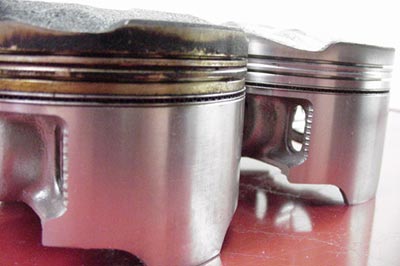
The one on the right was broken in as per MotoMan's instructions.
The one on the left was broken in exactly according to the owner's manual. The resulting leaky rings have allowed pressure to "blow by" down into the crankcase on acceleration, and oil to "suck-up" into the combustion chamber on deceleration.
Needless to say, this bike was slow !!
It's up to you:
The loss in power from an easy break-in and the resulting poor ring seal can be
anywhere from 2% - 10% !!
In other words:
The gain in power from using this break-in method can be anywhere from 2% - 10% !!
The piston on the right was broken in as
per MotoMan's instructions.
After a full season of hard racing:
- Perfect Ring Seal ...
- No Scuffing ...
- Lots of Trophies !!!
These Honda F3 pistons show
the difference.
Although these pistons came out of engines which were raced for a full season, they weren't set-up with any special clearances or other preparation.
These engines were never worked on prior to being raced. They were totally stock as built by Honda.
The only difference was the break in method they used...
The one on the right was broken in as per MotoMan's instructions.
The one on the left was broken in exactly according to the owner's manual. The resulting leaky rings have allowed pressure to "blow by" down into the crankcase on acceleration, and oil to "suck-up" into the combustion chamber on deceleration.
Needless to say, this bike was slow !!
It's up to you:
The loss in power from an easy break-in and the resulting poor ring seal can be
anywhere from 2% - 10% !!
In other words:
The gain in power from using this break-in method can be anywhere from 2% - 10% !!
I suggest you check that page out for more pix.


4th Gear
Joined: Oct 2005
Posts: 392
Likes: 1
From: San Antonio
WOW...so us dumb average Americans cant follow directions very well TO SAVE OUR LIVES..
What a bunch of crap...Go American bashing somewhere else...Give me a break. You think because you drive on the autobahn you know more!!!! Please.........what a joke.
Is there a Germanmotering.com where you can be with your own know it all kind...
TO SAVE OUR LIVES..What a bunch of crap...Go American bashing somewhere else...Give me a break. You think because you drive on the autobahn you know more!!!! Please.........what a joke.
Is there a Germanmotering.com where you can be with your own know it all kind...
Too many Americans are idiots when it comes to this stuff due to unbridled arrogance, or just ignorance. As I said, it's your car so do it your own way. Makes no difference to me. Just know advocating something other than what the manufacturer prescribes is irresponsible. And until you pull the pistons out of your motor to check them in consideration to your choice of theroy, you're just following your choice blindly. Still, since Florida doesn't offer any real test of your car, you're safe.
One of the world's best MINI tuner shops is in my town. I'll get his opinion on break in next time I see him. He also builds MINI Challenge racers.
http://cms.mini-clubsport.com/

2nd Gear
Joined: May 2008
Posts: 122
Likes: 0
Minispud: Perfectly said.
I broke-in my R56 using the above technique used for breaking in a performance engine, with the exception of an oil change done at 3k instead of asap. Within ~200 miles of owning my car, I gently reved the car out 500rpm higher every repeating cycle. When the desired level of rmp was attained, I closed the throttle and let the car decelerate from (speed in relation to rpm) down to about 2000 rpm; all in 4th gear.
Its amazing how much blow by smoke you'll actually get the first 3-5 times doing this. Its important not to go to crazy with acceleration; only about 1/2 throttle will get you up to 6000 rpms in 3rd gear. Your not just hammering it all the way to the top. Proceed by closing the throttle at high rpm to create massive vaccume. This will strip the cyl walls of asm lube and excess oils and promote effective beddin and a proper performance break-in.
When the smoke stops after about 1 to 3 pushes and drops from 6000 rpms your rings are now seated and ready to rock. Stock car pulled 174rwhp on a Dynojet.
I've done this on two cars and one bike and dyno numbers have always been proven higher than average.
I broke-in my R56 using the above technique used for breaking in a performance engine, with the exception of an oil change done at 3k instead of asap. Within ~200 miles of owning my car, I gently reved the car out 500rpm higher every repeating cycle. When the desired level of rmp was attained, I closed the throttle and let the car decelerate from (speed in relation to rpm) down to about 2000 rpm; all in 4th gear.
Its amazing how much blow by smoke you'll actually get the first 3-5 times doing this. Its important not to go to crazy with acceleration; only about 1/2 throttle will get you up to 6000 rpms in 3rd gear. Your not just hammering it all the way to the top. Proceed by closing the throttle at high rpm to create massive vaccume. This will strip the cyl walls of asm lube and excess oils and promote effective beddin and a proper performance break-in.
When the smoke stops after about 1 to 3 pushes and drops from 6000 rpms your rings are now seated and ready to rock. Stock car pulled 174rwhp on a Dynojet.
I've done this on two cars and one bike and dyno numbers have always been proven higher than average.
Hey, at least I'm over here defending America. What have you ever sacrificed for it? Nada (in case English isn't your first language)
Too many Americans are idiots when it comes to this stuff due to unbridled arrogance, or just ignorance. As I said, it's your car so do it your own way. Makes no difference to me. Just know advocating something other than what the manufacturer prescribes is irresponsible. And until you pull the pistons out of your motor to check them in consideration to your choice of theroy, you're just following your choice blindly. Still, since Florida doesn't offer any real test of your car, you're safe.
One of the world's best MINI tuner shops is in my town. I'll get his opinion on break in next time I see him. He also builds MINI Challenge racers.
http://cms.mini-clubsport.com/
Too many Americans are idiots when it comes to this stuff due to unbridled arrogance, or just ignorance. As I said, it's your car so do it your own way. Makes no difference to me. Just know advocating something other than what the manufacturer prescribes is irresponsible. And until you pull the pistons out of your motor to check them in consideration to your choice of theroy, you're just following your choice blindly. Still, since Florida doesn't offer any real test of your car, you're safe.
One of the world's best MINI tuner shops is in my town. I'll get his opinion on break in next time I see him. He also builds MINI Challenge racers.
http://cms.mini-clubsport.com/
4th Gear
Joined: Oct 2005
Posts: 392
Likes: 1
From: San Antonio
First you have no idea who I am and what I do for my country...while your in Germany defending my country my friends & Family are overseas in harms way...and yes English is my language..born in New York and always stand behind my country....not bad mouth it........what an arrogant A-Hole
I'll leave you alone. Sorry if I was a bit brash. Most of it was just for entertainment value. But you started it when you referred to me as "it". Be nice and you won't have to deal with any angst.
BTW, I don't doubt you stand behind your country. The fact you mentioned it speaks volumes. Most seem to just want to take and not give back anything.
Cheers!
5th Gear
Joined: Apr 2008
Posts: 609
Likes: 1
From: Woodbridge VA
can we get rid of the bashing BS?
As stated, this is a hot topic. many, many many folks believe that the manufact have the break in the way they do.
My opinion is, if they DIDnt do the ease in method recommendation, they would be fixing plenty of cars on their dime for folks who just buy the car and rip the ever living crap out of it from day one.
Seating the rings does work if followed correctly. However MINI cant account for the fact that most folks are idiots. it affects the bottom dollar. so the flip side is to tell folks to baby it, which will get just about everyone thorugh the warranty and extended warranty periods.
If you owned the company, what would you do? I think it is obvious that you always account for the lowest common denominator. Eg stupid people.
It is how the world works.
That being said, following the break in from moto guy, WILL break in your car and seat the rings that you get more HP to the wheel. I have had 3 sportbikes, 350Z, 2006 M3, and now my MINI and I can tell you the cars and bikes PULL.
I never pulled the engine apart on the cars, but i did on my two previous bikes and they looked clean as a whistle.
there is nothing wrong with the baby break in method.
I dont think it is irresponsible though.
As stated, this is a hot topic. many, many many folks believe that the manufact have the break in the way they do.
My opinion is, if they DIDnt do the ease in method recommendation, they would be fixing plenty of cars on their dime for folks who just buy the car and rip the ever living crap out of it from day one.
Seating the rings does work if followed correctly. However MINI cant account for the fact that most folks are idiots. it affects the bottom dollar. so the flip side is to tell folks to baby it, which will get just about everyone thorugh the warranty and extended warranty periods.
If you owned the company, what would you do? I think it is obvious that you always account for the lowest common denominator. Eg stupid people.
It is how the world works.
That being said, following the break in from moto guy, WILL break in your car and seat the rings that you get more HP to the wheel. I have had 3 sportbikes, 350Z, 2006 M3, and now my MINI and I can tell you the cars and bikes PULL.
I never pulled the engine apart on the cars, but i did on my two previous bikes and they looked clean as a whistle.
there is nothing wrong with the baby break in method.
I dont think it is irresponsible though.

4th Gear
Joined: Sep 2008
Posts: 388
Likes: 0
From: The dark side of the moon
can we get rid of the bashing BS?
As stated, this is a hot topic. many, many many folks believe that the manufact have the break in the way they do.
My opinion is, if they DIDnt do the ease in method recommendation, they would be fixing plenty of cars on their dime for folks who just buy the car and rip the ever living crap out of it from day one.
Seating the rings does work if followed correctly. However MINI cant account for the fact that most folks are idiots. it affects the bottom dollar. so the flip side is to tell folks to baby it, which will get just about everyone thorugh the warranty and extended warranty periods.
If you owned the company, what would you do? I think it is obvious that you always account for the lowest common denominator. Eg stupid people.
It is how the world works.
That being said, following the break in from moto guy, WILL break in your car and seat the rings that you get more HP to the wheel. I have had 3 sportbikes, 350Z, 2006 M3, and now my MINI and I can tell you the cars and bikes PULL.
I never pulled the engine apart on the cars, but i did on my two previous bikes and they looked clean as a whistle.
there is nothing wrong with the baby break in method.
I dont think it is irresponsible though.
As stated, this is a hot topic. many, many many folks believe that the manufact have the break in the way they do.
My opinion is, if they DIDnt do the ease in method recommendation, they would be fixing plenty of cars on their dime for folks who just buy the car and rip the ever living crap out of it from day one.
Seating the rings does work if followed correctly. However MINI cant account for the fact that most folks are idiots. it affects the bottom dollar. so the flip side is to tell folks to baby it, which will get just about everyone thorugh the warranty and extended warranty periods.
If you owned the company, what would you do? I think it is obvious that you always account for the lowest common denominator. Eg stupid people.
It is how the world works.
That being said, following the break in from moto guy, WILL break in your car and seat the rings that you get more HP to the wheel. I have had 3 sportbikes, 350Z, 2006 M3, and now my MINI and I can tell you the cars and bikes PULL.
I never pulled the engine apart on the cars, but i did on my two previous bikes and they looked clean as a whistle.
there is nothing wrong with the baby break in method.
I dont think it is irresponsible though.


3rd Gear
Joined: Jan 2009
Posts: 153
Likes: 0
From: Los Altos Hills, CA
If you do the hard break-in and something happens to your engine, can MINI deny your warranty claim saying, "you didn't follow the proper engine break-in procedure"??? Isn't the engine RPM's stored in your cars computer where the dealer can extract the data???
I just remember this from an issue with the early e46 M3's where the engine pretty much exploded due to insufficient oil and BMW were blaming the owners for driving at such high rpm's. They got this data from the logs in the car's computer But it started happening to M3's with SMG, which shifts automatically near red-line even in "manual mode".
I just remember this from an issue with the early e46 M3's where the engine pretty much exploded due to insufficient oil and BMW were blaming the owners for driving at such high rpm's. They got this data from the logs in the car's computer But it started happening to M3's with SMG, which shifts automatically near red-line even in "manual mode".
5th Gear
Joined: Apr 2008
Posts: 609
Likes: 1
From: Woodbridge VA
If you do the hard break-in and something happens to your engine, can MINI deny your warranty claim saying, "you didn't follow the proper engine break-in procedure"??? Isn't the engine RPM's stored in your cars computer where the dealer can extract the data???
I just remember this from an issue with the early e46 M3's where the engine pretty much exploded due to insufficient oil and BMW were blaming the owners for driving at such high rpm's. They got this data from the logs in the car's computer But it started happening to M3's with SMG, which shifts automatically near red-line even in "manual mode".
I just remember this from an issue with the early e46 M3's where the engine pretty much exploded due to insufficient oil and BMW were blaming the owners for driving at such high rpm's. They got this data from the logs in the car's computer But it started happening to M3's with SMG, which shifts automatically near red-line even in "manual mode".
Ill have to look that up. I dont think it does..