


Drivetrain JP Genuine Intercooler???


3rd Gear

Joined: Feb 2014
Posts: 169
Likes: 6
Intercooler thoughts :-).
1. It looks like it fits well behind your bumper, which if you don't want to alter your bodywork is good.
2. The number of fins and rungs/pipes looks far too low and gives me the impression it is not the most efficient core. You need surface area to transfer heat as well as overall size of intercooler. Visual inspection isn't a good test, so carry out proper fully loaded throttle tests for results. For info the standard intercooler is very small but it also have a really efficient core. Have a look at the number of fins both on the outside and on the inside. Very good at transferring heat, only held back by it's overall small size.
3. I can't buy that methanol injection at a tiny volume of actual liquid reduces post turbo inlet temps to below ambient. I think it is just your thermocouple getting saturated and then experiencing the direct effect of evaporation. Sounds dangerous that the car thinks it's boost is at a lower temp than it actually is. No one has every proved to me that the methanol actually reduces temp. I wish they would as I'd love sub ambient boost temps. The volume of air that it needs to cool is just far too large for the small amount of liquid. IMO.
4. I don't understand this chat about "llow reduced pressure across intercooler". You want hot air to enter the intercooler and cold air to come out the other side. My understanding is the same amount of air at a lower temp will have less volume so you WANT a pressure drop as that shows the temp is dropping. The more temp drop the better, which drives more pressure drop...
5. Whilst yes it is important to see how quickly the IATs drop after you back off the throttle, personally I am more interested on what it does DURING being on the throttle and then secondarily how quickly it drops after.
Just my thoughts and happy to hear some solid data either way :-)
Cheers,
Steven_RW
1. It looks like it fits well behind your bumper, which if you don't want to alter your bodywork is good.
2. The number of fins and rungs/pipes looks far too low and gives me the impression it is not the most efficient core. You need surface area to transfer heat as well as overall size of intercooler. Visual inspection isn't a good test, so carry out proper fully loaded throttle tests for results. For info the standard intercooler is very small but it also have a really efficient core. Have a look at the number of fins both on the outside and on the inside. Very good at transferring heat, only held back by it's overall small size.
3. I can't buy that methanol injection at a tiny volume of actual liquid reduces post turbo inlet temps to below ambient. I think it is just your thermocouple getting saturated and then experiencing the direct effect of evaporation. Sounds dangerous that the car thinks it's boost is at a lower temp than it actually is. No one has every proved to me that the methanol actually reduces temp. I wish they would as I'd love sub ambient boost temps. The volume of air that it needs to cool is just far too large for the small amount of liquid. IMO.
4. I don't understand this chat about "llow reduced pressure across intercooler". You want hot air to enter the intercooler and cold air to come out the other side. My understanding is the same amount of air at a lower temp will have less volume so you WANT a pressure drop as that shows the temp is dropping. The more temp drop the better, which drives more pressure drop...
5. Whilst yes it is important to see how quickly the IATs drop after you back off the throttle, personally I am more interested on what it does DURING being on the throttle and then secondarily how quickly it drops after.
Just my thoughts and happy to hear some solid data either way :-)
Cheers,
Steven_RW

3. I can't buy that methanol injection at a tiny volume of actual liquid reduces post turbo inlet temps to below ambient. I think it is just your thermocouple getting saturated and then experiencing the direct effect of evaporation. Sounds dangerous that the car thinks it's boost is at a lower temp than it actually is. No one has every proved to me that the methanol actually reduces temp. I wish they would as I'd love sub ambient boost temps. The volume of air that it needs to cool is just far too large for the small amount of liquid. IMO.
To further prove the point:
BMW recently announced water injection on there M4 Safety Car:
http://blog.caranddriver.com/hard-co...but-in-august/
Methanol (or nearly any liquid) will give a similar effect, just how much depends on the particular liquid's latent heat capacity.
I don't know what kind of proof you need? This is NOT a new idea. It has been around to combat knock at altitude in airplanes since they started flying over a hundred years ago and for cars since the invention of the turbocharger/supercharger also about a hundred years ago.
Do you know something that the rest of the world doesn't, if so please share.
EDIT: Sorry, I'm not trying to be a jerk.
Last edited by cerenkov; Mar 9, 2015 at 06:14 AM.
3rd Gear
Joined: Feb 2014
Posts: 169
Likes: 6
Hi - no worries about your direct questions or challenges, differing opinions are nothing too rare or a reason to all fall out but also do appreciate your EDIT as at the end of the day our joint aim is to learn more about cars, engines and making our minis go faster and go safer. World Peace!! etc ;-)
I have not carried out an active calculation of required volume of water or methanol vs the volume of air. Which is a fair challenge! It is gut feeling when I look at the sheer volume of air going in to an engine at full throttle, full RPM.
What I have done is had conversations with a tuner that has been building turbo cars for many many years (30+), carries out solid logical tests, is a natural cynic and also a serious experimenter (wants to twin turbo my mini or add a supercharger too but space is an issue) and so on and at no point has ever managed to see an increase in BHP driven by water injection systems. Experience showed that turning the boost down a little or working in another way to keep the inlet temps down was a more reliable and better way to sustain power. Water injection might stop detonation but he found it also reduced BHP at the same time. Maybe a safety system but not a "go faster" system in our experience.
To be clear, I'm loving the idea of a small amount of methanol decreasing my inlet temps below ambient. I already have gone far beyond most mini owners fitting a huge efficient intercooler, subtly chopping up my front end to make it fit and it takes up nearly the entire front end of my car in a bid to get the lowest inlet temps possible and have reaped the rewards from this in terms of extra power and consistent extra power.
Does anyone have a dyno graph (properly loaded test, over a number of seconds, say 30 seconds, to allow load to be stable and temps to rise) that shows X horsepower at Y inlet temp and then the same run with the methanol injection turned on showing no increase in boost but a decrease in inlet temp and an actual increase in BHP? Moving from way above ambient temps to below ambient temp should show a clear increase in BHP. I'm really concerned that the sub ambient inlet temp is actually a saturated thermocouple. Id prefer to keep the engine loaded in the state with the menthanol running and then take surface readings from pipework and so on using a thermometer pointer gun to see the temps end up below ambient. That would remove the risk of the saturated themocouple.
I'm up for being convinced and I will gladly buy the kit and install and test myself.
Hope that comes across as rationale and fair.
Thumbsup from Scotland
Steven
I have not carried out an active calculation of required volume of water or methanol vs the volume of air. Which is a fair challenge! It is gut feeling when I look at the sheer volume of air going in to an engine at full throttle, full RPM.
What I have done is had conversations with a tuner that has been building turbo cars for many many years (30+), carries out solid logical tests, is a natural cynic and also a serious experimenter (wants to twin turbo my mini or add a supercharger too but space is an issue) and so on and at no point has ever managed to see an increase in BHP driven by water injection systems. Experience showed that turning the boost down a little or working in another way to keep the inlet temps down was a more reliable and better way to sustain power. Water injection might stop detonation but he found it also reduced BHP at the same time. Maybe a safety system but not a "go faster" system in our experience.
To be clear, I'm loving the idea of a small amount of methanol decreasing my inlet temps below ambient. I already have gone far beyond most mini owners fitting a huge efficient intercooler, subtly chopping up my front end to make it fit and it takes up nearly the entire front end of my car in a bid to get the lowest inlet temps possible and have reaped the rewards from this in terms of extra power and consistent extra power.
Does anyone have a dyno graph (properly loaded test, over a number of seconds, say 30 seconds, to allow load to be stable and temps to rise) that shows X horsepower at Y inlet temp and then the same run with the methanol injection turned on showing no increase in boost but a decrease in inlet temp and an actual increase in BHP? Moving from way above ambient temps to below ambient temp should show a clear increase in BHP. I'm really concerned that the sub ambient inlet temp is actually a saturated thermocouple. Id prefer to keep the engine loaded in the state with the menthanol running and then take surface readings from pipework and so on using a thermometer pointer gun to see the temps end up below ambient. That would remove the risk of the saturated themocouple.
I'm up for being convinced and I will gladly buy the kit and install and test myself.
Hope that comes across as rationale and fair.
Thumbsup from Scotland
Steven
Last edited by Steven_RW; Mar 9, 2015 at 06:59 AM. Reason: Usual spelling mistakes :-)
At work, I do have a thermocouple that I can use to tape to the charge pipe and run the wire into the cabin to a reader but I'm not confident that the effect will be seen through the pipe wall.
I believe that you're right, methanol/water by itself doesn't add power but I don't use it for that. I use because I think it helps with the over all health of the engine.
When people tune these cars (or most turbos for that matter) they just end up focusing mostly on turning up the boost. As we know this can be really hard on the car and methanol/water is great for reducing the ill effects by:
1.) cooler intake charge (this is the part that you're debating some)
2.) increasing octane (which helps reduce knock).
3.) cooler combustion chamber. Ford Motor Company wrote an excellent research paper on this effect.
I think of it as an intercooler on steroids.
I believe that you're right, methanol/water by itself doesn't add power but I don't use it for that. I use because I think it helps with the over all health of the engine.
When people tune these cars (or most turbos for that matter) they just end up focusing mostly on turning up the boost. As we know this can be really hard on the car and methanol/water is great for reducing the ill effects by:
1.) cooler intake charge (this is the part that you're debating some)
2.) increasing octane (which helps reduce knock).
3.) cooler combustion chamber. Ford Motor Company wrote an excellent research paper on this effect.
I think of it as an intercooler on steroids.
3rd Gear
Joined: Feb 2014
Posts: 169
Likes: 6
If it's only been the cooler then I would look for leaks
3rd Gear
Joined: Feb 2014
Posts: 169
Likes: 6
Maybe the charge air pipe has less silencing in it. I don't know the exact item and it's spec but it may have removed the intake baffle thing that's just before the intercooler.
Probably no big issue. Probably exactly what you expect.
Ps it would run fine with a reasonably small air leak because of how it monitors air volume using a map sensor Not a mass air flow meter.
Probably no big issue. Probably exactly what you expect.
Ps it would run fine with a reasonably small air leak because of how it monitors air volume using a map sensor Not a mass air flow meter.
Yes, you will hear the turbo more because when you installed the NM hot charge pipe it removes the intake muffler piece. I noticed the same thing when I removed the intake muffler (that is in between the turbo and the intercooler). If you look at the inside of that muffler piece you'll notice a bunch of holes/baffles. I'm assuming that it is designed to eliminate some of the turbo noise.

3rd Gear
Joined: May 2012
Posts: 163
Likes: 3
 NM Eng air charge pipe.
The MINI Cooper S engine utilizes a turbocharger to pressurize the intake tract to force feed the engine air to produce power. As such, NM Engineering has identified a weak point that impairs the efficiency of this system.
The NM Engineering Hi-Flow Charge Pipe replaces the factory necked-down hose between the intercooler and throttle body (cold-side) with a new pipe and silicone couplers that will not expand under boost. The system eliminates the OEM sound chamber which results in increased turbo response as well as mid-range and top-end power.
Last edited by Club77; Mar 28, 2015 at 06:54 AM.
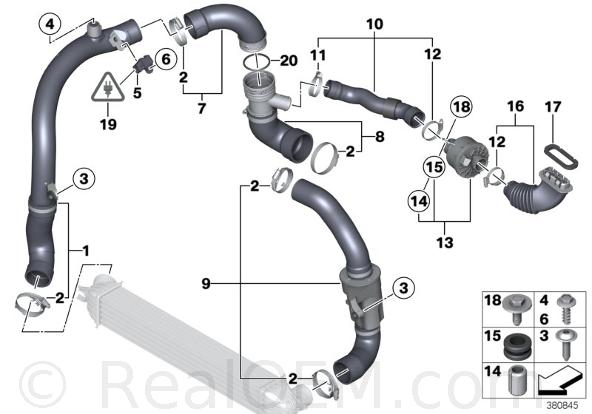
The piece that I was talking about earlier that silences the turbo spool is part number 9.
3rd Gear
Joined: May 2012
Posts: 163
Likes: 3
If you're asking if the NM Eng air charge pipe is required to disconnect the sound amplifier ducting from the firewall, then no. Only the earlier model year R56 had the sound amplifier (noise maker) the newer model years (from 2011) did not. But may people just install a pvc pipe plug from the hardware store into the "tee" of part number 8. The piece that I was talking about earlier that silences the turbo spool is part number 9.

Thread
Thread Starter
Forum
Replies
Last Post
ECSTuning
Interior/Exterior Products
0
Oct 1, 2015 12:34 PM
ECSTuning
Vendor Classifieds
0
Oct 1, 2015 12:34 PM
ECSTuning
Interior/Exterior Products
0
Oct 1, 2015 12:28 PM
ECSTuning
Vendor Classifieds
0
Oct 1, 2015 12:28 PM
ECSTuning
Vendor Announcements
0
Oct 1, 2015 12:13 PM