


Drivetrain Supercharger bypass valve theory of operation.


3rd Gear
Joined: May 2004
Posts: 243
Likes: 0
From: 3rd Stone from the Sun
>>i still think a cadidate is valve flutter eliminated by throttling the vac line
...and the presence of any oscillation is an indication that the valve is spending a considerable amount of time in a less-than-max-boost position.
The only way to know is to use the OBD logging to capture data on a known yoyoer with and without the mod, and under the same driving condition, say 2nd gear acceleration from 1.5krpm with a step throt input of 20%. 100 msec intervals should be sufficient, 50 msec better, candidate captured data might include pre and post SC pressure, throttle input and throttle body position, RPM. I'd buy one of those OBD logger gimmicks if I knew which one would do the job.
...and the presence of any oscillation is an indication that the valve is spending a considerable amount of time in a less-than-max-boost position.
The only way to know is to use the OBD logging to capture data on a known yoyoer with and without the mod, and under the same driving condition, say 2nd gear acceleration from 1.5krpm with a step throt input of 20%. 100 msec intervals should be sufficient, 50 msec better, candidate captured data might include pre and post SC pressure, throttle input and throttle body position, RPM. I'd buy one of those OBD logger gimmicks if I knew which one would do the job.

4th Gear
Joined: Dec 2002
Posts: 314
Likes: 1
From: Sammamish, WA
Good morning all,
I have been following this thread with interest and want to respond. I agree with John (jlm) and others that the "device" functions as a restrictor in the pressure/vacuum line to dampen the pressure fluctuations which may result in a functional improvement in the operation of the bypass valve, especially with pulleyed engines. The restrictor in the pressure/vacuum line has an electrical analog of a single element "low pass filter". Huh?
I'd like to explain this concept as an aid to understanding the theory and possible benefits of the restrictor. A low pass filter is a common and important circuit element in electrical systems. It's value is that the low pass filter dampens the rapid fluctuations in electrical signals. This dampening is sometimes necessary to stabilize the function of the down stream electrical circuitry. A low pass filter changes the shape of the wave by eliminating the high frequency component, so the "rise time", or onset of down stream action, is slightly delayed. Back to the bypass valve: the bypass valve action will be a little bit slower because of the dampening effect of the restriction (a.k.a. "device" . Back to the electrical circuit: the signals going in either direction through a simple low pass filter will have the wave shape changed in exactly the same way. The shaping of the electrical impulse and the shaping of the pressure pulse is shaped symmetrically depending on the direction of travel. Hence the opening and closing of the bypass valve will each be slowed slightly in equal degrees. There will be no asymentrical response as some have speculated.
Some early posters have noted a stabilization of their boost/vacuum guage readings and an improvement in throttle response. Not surprising given a possible stabilization of the bypass valve action. This bypass valve stabilization may be especially important with pulleyed engines. The OEM valve may have been calibrated to the stock setup and all of us who are running underdrive pulleys may get benefit from this stabilization tweek. The human mind can perceive quality differences in physical experiences that can elude objective measurement. I think that the early experimenters are indeed noting a quality change in throttle response, changes that might not easily be detected in pressure plots or lap times.
Regards,
John Petrich in Seattle
I have been following this thread with interest and want to respond. I agree with John (jlm) and others that the "device" functions as a restrictor in the pressure/vacuum line to dampen the pressure fluctuations which may result in a functional improvement in the operation of the bypass valve, especially with pulleyed engines. The restrictor in the pressure/vacuum line has an electrical analog of a single element "low pass filter". Huh?
I'd like to explain this concept as an aid to understanding the theory and possible benefits of the restrictor. A low pass filter is a common and important circuit element in electrical systems. It's value is that the low pass filter dampens the rapid fluctuations in electrical signals. This dampening is sometimes necessary to stabilize the function of the down stream electrical circuitry. A low pass filter changes the shape of the wave by eliminating the high frequency component, so the "rise time", or onset of down stream action, is slightly delayed. Back to the bypass valve: the bypass valve action will be a little bit slower because of the dampening effect of the restriction (a.k.a. "device"
. Back to the electrical circuit: the signals going in either direction through a simple low pass filter will have the wave shape changed in exactly the same way. The shaping of the electrical impulse and the shaping of the pressure pulse is shaped symmetrically depending on the direction of travel. Hence the opening and closing of the bypass valve will each be slowed slightly in equal degrees. There will be no asymentrical response as some have speculated.Some early posters have noted a stabilization of their boost/vacuum guage readings and an improvement in throttle response. Not surprising given a possible stabilization of the bypass valve action. This bypass valve stabilization may be especially important with pulleyed engines. The OEM valve may have been calibrated to the stock setup and all of us who are running underdrive pulleys may get benefit from this stabilization tweek. The human mind can perceive quality differences in physical experiences that can elude objective measurement. I think that the early experimenters are indeed noting a quality change in throttle response, changes that might not easily be detected in pressure plots or lap times.
Regards,
John Petrich in Seattle

4th Gear
Joined: May 2003
Posts: 507
Likes: 0
So I did some testing today with an adjustable valve in my Vacuum line on my Bypass valve....I adjusted the valve from full open to full close at 4 increments. I am able to get my hand in and adjust the valve while the car is running so I was able to get out of the car at the side of the road, adjust the valve and continue to drive so that I would be more likely to notice the effects. Full open felt the same as stock. Every increment to full close and the car seemed to get smoother with respect to the slight buck you get when mashing the throttle but the car also felt slower and slower. turn the Valve off and you end up with no supercharger boost at all. Restricting the vacuum line definetly slows down the valve and as far as I'm concerned makes your car slower too. This is one mod I will skip.
_________________

_________________
3rd Gear
Joined: May 2004
Posts: 243
Likes: 0
From: 3rd Stone from the Sun
>> I am able to get my hand in and adjust the valve while the car is running so I was able to get out of the car at the side of the road, adjust the valve and continue to drive so that I would be more likely to notice the effects.
>> turn the Valve off and you end up with no supercharger boost at all.
Since you were adjusting the valve at the side of the road with motor idling, when you shut the valve off it was at full vacuum, and you may have stopped the valve in its open position. Try closing it with the engine shut off - should stop it in the closed position?
>> turn the Valve off and you end up with no supercharger boost at all.
Since you were adjusting the valve at the side of the road with motor idling, when you shut the valve off it was at full vacuum, and you may have stopped the valve in its open position. Try closing it with the engine shut off - should stop it in the closed position?

6th Gear
Joined: Oct 2002
Posts: 3,652
Likes: 6
From: Lansdale, PA
I just logged a few runs with and without a zip tie holding the bypass closed and a heavy duty paper clip pinching the vacuum line partly shut. The paper clip looks like this:

I did each of the runs in 2nd gear on the same stretch of road. Run A was going North, Run B was going South. Runs labelled "2-3" mean I went from zero throttle to WOT at 2k rpm, then held WOT til 3k rpm, where I went to zero throttle. Runs labelled "4-5" mean I went from zero throttle to WOT at 4k rpm, then held WOT til 5k rpm, where I went to zero throttle.
"zip" means I had a zip tie holding the bypass in its closed position (against the screw stop)
"stock" means the bypass was unmolested
"pinch" means the paperclip was pinching the vacuum line mostly closed
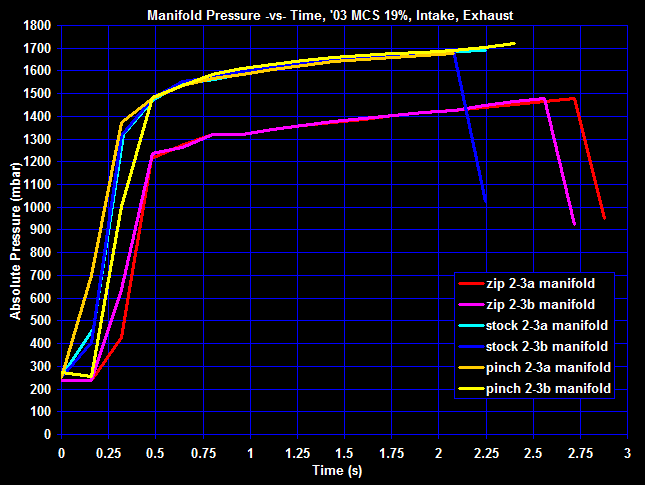
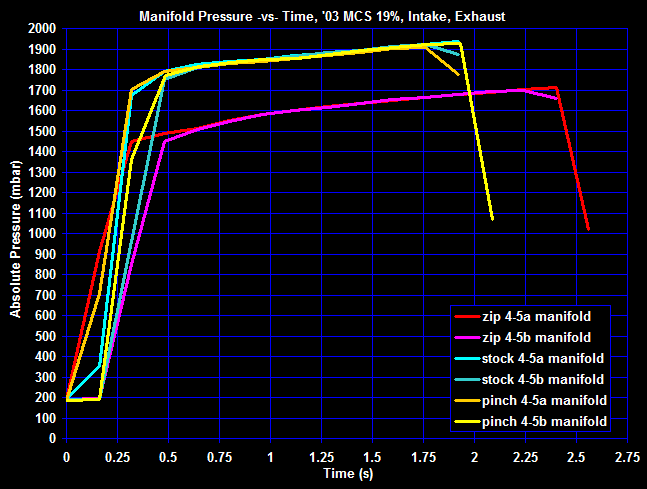
I did each of the runs in 2nd gear on the same stretch of road. Run A was going North, Run B was going South. Runs labelled "2-3" mean I went from zero throttle to WOT at 2k rpm, then held WOT til 3k rpm, where I went to zero throttle. Runs labelled "4-5" mean I went from zero throttle to WOT at 4k rpm, then held WOT til 5k rpm, where I went to zero throttle.
"zip" means I had a zip tie holding the bypass in its closed position (against the screw stop)
"stock" means the bypass was unmolested
"pinch" means the paperclip was pinching the vacuum line mostly closed

4th Gear
Joined: Nov 2003
Posts: 335
Likes: 0
From: Los Angeles, Ca
i have very little understanding of how the plumbing on all this works.. but here is a thought, that I have not seen here..
the valves normal state.. when the engine is not running.. would be closed??
if this is true.. when the engine starts you get a vacuum in the throttle body that decreases with throttle position??
so in effect, if you lower the pressure via a tube restriction, the valve will not open as wide. When you increase the throttle with the attendent lower vacuum.. the valve closes faster because it is not open as wide as stock...
is this a possible theory??
a
the valves normal state.. when the engine is not running.. would be closed??
if this is true.. when the engine starts you get a vacuum in the throttle body that decreases with throttle position??
so in effect, if you lower the pressure via a tube restriction, the valve will not open as wide. When you increase the throttle with the attendent lower vacuum.. the valve closes faster because it is not open as wide as stock...
is this a possible theory??
a
6th Gear
Joined: Oct 2002
Posts: 3,652
Likes: 6
From: Lansdale, PA
Here are my findings so far. Holding the bypass closed (with zip tie or equivalent), seems to be a bad idea for boost production. I lost between 3 and 4 psi compared to stock. In fact, my boost curve with the bypass held closed was close to stock boost levels despite my 19% pulley!
I didn't detect either via butt dyno or looking at the data, any difference in performance between the hose pinched or not. I'll try putting a section of smaller hose inside the existing one to see if that alters the situation at all. If someone (unaffiliated with Peter Horvath) has the M7 device, I'd be happy to try it out.
_________________

Zeigen Sie mir die Zahlen!.:.My Mods
I didn't detect either via butt dyno or looking at the data, any difference in performance between the hose pinched or not. I'll try putting a section of smaller hose inside the existing one to see if that alters the situation at all. If someone (unaffiliated with Peter Horvath) has the M7 device, I'd be happy to try it out.
_________________
Zeigen Sie mir die Zahlen!.:.My Mods

ok, I don't get it. Not to discount Andy's test methods, however the results make no technical sense. There's no reason the zip-tie will reduce boost, as the bypass valve operates identically to stock at WOT.
Andy - are you sure you actually tied the valve fully shut? The only thing I can think of is it inadvertantly stuck slightly open.
Andy - are you sure you actually tied the valve fully shut? The only thing I can think of is it inadvertantly stuck slightly open.

3rd Gear
Joined: Feb 2003
Posts: 241
Likes: 1
From: San Diego, CA
WARNING - LONG POST! You asked for theory.............
Time for the mechanical engineer to weigh in. First, a few fundamentals:
The vacuum being discussed here IS pressure; just defined in terms relative to our atmospheric pressure, which is +14.696 PSI (at sea level and zero degrees C). Absolute pressure is of course relative to an absolute vacuum, such as is found in space. For a short primer on pressure, absolute and atmospheric, look here:
What is Pressure?
The manifold vacuum acting on the diaphragm is some positive absolute pressure between zero and 14.696 PSI. Looking at Andy's spreadsheet the lowest manifold pressure was about 188 mBar or 2.7 PSIA (89 MPH, 4231 RPM, throttle closed). One side of the diaphragm is exposed to this vacuum, through the port in the valve casting, the subject tube, and the diaphragm chamber. The other side of the diaphragm is exposed to atmospheric pressure. The difference in pressure from one side of the diaphragm to the other creates a force which pushes the diaphragm in the direction of the lower pressure. This force is proportional to both the pressure differential and physical area of the diaphragm; and when the force exceeds that of the spring (which is pushing on the diaphragm in the opposite direction) the diaphragm moves, opening the bypass valve.
As manifold pressure changes, under different throttle and RPM conditions, a pressure differential is created between the manifold and the diaphragm chamber. Air flows in or out through the casting port and tube until that differential equalizes. This is key to the discussion. !! Air molecules must move in or out of the diaphragm chamber to either open or close the bypass valve !!
What this means is that anything that resists that air flow (like a restrictor in the tube) will slow the response of the valve. Further, a simple restrictor will resist flow in both directions, slowing response in both directions. Any assertion that a restrictor slows the opening of the valve but speeds the closing of the valve is therefore fundamentally wrong.
Also, since the restrictor only slows the movement of air and does not in any way change the absolute pressure on the diaphragm once the air is done moving, any assertion that the restrictor "reduces the vacuum on the diaphragm" can only be true for the brief instant that the air is moving through the tube. Once the pressure has equalized between the manifold and the diaphragm chamber, the force acting on the diaphragm is the same, with or without the restrictor. And again, that instantaneous effect will be the same in both directions.
Finally, the assertion that the restrictor does the same thing that the stronger spring of Ryephix2 does is fundamentally wrong. The restrictor slows the valve response as described above, the spring changes the force required to move the valve. So with the stronger spring, a greater pressure differential across the diaphragm (lower absolute manifold pressure) is required to open the valve.
So how is it that perfectly rational people report increased throttle response with the "device" installed? Here are my thoughts:
(Please note: I've not seen or read a detailed physical description of the "device". Out of scientific curiousity and for the price of three stamps, I've "ordered" one; but not yet received it.)
If the "device" is indeed a restrictor of sufficient degree to impede the air flow in and out of the diaphragm chamber, it is possible that the effect people report of increased throttle response (more likely boost response than throttle response) is one experienced between gears and under hard acceleration, but not on initial start from idle. While idling, manifold pressure is low and the valve is open. Open the throttle to take off and the valve slowly closes. However, once moving under hard (open) throttle, the valve is closed. During the short off throttle between gears, there will be a momentary drop in manifold pressure, but it may not last long enough to open or fully open the valve; which would mean an instant later when back on the throttle, the valve will be closed or near closed and the return to closed and to full boost will be faster.
Another possibility is that the "device" isn't sufficiently small enough to impede the flow through the tube, but simply takes up a significant amount of the internal volume of the tube. Since air molecules are being moved in or out to close or open the valve, any reduction in the number of molecules to be moved will reduce the time it takes to move those molecules at a given pressure differential. So if one could reduce the internal volume of the system substantially, the valve response time might be improved in a perceptable way.
After studying the bench photos of the valve body, I suspect that the biggest restriction in the stock configuration may be the port in the body casting where the tube attaches. If so, the inside diameter of the tube could well be reduced without a measurable change in the flow characteristics.
Working against this volume theory is the fact that the tube volume doesn't appear, from the photos, to be the majority of the system volume. The diaphragm chamber (which is large enough to contain the spring) appears to be the majority of the system volume. If the tube volume were 10% of the total system volume, then reducing its volume by 50% would only reduce system volume by 5%. I would guess that any noticeable difference gained by changing system volume would require a proportionally huge decrease in total system volume.
So what, if anything, do we do to our bypass valves to improve performance and/or driveability?
First, I think everyone should check that their valve closes completely when closed against the adjustable stop (see Ryan's instructions in "the Yo-Yo Chronicles". As Ryan found, the factory may not have spent much time getting this one just right, and any leak in the closed position will compromise boost/performance. This could easily account for some of the variability seen in the stock dyno output of different cars.
Second, it's starting to look as though the v38 software will address most of the driveability issues. We should all be pressuring our dealers for v38 updates as soon as it becomes available.
Beyond that (which may be as far as I go) one starts getting into uncharted territory, compromises, and potentially complicated modifications.
Since it will damp bypass valve oscillations, the restrictor route may provide some with a much needed improvement in driveability, at the expense of a slower responding valve. As described above, it may also aid in boost retention between gears, at the expense of slower boost development off idle.
Ideally, the valve would be made to respond faster (both closing and opening). This could be done, given enough time and money, by:
- reducing the rotating mass of the butterfly and linkage
- reducing the moving mass of the diaphragm assembly
- increasing the leverage the spring and diaphragm have on the butterfly
- increasing the force of the spring and diaphragm by making them larger
- reducing diaphragm chamber volume (external spring?)
- enlarging any existing restrictions in the vacuum path
All of these require significant hardware design, fabrication, and modification; and run the risk of creating other problems, like adverse interaction with throttle position programming and control.
Finally, an option promoted by greatbear on page 1 of this thread, and one of the only other options I'm considering, would be to restrict the air flow FROM the diaphragm chamber, but not TO the diaphragm chamber. This would truly make the valve open more slowly, but retain it's current rate of closing. If the valve would close quickly, but take five or ten seconds to open, then with some prudent driving habits one might get the best of both worlds, performance and economy.
When one wants high fuel economy, such as in highway cruising, a steady throttle foot would give the valve ample time to open. Need to pass, a quick stab of the throttle should close the valve quickly and allow full boost development. Sitting at a light for thirty seconds, waiting for green, the valve opens at idle. But a quick stab of the throttle (in neutral) a second or two before launch closes the valve for full boost on launch. Between gears, off throttle, the valve would not have enough time to open much.
greatbear - sorry, but I know all too well of those vacuum valves from the old cars that you are experimenting with. They were unreliable in their own day. I can't imagine you'll ever get them to work well today. The easy way to implement this would be a very small restrictor in parallel with a large low-actuation-pressure one-way check valve inserted in the vacuum tube. I've starting tracking down some parts in case I want to try this. Here are the sources if anyone wants to experiment:
Tubing Check Valves
Barbed Restrictors
I'd splice the check valve into the main vacuum tube (easy); then somehow add the restrictor in parallel "around" it (where/how I'm not sure yet). Remember, the check valve path should be short and undrestricted; the restrictor path doesn't need to be either.
So that's my $1.25. My apologies for the lengthy disertation, but I've been on the sidelines of this whole mess since the beginning and had to weigh in. If you've gotten this far, I commend your perseverance; I guess this makes minihune seem like a man of few words. I further commend those in pursuit of real science, you know who you are. Now back to observation mode until further notice......
Cheers to all,
James
Time for the mechanical engineer to weigh in. First, a few fundamentals:
The vacuum being discussed here IS pressure; just defined in terms relative to our atmospheric pressure, which is +14.696 PSI (at sea level and zero degrees C). Absolute pressure is of course relative to an absolute vacuum, such as is found in space. For a short primer on pressure, absolute and atmospheric, look here:
What is Pressure?
The manifold vacuum acting on the diaphragm is some positive absolute pressure between zero and 14.696 PSI. Looking at Andy's spreadsheet the lowest manifold pressure was about 188 mBar or 2.7 PSIA (89 MPH, 4231 RPM, throttle closed). One side of the diaphragm is exposed to this vacuum, through the port in the valve casting, the subject tube, and the diaphragm chamber. The other side of the diaphragm is exposed to atmospheric pressure. The difference in pressure from one side of the diaphragm to the other creates a force which pushes the diaphragm in the direction of the lower pressure. This force is proportional to both the pressure differential and physical area of the diaphragm; and when the force exceeds that of the spring (which is pushing on the diaphragm in the opposite direction) the diaphragm moves, opening the bypass valve.
As manifold pressure changes, under different throttle and RPM conditions, a pressure differential is created between the manifold and the diaphragm chamber. Air flows in or out through the casting port and tube until that differential equalizes. This is key to the discussion. !! Air molecules must move in or out of the diaphragm chamber to either open or close the bypass valve !!
What this means is that anything that resists that air flow (like a restrictor in the tube) will slow the response of the valve. Further, a simple restrictor will resist flow in both directions, slowing response in both directions. Any assertion that a restrictor slows the opening of the valve but speeds the closing of the valve is therefore fundamentally wrong.
Also, since the restrictor only slows the movement of air and does not in any way change the absolute pressure on the diaphragm once the air is done moving, any assertion that the restrictor "reduces the vacuum on the diaphragm" can only be true for the brief instant that the air is moving through the tube. Once the pressure has equalized between the manifold and the diaphragm chamber, the force acting on the diaphragm is the same, with or without the restrictor. And again, that instantaneous effect will be the same in both directions.
Finally, the assertion that the restrictor does the same thing that the stronger spring of Ryephix2 does is fundamentally wrong. The restrictor slows the valve response as described above, the spring changes the force required to move the valve. So with the stronger spring, a greater pressure differential across the diaphragm (lower absolute manifold pressure) is required to open the valve.
So how is it that perfectly rational people report increased throttle response with the "device" installed? Here are my thoughts:
(Please note: I've not seen or read a detailed physical description of the "device". Out of scientific curiousity and for the price of three stamps, I've "ordered" one; but not yet received it.)
If the "device" is indeed a restrictor of sufficient degree to impede the air flow in and out of the diaphragm chamber, it is possible that the effect people report of increased throttle response (more likely boost response than throttle response) is one experienced between gears and under hard acceleration, but not on initial start from idle. While idling, manifold pressure is low and the valve is open. Open the throttle to take off and the valve slowly closes. However, once moving under hard (open) throttle, the valve is closed. During the short off throttle between gears, there will be a momentary drop in manifold pressure, but it may not last long enough to open or fully open the valve; which would mean an instant later when back on the throttle, the valve will be closed or near closed and the return to closed and to full boost will be faster.
Another possibility is that the "device" isn't sufficiently small enough to impede the flow through the tube, but simply takes up a significant amount of the internal volume of the tube. Since air molecules are being moved in or out to close or open the valve, any reduction in the number of molecules to be moved will reduce the time it takes to move those molecules at a given pressure differential. So if one could reduce the internal volume of the system substantially, the valve response time might be improved in a perceptable way.
After studying the bench photos of the valve body, I suspect that the biggest restriction in the stock configuration may be the port in the body casting where the tube attaches. If so, the inside diameter of the tube could well be reduced without a measurable change in the flow characteristics.
Working against this volume theory is the fact that the tube volume doesn't appear, from the photos, to be the majority of the system volume. The diaphragm chamber (which is large enough to contain the spring) appears to be the majority of the system volume. If the tube volume were 10% of the total system volume, then reducing its volume by 50% would only reduce system volume by 5%. I would guess that any noticeable difference gained by changing system volume would require a proportionally huge decrease in total system volume.
So what, if anything, do we do to our bypass valves to improve performance and/or driveability?
First, I think everyone should check that their valve closes completely when closed against the adjustable stop (see Ryan's instructions in "the Yo-Yo Chronicles"
. As Ryan found, the factory may not have spent much time getting this one just right, and any leak in the closed position will compromise boost/performance. This could easily account for some of the variability seen in the stock dyno output of different cars.Second, it's starting to look as though the v38 software will address most of the driveability issues. We should all be pressuring our dealers for v38 updates as soon as it becomes available.
Beyond that (which may be as far as I go) one starts getting into uncharted territory, compromises, and potentially complicated modifications.
Since it will damp bypass valve oscillations, the restrictor route may provide some with a much needed improvement in driveability, at the expense of a slower responding valve. As described above, it may also aid in boost retention between gears, at the expense of slower boost development off idle.
Ideally, the valve would be made to respond faster (both closing and opening). This could be done, given enough time and money, by:
- reducing the rotating mass of the butterfly and linkage
- reducing the moving mass of the diaphragm assembly
- increasing the leverage the spring and diaphragm have on the butterfly
- increasing the force of the spring and diaphragm by making them larger
- reducing diaphragm chamber volume (external spring?)
- enlarging any existing restrictions in the vacuum path
All of these require significant hardware design, fabrication, and modification; and run the risk of creating other problems, like adverse interaction with throttle position programming and control.
Finally, an option promoted by greatbear on page 1 of this thread, and one of the only other options I'm considering, would be to restrict the air flow FROM the diaphragm chamber, but not TO the diaphragm chamber. This would truly make the valve open more slowly, but retain it's current rate of closing. If the valve would close quickly, but take five or ten seconds to open, then with some prudent driving habits one might get the best of both worlds, performance and economy.
When one wants high fuel economy, such as in highway cruising, a steady throttle foot would give the valve ample time to open. Need to pass, a quick stab of the throttle should close the valve quickly and allow full boost development. Sitting at a light for thirty seconds, waiting for green, the valve opens at idle. But a quick stab of the throttle (in neutral) a second or two before launch closes the valve for full boost on launch. Between gears, off throttle, the valve would not have enough time to open much.
greatbear - sorry, but I know all too well of those vacuum valves from the old cars that you are experimenting with. They were unreliable in their own day. I can't imagine you'll ever get them to work well today. The easy way to implement this would be a very small restrictor in parallel with a large low-actuation-pressure one-way check valve inserted in the vacuum tube. I've starting tracking down some parts in case I want to try this. Here are the sources if anyone wants to experiment:
Tubing Check Valves
Barbed Restrictors
I'd splice the check valve into the main vacuum tube (easy); then somehow add the restrictor in parallel "around" it (where/how I'm not sure yet). Remember, the check valve path should be short and undrestricted; the restrictor path doesn't need to be either.
So that's my $1.25. My apologies for the lengthy disertation, but I've been on the sidelines of this whole mess since the beginning and had to weigh in. If you've gotten this far, I commend your perseverance; I guess this makes minihune seem like a man of few words. I further commend those in pursuit of real science, you know who you are. Now back to observation mode until further notice......
Cheers to all,
James


Thread Starter
|
Banned
Joined: Mar 2003
Posts: 2,859
Likes: 0
From: Plymouth, MN
James, you are a great communicator.
Thank you for taking the time to type in your superb posting.
Everything you say matches 100% with my understanding of the operation of this bypass valve, and also differs from the reports of quicker throttle response in exactly the way I would expect it to.
I'm thinking about buying a bypass valve and modifying it so that we can record the actual valve position at a rapid rate. Then, someone can install it and answer the question with a definitive science experiment.
If someone has an extra valve they would be willing to send me. (No SASE required :smile: ) I'll modify it, include a small microprocessor to record the signals and a program for a PC to unload them and write a file of positions. PM me if interesetd. I don't have an MCS, so I cannot perform these experiments myself.
Once again, THANK YOU for the posting.
What is your ME background by the way? (If you don't mind posting it. I'll understand if you are silent on this matter)
Thank you for taking the time to type in your superb posting.
Everything you say matches 100% with my understanding of the operation of this bypass valve, and also differs from the reports of quicker throttle response in exactly the way I would expect it to.
I'm thinking about buying a bypass valve and modifying it so that we can record the actual valve position at a rapid rate. Then, someone can install it and answer the question with a definitive science experiment.
If someone has an extra valve they would be willing to send me. (No SASE required :smile: ) I'll modify it, include a small microprocessor to record the signals and a program for a PC to unload them and write a file of positions. PM me if interesetd. I don't have an MCS, so I cannot perform these experiments myself.
Once again, THANK YOU for the posting.
What is your ME background by the way? (If you don't mind posting it. I'll understand if you are silent on this matter)
3rd Gear
Joined: May 2004
Posts: 243
Likes: 0
From: 3rd Stone from the Sun
Ryphile, in your intial investigation of the yoyo, did you confirm that the main throttle body butterfly is oscillating during yoyo? Conversely, is the throttle body butterfly position fixed in opening (as a function of throttle input) while only the bypass valve oscillates?
This is quite important because if the former, then the yoyo is a function of not merely the bypass - it may only be an indicator - but of the input to the system and is a software involved problem (else how could v38 affect it?). On the other hand, if the throttle body butterfly is stationary during the yoyo then the yoyo is primarily a mechanical feedback problem. I reiterate - if software (v38) can affect this problem and not completely destroy system reponse by slowing it unuseably then this is a software interaction and is an indication of a control system with multiple feedback paths - mechanical through the bypass valve, and software via vacuum sensing and throttle body modulation.
BTW, count me among the patient and respectful - your efforts are highly regarded.
This is quite important because if the former, then the yoyo is a function of not merely the bypass - it may only be an indicator - but of the input to the system and is a software involved problem (else how could v38 affect it?). On the other hand, if the throttle body butterfly is stationary during the yoyo then the yoyo is primarily a mechanical feedback problem. I reiterate - if software (v38) can affect this problem and not completely destroy system reponse by slowing it unuseably then this is a software interaction and is an indication of a control system with multiple feedback paths - mechanical through the bypass valve, and software via vacuum sensing and throttle body modulation.
BTW, count me among the patient and respectful - your efforts are highly regarded.

>>....So how is it that perfectly rational people report increased throttle response with the "device" installed? ......
....During the short off throttle between gears, there will be a momentary drop in manifold pressure, but it may not last long enough to open or fully open the valve; which would mean an instant later when back on the throttle, the valve will be closed or near closed and the return to closed and to full boost will be faster.
James
>>
what a great post james! this is the type of informed, rational, intelligent discusssion i expect from a professional engineer, as opposed to the all to frequent blathering from those who never did their math homework and who denegrate "theory."
i had the exactly same hypothesis about the reported improved throttle response: it's occuring during a rapid off-throttle back-on-throttle transient that is much faster than the response of the restricted flow, ergo the valve stays "more" closed than it normally would.
it would be great if somebody could test this.
"it's not a yo-yo fix, it's a science experiment."
flyboy2160
....During the short off throttle between gears, there will be a momentary drop in manifold pressure, but it may not last long enough to open or fully open the valve; which would mean an instant later when back on the throttle, the valve will be closed or near closed and the return to closed and to full boost will be faster.
James
>>
what a great post james! this is the type of informed, rational, intelligent discusssion i expect from a professional engineer, as opposed to the all to frequent blathering from those who never did their math homework and who denegrate "theory."
i had the exactly same hypothesis about the reported improved throttle response: it's occuring during a rapid off-throttle back-on-throttle transient that is much faster than the response of the restricted flow, ergo the valve stays "more" closed than it normally would.
it would be great if somebody could test this.
"it's not a yo-yo fix, it's a science experiment."
flyboy2160


4th Gear
Joined: Oct 2002
Posts: 587
Likes: 0
Andy said:
And SuperMini said:
Can someone offer a succinct explanation on why zip-tieing or closing off the vacuum altogether would reduce boost? When there's no vacuum in that circuit we should see full boost, not less boost, right? What am I missing? TIA, Jeff
ps: Has anyone provided the dimensions of the device yet? It'd still be a good no-cost experiment and I'm curious to see myself how it behaves.
Here are my findings so far. Holding the bypass closed (with zip tie or equivalent), seems to be a bad idea for boost production. I lost between 3 and 4 psi compared to stock. In fact, my boost curve with the bypass held closed was close to stock boost levels despite my 19% pulley!
turn the Valve off and you end up with no supercharger boost at all.
ps: Has anyone provided the dimensions of the device yet? It'd still be a good no-cost experiment and I'm curious to see myself how it behaves.
3rd Gear
Joined: Feb 2003
Posts: 241
Likes: 1
From: San Diego, CA
friedduck,
Must say I'm totally perplexed by Andy's results. Not only are they contrary to what the theory would predict, but also contrary to Ryan's experimental results with Ryphix1 (which is basically what Andy did). Quite a few members have implemented Ryphix1 with no negative effect other than a drop in fuel economy. I think this one needs a second look.
SuperMini's results are easy to explain. The valve he closed was a manual valve he inserted in the vacuum line on the bypass valve. Think of it as an adjustable restrictor that adjusts from very little restriction to the ultimate restriction (closed - no flow). Since he closed the manual valve while the engine was running at idle, the bypass valve was open. He essentially locked the bypass valve open, guaranteeing no boost. Remember the picture Ryan took where he applied vacuum to the bypass valve and then pinched off the tube to show the open bypass valve? This is what SuperMini basically did. Now if he shut the engine off, opened his manual valve, gave it time to fully close the bypass valve, then shut the manual valve and restart the car, I think his results would have been much different.
Cheers,
James
Must say I'm totally perplexed by Andy's results. Not only are they contrary to what the theory would predict, but also contrary to Ryan's experimental results with Ryphix1 (which is basically what Andy did). Quite a few members have implemented Ryphix1 with no negative effect other than a drop in fuel economy. I think this one needs a second look.
SuperMini's results are easy to explain. The valve he closed was a manual valve he inserted in the vacuum line on the bypass valve. Think of it as an adjustable restrictor that adjusts from very little restriction to the ultimate restriction (closed - no flow). Since he closed the manual valve while the engine was running at idle, the bypass valve was open. He essentially locked the bypass valve open, guaranteeing no boost. Remember the picture Ryan took where he applied vacuum to the bypass valve and then pinched off the tube to show the open bypass valve? This is what SuperMini basically did. Now if he shut the engine off, opened his manual valve, gave it time to fully close the bypass valve, then shut the manual valve and restart the car, I think his results would have been much different.
Cheers,
James
Thread Starter
|
Banned
Joined: Mar 2003
Posts: 2,859
Likes: 0
From: Plymouth, MN
This is what I love about these discussion.
Someone posts data, several people think about it and post comments and the original poster says "Yeah, I don't understand it either"
Wonderful example of scientific thinking people. I applaude everyone for keeping this up.
We should be able to figure this out, and maybe the entire MINI community will learn something we didn't know about the operation of the MCS supercharge system. That could actually spawn several new mods. Wouldn't THAT be a shining example of the way the MINI community can come toghether and show that eveyone can benefit from openness and science?
Andy, would you be willing to install a different valve with position monitoring if I sent it to you?
I don't have any idea how hard it is to replace the valve.
Someone posts data, several people think about it and post comments and the original poster says "Yeah, I don't understand it either"
Wonderful example of scientific thinking people. I applaude everyone for keeping this up.
We should be able to figure this out, and maybe the entire MINI community will learn something we didn't know about the operation of the MCS supercharge system. That could actually spawn several new mods. Wouldn't THAT be a shining example of the way the MINI community can come toghether and show that eveyone can benefit from openness and science?
Andy, would you be willing to install a different valve with position monitoring if I sent it to you?
I don't have any idea how hard it is to replace the valve.

3rd Gear
Joined: Oct 2003
Posts: 185
Likes: 0
From: Orlando
Great post James, very enlightening.
Andy; In your runs you said the engine was at 2k and 4k rpm respectively, with the throttle closed. Did you accelerate to that engine speed and then close the throttle, to start the test? Is it possible that the running conditions immediately prior to the test commencing might have generated the discrepancies in the rise of the intake pressure? There are significant differences in the same type of run where the only variable changed is the direction. I'm only referring to the extreme left portion of the graph which documents the rate of change of the manifold pressure (implying the rate of change of the valve position) and not the final pressure measured.
In the tests with the vacuum line pinched shut you can see what I am talking about. In one direction the pressue starts to rise immediately, but in the other it does not. However, these differences are not always mirrored in the other tests, implying there is some other variable at work. Very puzzleing!
Andy; In your runs you said the engine was at 2k and 4k rpm respectively, with the throttle closed. Did you accelerate to that engine speed and then close the throttle, to start the test? Is it possible that the running conditions immediately prior to the test commencing might have generated the discrepancies in the rise of the intake pressure? There are significant differences in the same type of run where the only variable changed is the direction. I'm only referring to the extreme left portion of the graph which documents the rate of change of the manifold pressure (implying the rate of change of the valve position) and not the final pressure measured.
In the tests with the vacuum line pinched shut you can see what I am talking about. In one direction the pressue starts to rise immediately, but in the other it does not. However, these differences are not always mirrored in the other tests, implying there is some other variable at work. Very puzzleing!
4th Gear
Joined: May 2003
Posts: 507
Likes: 0
After the real testing that I did my feeling is that there is no benifit with respect to power or throttle response with this "Device". There may be some be benifit to those who want "smoother" throttle response by slowing the valve movement. "Smoother" in this case will contradict Power and Throttle Response in my opinion.

4th Gear
Joined: May 2003
Posts: 507
Likes: 0
>>>>Since he closed the manual valve while the engine was running at idle, the bypass valve was open.
>>
>>Ah--makes perfect sense. Thanks for clearing that up.
>>
>>--Jeff
Correct!
>>
>>Ah--makes perfect sense. Thanks for clearing that up.
>>
>>--Jeff
Correct!
6th Gear
Joined: Oct 2002
Posts: 3,652
Likes: 6
From: Lansdale, PA
Here's the procedure I used for each test:
Accelerate gently in 2nd gear to slightly higher than 2000 rpm.
Let completely off the accelerator and allow revs to drop to 2000 rpm.
Floor accelerator until rpm reach 3000 rpm,
Let completely off the accelerator
Accelerate gently in 2nd gear to slightly higher than 4000 rpm.
Let completely off the accelerator and allow revs to drop to 4000 rpm.
Floor accelerator until rpm reach 5000 rpm,
Let completely off the accelerator
I did this in each configurations, going North and South on the same stretch of road (A & B runs).
Accelerate gently in 2nd gear to slightly higher than 2000 rpm.
Let completely off the accelerator and allow revs to drop to 2000 rpm.
Floor accelerator until rpm reach 3000 rpm,
Let completely off the accelerator
Accelerate gently in 2nd gear to slightly higher than 4000 rpm.
Let completely off the accelerator and allow revs to drop to 4000 rpm.
Floor accelerator until rpm reach 5000 rpm,
Let completely off the accelerator
I did this in each configurations, going North and South on the same stretch of road (A & B runs).
3rd Gear
Joined: Oct 2003
Posts: 185
Likes: 0
From: Orlando
WARNING-PURE SPECULATION
Could it be that the ECU is not opening the throttle butterfly to WOT, even though your foot is telling it to, maybe waiting for some minimum air pressure in the manifold, or some other parameter to change?
I still cant wrap my mind around the lower manifold pressure with the bypass zipped shut. Whats up with that?
Could it be that the ECU is not opening the throttle butterfly to WOT, even though your foot is telling it to, maybe waiting for some minimum air pressure in the manifold, or some other parameter to change?
I still cant wrap my mind around the lower manifold pressure with the bypass zipped shut. Whats up with that?