


Drivetrain Clarification on the MaxVelocity MCS intake


1st Gear
Joined: Apr 2004
Posts: 37
Likes: 0
From: SF Bay Area
>>
>>>> With the hood open, it makes no sense to measure temperatures in the intake area vs the rest of the engine bay because no one will drive with an open hood.
>>
>> During our dyno the hood was open and would not involve the heat shield as ambient air was always present and circulating over the entire engine bay.
>>>>
>>
>>this is one of my pet peeves that i've harped on before, so don't take this personally.
>>
>>if you ran the test this way against a stock airbox, your test is COMPLETELY UNSCIENTIFIC AND TOTALLY BOGUS.
>>
>>you eliminated the restrictive inlet tubing tubing and its power robbing 70 degree bend for your inlet, but left it in place for the stock one. ideally both should be tested with a closed hood on a rolling road wind tunnel or as close to that as you can get.
>>
>>why do the inlet manufacturers keep selling the same old stuff, but leave the single biggest problem with the inlet unaddressed: the poor inlet position and that severe 70 degree bend in flow path. why not redesign a hood/inlet that will make a real difference....
>>
>>you may ignoire physics, but physics never ignores you,
>>flyboy2160
>>
flyboy2160 - we didn't elimate anything. the air box is closed by design and that is how we tested it. We did not block anything and we did not remove anything other than the filtration systems and heat shield/top of air box and some screws.
Unfortunately, we cannot achieve the air velocity that you would have when you are moving at anything over 10-20 miles per hour. We cannot dyno while driving down the street. If we used a G-Tech, someone would say that the G-Tech is not an accurate means of measuring hp/tq. Do you see my point?
Even with an open hood the heat shield sits inches in front of the filter acting like a wall for the K&N filter while the fan is working. The filter would still be sucking in air from any sources that are available. You are right, we are not completely scientific with our testing BUT we are close. To get super accurate results we would need super expensive tools and a lab with the engine on a dyno. Unfortunately, I cannot afford a lab, such testing equipment, and a couple of Cooper S engines. Actually, if someone wants to invest in developing an alternative FI solution, I would be game for a dedicated test facility, but then I'd have to quit may day job. YES!!!!
_________________
Roman S.
MaxVelocity.net

>>>> With the hood open, it makes no sense to measure temperatures in the intake area vs the rest of the engine bay because no one will drive with an open hood.
>>
>> During our dyno the hood was open and would not involve the heat shield as ambient air was always present and circulating over the entire engine bay.
>>>>
>>
>>this is one of my pet peeves that i've harped on before, so don't take this personally.
>>
>>if you ran the test this way against a stock airbox, your test is COMPLETELY UNSCIENTIFIC AND TOTALLY BOGUS.
>>
>>you eliminated the restrictive inlet tubing tubing and its power robbing 70 degree bend for your inlet, but left it in place for the stock one. ideally both should be tested with a closed hood on a rolling road wind tunnel or as close to that as you can get.
>>
>>why do the inlet manufacturers keep selling the same old stuff, but leave the single biggest problem with the inlet unaddressed: the poor inlet position and that severe 70 degree bend in flow path. why not redesign a hood/inlet that will make a real difference....
>>
>>you may ignoire physics, but physics never ignores you,
>>flyboy2160
>>
flyboy2160 - we didn't elimate anything. the air box is closed by design and that is how we tested it. We did not block anything and we did not remove anything other than the filtration systems and heat shield/top of air box and some screws.
Unfortunately, we cannot achieve the air velocity that you would have when you are moving at anything over 10-20 miles per hour. We cannot dyno while driving down the street. If we used a G-Tech, someone would say that the G-Tech is not an accurate means of measuring hp/tq. Do you see my point?
Even with an open hood the heat shield sits inches in front of the filter acting like a wall for the K&N filter while the fan is working. The filter would still be sucking in air from any sources that are available. You are right, we are not completely scientific with our testing BUT we are close. To get super accurate results we would need super expensive tools and a lab with the engine on a dyno. Unfortunately, I cannot afford a lab, such testing equipment, and a couple of Cooper S engines. Actually, if someone wants to invest in developing an alternative FI solution, I would be game for a dedicated test facility, but then I'd have to quit may day job.
YES!!!!_________________
Roman S.
MaxVelocity.net

6th Gear
Joined: Apr 2003
Posts: 3,957
Likes: 2
From: a canyon, south Bay Area
Good to see more choices coming to mkt.
I still would like to see someone try puting an air filter right on the TB. True that it won't be "cold" air, but on a SC application, cooler intake air is most likely not as significant as on a NA engine. There might be more to be gained by a shorter and more direct path to the TB, than relatively cooler air with a longer angular path.
A unique sized filter (tigher quarters down there) mated to a velocity stack that feeds the TB a few inches a way is someting I feel needs some testing...
With the IC cooling things off after compression, I sort of feel that the emphasis at the intake side should first be with shortening the path, and making it as direct as possible, and funneling it along the way to the TB for speed. Thereafter, if there is a way to further cool it, fine...
Just my 2 cents
_________________
2003 IB MCS
I still would like to see someone try puting an air filter right on the TB. True that it won't be "cold" air, but on a SC application, cooler intake air is most likely not as significant as on a NA engine. There might be more to be gained by a shorter and more direct path to the TB, than relatively cooler air with a longer angular path.
A unique sized filter (tigher quarters down there) mated to a velocity stack that feeds the TB a few inches a way is someting I feel needs some testing...
With the IC cooling things off after compression, I sort of feel that the emphasis at the intake side should first be with shortening the path, and making it as direct as possible, and funneling it along the way to the TB for speed. Thereafter, if there is a way to further cool it, fine...
Just my 2 cents
_________________
2003 IB MCS

2nd Gear
Joined: Jan 2003
Posts: 136
Likes: 0
From: Germany
>>Good to see more choices coming to mkt.
>>
And the price is very attractive, especially during the month of May.
If it puts up real world numbers simliar to the others, then it's a good deal.
If I hadn't just bought the Alta, I'd be filling out an order request right now.
>>
And the price is very attractive, especially during the month of May.
If it puts up real world numbers simliar to the others, then it's a good deal.
If I hadn't just bought the Alta, I'd be filling out an order request right now.

6th Gear
Joined: Jun 2002
Posts: 3,359
Likes: 1
From: New Jersey
I still would like to see someone try puting an air filter right on the TB. True that it won't be "cold" air, but on a SC application, cooler intake air is most likely not as significant as on a NA engine.
6th Gear
Joined: Apr 2003
Posts: 3,957
Likes: 2
From: a canyon, south Bay Area
Cooler intake air is obviously beneficial. I am not contesting that. On a NA engine, that air is fed into the manifold for combusion, so there is direct relationship there. For us, it gets compressed by the SC and with that heated. Our "cool" air (just ambient air temp at best, right?) is not getting used for combustion purposes. It is getting heated quite a bit by the SC. The last of the cooling is done at the IC to bring it back down, ideally without too much pressure drop...
I don't doubt that cooler air will come-out of the SC with a lower intake temp than warmer air, but would it be at the same delta? That is if a CAI makes for 15 degree cooler intake air over otherwise, will the compressed hotter air out of the SC also be 15 degrees cooler than air post SC? I don't know. I don't think anyone really knows as of yet.
Many aftermkt CAI's have helped by shielding-off engine bay heat, and that is good. But, they have also received gains by simply having better flow. Or have all of the gains really been had just by flow, and not by "cooler" air? The stock intake system is enclosed from the engine heat probably better than anything I have seen from the aftermkt, yet it is not a CAI? It is made of thick plastic which as said earlier is quite good with heat, and even better than metal boxes, particulary ones that rely upon a seal against the hood lining.
While I have no testing or evidence to support it, if I had to guess, the vast majority of the gains that we are seeing on intakes are due to increased flow. The air in the stock box is probably not any warmer, and IF it is, is probably not much. And I wouldn't be surprised if the air in the stock box is cooler due to better insulation. If that is correct, gains are primarily due, if not totally due to the increase of flow, then more could be had by further improving flow characteristics. As flyboy says, the path is not ideal for airflow. The shorter and straighter it is, the better...
Has anyone ever put a K&N type filter in the stock box, and opened up the back more into the cowl area? Again, I believe our stock box to be best thing I've seen for sealing-out hotter air. Couple that with what is really giving us our aftermkt intake gains (a high flow filter), and I think one would have the best solution yet, while also being the cheapest, and also giving a stock appearance
That approach would still have the aforementioned undesirable flow paths, but for one who wants to stay in the stock location, I think that is most ideal.
Some experimentation with a filter essentially right on the TB does merit some testing, and I think Andy was pondering such. At least he seemed interested...
Slightly warmer air is not evil here. If so, the Twin Charger would not be producing power, yet it is pumping hot air into the SC. I am convinced that it is about flow first and foremost, and if it can be made cooler, that would be a secondary focus on the intake side. The cooling attention is better directed at the IC, IMHO.
_________________
2003 IB MCS
I don't doubt that cooler air will come-out of the SC with a lower intake temp than warmer air, but would it be at the same delta? That is if a CAI makes for 15 degree cooler intake air over otherwise, will the compressed hotter air out of the SC also be 15 degrees cooler than air post SC? I don't know. I don't think anyone really knows as of yet.
Many aftermkt CAI's have helped by shielding-off engine bay heat, and that is good. But, they have also received gains by simply having better flow. Or have all of the gains really been had just by flow, and not by "cooler" air? The stock intake system is enclosed from the engine heat probably better than anything I have seen from the aftermkt, yet it is not a CAI? It is made of thick plastic which as said earlier is quite good with heat, and even better than metal boxes, particulary ones that rely upon a seal against the hood lining.
While I have no testing or evidence to support it, if I had to guess, the vast majority of the gains that we are seeing on intakes are due to increased flow. The air in the stock box is probably not any warmer, and IF it is, is probably not much. And I wouldn't be surprised if the air in the stock box is cooler due to better insulation. If that is correct, gains are primarily due, if not totally due to the increase of flow, then more could be had by further improving flow characteristics. As flyboy says, the path is not ideal for airflow. The shorter and straighter it is, the better...
Has anyone ever put a K&N type filter in the stock box, and opened up the back more into the cowl area? Again, I believe our stock box to be best thing I've seen for sealing-out hotter air. Couple that with what is really giving us our aftermkt intake gains (a high flow filter), and I think one would have the best solution yet, while also being the cheapest, and also giving a stock appearance
That approach would still have the aforementioned undesirable flow paths, but for one who wants to stay in the stock location, I think that is most ideal.
Some experimentation with a filter essentially right on the TB does merit some testing, and I think Andy was pondering such. At least he seemed interested...
Slightly warmer air is not evil here. If so, the Twin Charger would not be producing power, yet it is pumping hot air into the SC. I am convinced that it is about flow first and foremost, and if it can be made cooler, that would be a secondary focus on the intake side. The cooling attention is better directed at the IC, IMHO.
_________________
2003 IB MCS
1st Gear
Joined: Apr 2004
Posts: 37
Likes: 0
From: SF Bay Area
>>
On a supercharged or turbo application for that matter, cold air is absolutely essential. Hot humid days make the stock S slow as a pig yet your average car doesn't get affected nearly as much.
greatgro - You are absolutely correct, a car that has FI is much more affected by air temparature than a NA.
TonyB - A K&N panel filter would still have a smaller surface area than the cone filter that we use. I'll get this confirmed but I believe I am right. Look at the A/F on our dyno results. Notice how rich our car ran with the stock software. Actually, what our Intake did was prolonged the period of 'super rich'. Rich is safer than lean, espeically on a FI'd car but there is quite a bit of power loss do to a rich setting (although cylinder wash is also bad but not as bad as detonation). If the mixture could be raised to 11-12, our MINI would have probably gained another 10hp. BUT our goal was to test the intake and not the air/fuel. I think with just good software tuning and a cold air intake could yield extremely good results.
_________________
Roman S.
MaxVelocity.net
I still would like to see someone try puting an air filter right on the TB. True that it won't be "cold" air, but on a SC application, cooler intake air is most likely not as significant as on a NA engine.
greatgro - You are absolutely correct, a car that has FI is much more affected by air temparature than a NA.
TonyB - A K&N panel filter would still have a smaller surface area than the cone filter that we use. I'll get this confirmed but I believe I am right. Look at the A/F on our dyno results. Notice how rich our car ran with the stock software. Actually, what our Intake did was prolonged the period of 'super rich'. Rich is safer than lean, espeically on a FI'd car but there is quite a bit of power loss do to a rich setting (although cylinder wash is also bad but not as bad as detonation). If the mixture could be raised to 11-12, our MINI would have probably gained another 10hp. BUT our goal was to test the intake and not the air/fuel. I think with just good software tuning and a cold air intake could yield extremely good results.
_________________
Roman S.
MaxVelocity.net
6th Gear
Joined: Apr 2003
Posts: 3,957
Likes: 2
From: a canyon, south Bay Area
Thankfully we don't have that humidity issue out here in CA  But, it does get plenty hot though (90's low 100's in the summer months). And yes, the MCS does bog down big time!
But, a CAI doesn't remedy that per se. That name is really a misnomer as there is no cold air, or chilling of it. It doesn't make that ambient air colder or less wet. Minus the introduction of a cooling agent, the best we can hope for is ambient conditions, and if that is hot and humid, that is your "cold" air...
After my previous post, I went out to my storage area and pulled-out my stock intake box. It is indeed a CAI by the definitions used around here, and again a better one in that it most likely seals-out engine bay heat better than anything in the aftermkt. So, what that tells me is that the aftermkt gains are had by increasing the flow (the filter itself, and/or the opening-up the plenum for more air), as opposed to a cooler draw of air compared to stock.
Converting the stock box for a high flow filter doesn't look so easy though. It has a pretty low profile, but there might be something out there...
But, it does get plenty hot though (90's low 100's in the summer months). And yes, the MCS does bog down big time!But, a CAI doesn't remedy that per se. That name is really a misnomer as there is no cold air, or chilling of it. It doesn't make that ambient air colder or less wet. Minus the introduction of a cooling agent, the best we can hope for is ambient conditions, and if that is hot and humid, that is your "cold" air...
After my previous post, I went out to my storage area and pulled-out my stock intake box. It is indeed a CAI by the definitions used around here, and again a better one in that it most likely seals-out engine bay heat better than anything in the aftermkt. So, what that tells me is that the aftermkt gains are had by increasing the flow (the filter itself, and/or the opening-up the plenum for more air), as opposed to a cooler draw of air compared to stock.
Converting the stock box for a high flow filter doesn't look so easy though. It has a pretty low profile, but there might be something out there...
1st Gear
Joined: Apr 2004
Posts: 37
Likes: 0
From: SF Bay Area
>>Thankfully we don't have that humidity issue out here in CA :smile:. I had a 'stock CAI' too (when I bought my car) but it's been replaced with an aftermarket one, actually several times. My M3 also had a stock airbox which looked like a great design. When I first bought my car, I wanted to keep it stock. I put a panel air K&N filter in and didn't really notice much difference. But with an AA intake, and then a Dinan, a difference was felt (but that's just my .02).
I think I'm getting off topic here. I would like to answer questions about our intake if anyone has any more.
Thank you all for the hospitality... great forum.
_________________
Roman S.
MaxVelocity.net
I think I'm getting off topic here. I would like to answer questions about our intake if anyone has any more.
Thank you all for the hospitality... great forum.
_________________
Roman S.
MaxVelocity.net

6th Gear
Joined: Oct 2002
Posts: 3,652
Likes: 6
From: Lansdale, PA
Have you done any air pressure testing of your intake versus stock? For example, with the Alta intake, I recorded a difference in pressure of roughly 0.5 psi at redline:
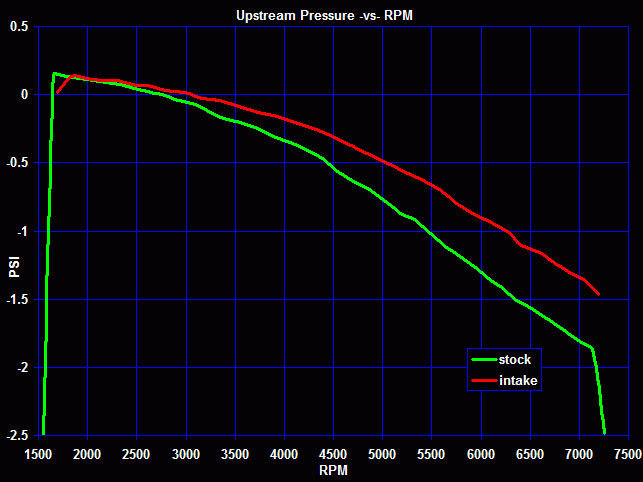
Have you done any air temperature testing of your intake versus stock?
Have you done any air temperature testing of your intake versus stock?
1st Gear
Joined: Apr 2004
Posts: 37
Likes: 0
From: SF Bay Area
Andy - No we did not. We just did a dyno and looked at the air/fuel so no thermodynamic, hydrodynamic, or any other flow bench testing was done. I would probably do some of these tests if I was designing a MAF but this is a CAI. You are welcome to test our kit but as I was told earilier, brands XX use the same air filter so you will probably get the similar result as your testing does not really test the heat shield.
6th Gear
Joined: Apr 2003
Posts: 3,957
Likes: 2
From: a canyon, south Bay Area
Thanks Roman for your prompt replies. We are for the most part a very friendly community here, but we are quite critical when it comes to the evaluation of products and their claims. I certainly hope that I didn't make you feel like a shmuck That was not my intent, and my dialog was not directed at your product, or any other one for that matter. FWIW, I have a Rogue intake with cowl mod, so I'm a shmuck aslo 
Seriously, welcome to the community. Do you guys have more products in the pipeline for us?
That was not my intent, and my dialog was not directed at your product, or any other one for that matter. FWIW, I have a Rogue intake with cowl mod, so I'm a shmuck aslo Seriously, welcome to the community. Do you guys have more products in the pipeline for us?

Has anyone ever tried to find a high flow oiled-type filter to fit inside the stock airbox? I just checked tho oval filter sizes at k&n and it looks like there may be several filter sizes that would fit inside the box. A short length of tubing might be needed to connect it to the intake inside the box, but it looks doable.
Of the oval shaped filters with 2 1/4" mounting flanges, they list a 3.75 x 4.5 x 5" and a 3.75 x 4.5 x 6". The stock airbox is 9.5 x 5 x 6" or so, on the inside. If the stock box is the only true CAI completely cut off from engine bay heat, and is constructed of a heat disipating material much better than metal, shouldn't someone have tried this??? ops:
ops: 
-joe
Of the oval shaped filters with 2 1/4" mounting flanges, they list a 3.75 x 4.5 x 5" and a 3.75 x 4.5 x 6". The stock airbox is 9.5 x 5 x 6" or so, on the inside. If the stock box is the only true CAI completely cut off from engine bay heat, and is constructed of a heat disipating material much better than metal, shouldn't someone have tried this???
ops: -joe
6th Gear
Joined: Apr 2003
Posts: 3,957
Likes: 2
From: a canyon, south Bay Area
That's what I've been saying Joe. I think there is something there alright. The filter options are somewhat limited though for inside the stock box. If you haven't noticed, Andy has picked-up on some thoughts shared above in his Hot Air intake thread. Good stuff!
6th Gear
Joined: Oct 2002
Posts: 3,652
Likes: 6
From: Lansdale, PA
MaxVelocity wrote:
Perhaps I wasn't too clear in my description of the testing I did. This isn't a flow bench or theoretical calculation. I logged the air pressure in the intake system on the road, in a moving vehicle, with the hood closed. Do you believe that this type of testing is not relevant for an intake?
BTW, the MINI doesn't have a MAF.
_________________
SHOW ME THE NUMBERS!

...How Fast is Your MINI?...My Mods...
Andy - No we did not. We just did a dyno and looked at the air/fuel so no thermodynamic, hydrodynamic, or any other flow bench testing was done. I would probably do some of these tests if I was designing a MAF but this is a CAI. You are welcome to test our kit but as I was told earilier, brands XX use the same air filter so you will probably get the similar result as your testing does not really test the heat shield.
BTW, the MINI doesn't have a MAF.
_________________
SHOW ME THE NUMBERS!
...How Fast is Your MINI?...My Mods...
1st Gear
Joined: Apr 2004
Posts: 37
Likes: 0
From: SF Bay Area
>>MaxVelocity wrote:
>>
>>
>>Perhaps I wasn't too clear in my description of the testing I did. This isn't a flow bench or theoretical calculation. I logged the air pressure in the intake system on the road, in a moving vehicle, with the hood closed. Do you believe that this type of testing is not relevant for an intake?
>>
>>BTW, the MINI doesn't have a MAF.
>>
Andy - Yeh, I know the mini doesn't have a maf just an example I thought of. Like I mentioned earlier, we only did the dyno to see what the fruits of our work were worth.
Tony - Thank you very much for the hospitality. We have SEVERAL new projects in the works and I am very tempted to post pictures, but I think I will wait a bit. I WILL post a couple tomorrow just to see what you guys think of one particular part.
Best regards,
Roman
>>
Andy - No we did not. We just did a dyno and looked at the air/fuel so no thermodynamic, hydrodynamic, or any other flow bench testing was done. I would probably do some of these tests if I was designing a MAF but this is a CAI. You are welcome to test our kit but as I was told earilier, brands XX use the same air filter so you will probably get the similar result as your testing does not really test the heat shield.
>>Perhaps I wasn't too clear in my description of the testing I did. This isn't a flow bench or theoretical calculation. I logged the air pressure in the intake system on the road, in a moving vehicle, with the hood closed. Do you believe that this type of testing is not relevant for an intake?
>>
>>BTW, the MINI doesn't have a MAF.
>>
Andy - Yeh, I know the mini doesn't have a maf
just an example I thought of. Like I mentioned earlier, we only did the dyno to see what the fruits of our work were worth.Tony - Thank you very much for the hospitality. We have SEVERAL new projects in the works and I am very tempted to post pictures, but I think I will wait a bit. I WILL post a couple tomorrow just to see what you guys think of one particular part.
Best regards,
Roman

5th Gear
Joined: Jan 2004
Posts: 760
Likes: 0
From: Back IN Chicopee
Next step. Get Mini to approve this mod. Be a step ahead of the competition. Non warranty voiding mod. Worrying about $179 or whatever your CAI costs is nothing to the "sorry, you put XYZ on your car and now you have to pay " Ifd thats possible.
Paul
Paul
1st Gear
Joined: Apr 2004
Posts: 37
Likes: 0
From: SF Bay Area
>>Next step. Get Mini to approve this mod. Be a step ahead of the competition. Non warranty voiding mod. Worrying about $179 or whatever your CAI costs is nothing to the "sorry, you put XYZ on your car and now you have to pay " Ifd thats possible.
>>
>>Paul
I wish I could afford it Paul, but it will cost major rubles to get MINI approval. The only vendor approved for BMW is Dinan. That's one out of hundreds. It just costs too much.
I will save all other products that we making till release date but here is a sample of what's to come in a couple of weeks.

>>
>>Paul
I wish I could afford it Paul, but it will cost major rubles to get MINI approval. The only vendor approved for BMW is Dinan. That's one out of hundreds. It just costs too much.
I will save all other products that we making till release date but here is a sample of what's to come in a couple of weeks.


Banned
Joined: Mar 2003
Posts: 2,859
Likes: 0
From: Plymouth, MN
>>it is 100% pure carbon. Hmmm, if carbon is bad at heat insulation, I wonder why the Space shuttle is made mostly of it?
Ah hahahah. That made me spit my coffee out!
1) I don't think your intake is 100% pure carbon. Is it really? That would be very fragile.
2) The Space Shuttle tile insulation contain almost no carbon. It is foam-like glass. Shuttle tiles
I guess I cound say: "if carbon is so great at insulating, why doesn't the Space Shuttle use it" But tht would be just too silly.
Ah hahahah. That made me spit my coffee out!
1) I don't think your intake is 100% pure carbon. Is it really? That would be very fragile.
2) The Space Shuttle tile insulation contain almost no carbon. It is foam-like glass. Shuttle tiles
I guess I cound say: "if carbon is so great at insulating, why doesn't the Space Shuttle use it"
But tht would be just too silly.
6th Gear
Joined: Oct 2002
Posts: 4,831
Likes: 1
From: Phoenix, AZ
>>Well it's funky how you ran the dyno test with the new intake first when the engine was cool, then just 10 minutes later ran it with the stock intake. Or is that the normal thing to do?
I think it would have been prudent to put the intake system being tested back onto the car after the second dyno run, then do a third run at exactly the same interval as between runs 1 and 2.

I think it would have been prudent to put the intake system being tested back onto the car after the second dyno run, then do a third run at exactly the same interval as between runs 1 and 2.
regardless of what anyone thinks or theories say i think it's safe to say that this type of intake has shown to make at least a couple of hp, right? so why don't we just leave it up to the customers to decide which on they wish to purchase, all these tests and all the lingo are giving me a headache. :???: . but, i do appreciate all you truth seekers out there, i just don't get it sometimes.
6th Gear
Joined: Oct 2002
Posts: 3,652
Likes: 6
From: Lansdale, PA
Compare the coefficient of heat transfer between aluminum, steel, hdpe (or PP, etc), and cfrp. The best insulators are good ol' molded plastic, followed by carbon fiber, followed by steel, followed by aluminum.
The best CoBB (Coefficient of Bling Bling) would be carbon fiber, followed by stainless steel, followed by aluminum, followed by molded plastic.
_________________
SHOW ME THE NUMBERS!
...How Fast is Your MINI?...My Mods...
The best CoBB (Coefficient of Bling Bling) would be carbon fiber, followed by stainless steel, followed by aluminum, followed by molded plastic.
_________________
SHOW ME THE NUMBERS!
...How Fast is Your MINI?...My Mods...