


Drivetrain Is this normal results for 2003 Cooper S JCW 210hp dyno?


Thanks //MZero! I'll have it checked.
In the meantime here are the dyno sheets are promised.
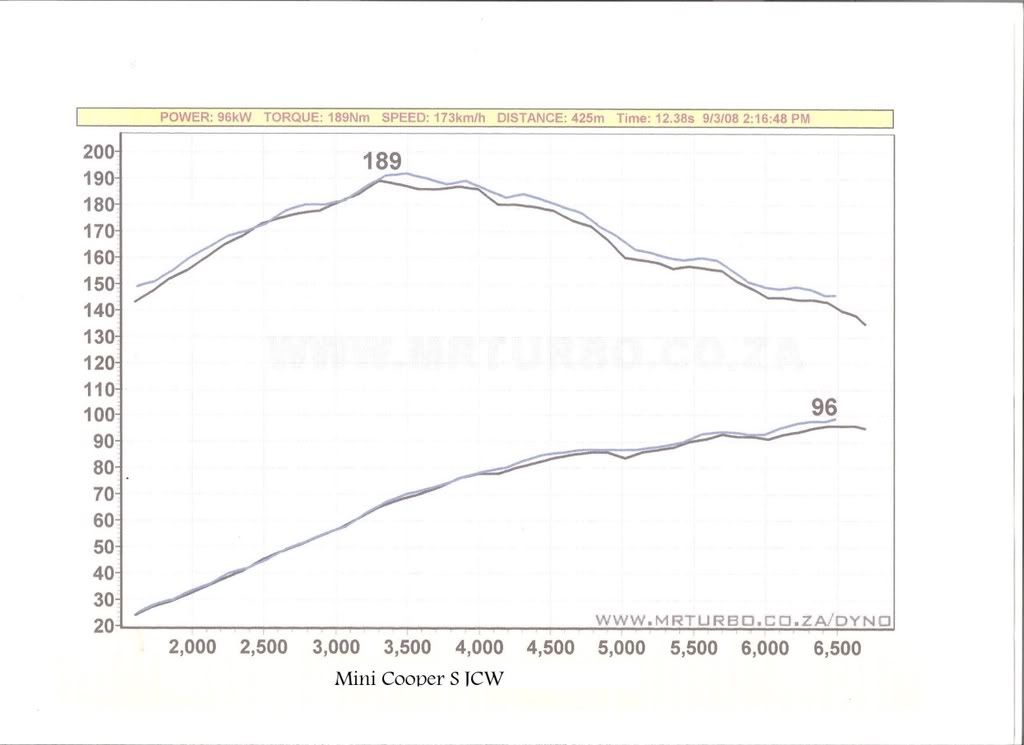
First one is of my Mini Cooper S JCW. Does everything look normal here? No clutch slippage etc?
My friend's Fiesta ST that was dyno'd right before me. Car is stock except for aftermarket cams and CAI.

In the meantime here are the dyno sheets are promised.
First one is of my Mini Cooper S JCW. Does everything look normal here? No clutch slippage etc?
My friend's Fiesta ST that was dyno'd right before me. Car is stock except for aftermarket cams and CAI.

1st Gear
Joined: Jun 2007
Posts: 44
Likes: 0
Mike - what gear was used (both Mini & Fiesta?) For your car the graph shows 173 km/h and 425m vs Fiesta 133 km/h vs 225m - what is the significance of that? Also remember that dyno results can be like stats, it can prove (or not prove) anything. The fact that you physically out-accelarate the Fiesta comfortably (in a heavier car) should show that the dyno results may be questionable. What did Mr Turbo (dyno place) have to say about the results, conversion factors etc? Did they test any other MCS's or JCW's - would be interesting to see more data. Cheers

Thread Starter
|
4th Gear
Joined: Jul 2008
Posts: 522
Likes: 0
I haven't replaced anything yet. That same friend of mine are going to another dyno to get a "2nd opinion". We will see if my results are proportionate to the previous dyno and then I will know if something must be wrong with my car.
Thread Starter
|
4th Gear
Joined: Jul 2008
Posts: 522
Likes: 0
That's exactly what doesn't make sense to me. That's why I'm suspecting something is not running 100% with my car.
Thread Starter
|
4th Gear
Joined: Jul 2008
Posts: 522
Likes: 0
Mike - what gear was used (both Mini & Fiesta?) For your car the graph shows 173 km/h and 425m vs Fiesta 133 km/h vs 225m - what is the significance of that? Also remember that dyno results can be like stats, it can prove (or not prove) anything. The fact that you physically out-accelarate the Fiesta comfortably (in a heavier car) should show that the dyno results may be questionable. What did Mr Turbo (dyno place) have to say about the results, conversion factors etc? Did they test any other MCS's or JCW's - would be interesting to see more data. Cheers
I got your PM and will give you a ring later today


3rd Gear
Joined: Oct 2007
Posts: 269
Likes: 0
From: Everett, WA
Actually thats lower than a Cooper S should dyno as well. There doesn't seem to be a problem with the dyno except it might read a touch low, but that doesn't explain the missing 50 whp.
I think re-dynoing is a waste of time and money. Start focusing on the problem not the symptoms! Do yourself a favor - do an MCS tune up - Belt, Intercooler Boots, and possibly Spark Plugs. You'll spend less than $100 and likely solve the problem completely.
I think re-dynoing is a waste of time and money. Start focusing on the problem not the symptoms! Do yourself a favor - do an MCS tune up - Belt, Intercooler Boots, and possibly Spark Plugs. You'll spend less than $100 and likely solve the problem completely.
Thread Starter
|
4th Gear
Joined: Jul 2008
Posts: 522
Likes: 0
Actually thats lower than a Cooper S should dyno as well. There doesn't seem to be a problem with the dyno except it might read a touch low, but that doesn't explain the missing 50 whp.
I think re-dynoing is a waste of time and money. Start focusing on the problem not the symptoms! Do yourself a favor - do an MCS tune up - Belt, Intercooler Boots, and possibly Spark Plugs. You'll spend less than $100 and likely solve the problem completely.
I think re-dynoing is a waste of time and money. Start focusing on the problem not the symptoms! Do yourself a favor - do an MCS tune up - Belt, Intercooler Boots, and possibly Spark Plugs. You'll spend less than $100 and likely solve the problem completely.

I'll give that a try - hopefully my problems will be solved then!

Mike, does something really feel wrong with the car? If not I don't know why you are trying to fix something that may not be broken. Do ONE thing...call the dyno operator and ask if the numbers are corrected or uncorrected in relation to atmospheric pressure.
If the numbers are uncorrected then YOUR CAR IS OKAY! Continue on with modding, change your belt when you put a new pulley on, have the plugs "looked at" when they pull them out for the compression test...you probably don't need new ones, nor will they help. Visually inspect your intercooler boots...do they look worn and old, or do they look like they might be ok?
Honestly there really is no reason to spend money that you don't need to. Re-dynoing may be a waste of money, or it may not. If the numbers at the new dyno are corrected and the ones at the first dyno were uncorrected, then you will finally see that you car is actually making decent power...Some people put too much weight in dyno numbers, sure if your car is only making 130whp corrected something is seriously wrong and must be looked at. But if your car is making 165whp corrected then I wouldn't be concerned.
If the numbers are uncorrected then YOUR CAR IS OKAY! Continue on with modding, change your belt when you put a new pulley on, have the plugs "looked at" when they pull them out for the compression test...you probably don't need new ones, nor will they help. Visually inspect your intercooler boots...do they look worn and old, or do they look like they might be ok?
Honestly there really is no reason to spend money that you don't need to. Re-dynoing may be a waste of money, or it may not. If the numbers at the new dyno are corrected and the ones at the first dyno were uncorrected, then you will finally see that you car is actually making decent power...Some people put too much weight in dyno numbers, sure if your car is only making 130whp corrected something is seriously wrong and must be looked at. But if your car is making 165whp corrected then I wouldn't be concerned.
3rd Gear
Joined: Oct 2007
Posts: 269
Likes: 0
From: Everett, WA
Like I said - when my belt was slipping I had no idea. The car felt fine, but in anticipation of an RMW tune I put on a new shorter belt and the car was immediately much faster. I had no clue it could make such a huge difference.
^ If he wasn't on the stock pulley I could see that being a real problem. But stock JCW pulley with stock JCW belt...and the fact that it appears he is making ~ 160whp
Now if he had a 15% pulley and stock belt, or even JCW belt, then I would look into that. But this is not the case
Now if he had a 15% pulley and stock belt, or even JCW belt, then I would look into that. But this is not the case
Thread Starter
|
4th Gear
Joined: Jul 2008
Posts: 522
Likes: 0
Mike, does something really feel wrong with the car? If not I don't know why you are trying to fix something that may not be broken. Do ONE thing...call the dyno operator and ask if the numbers are corrected or uncorrected in relation to atmospheric pressure.
If the numbers are uncorrected then YOUR CAR IS OKAY! Continue on with modding, change your belt when you put a new pulley on, have the plugs "looked at" when they pull them out for the compression test...you probably don't need new ones, nor will they help. Visually inspect your intercooler boots...do they look worn and old, or do they look like they might be ok?
Honestly there really is no reason to spend money that you don't need to. Re-dynoing may be a waste of money, or it may not. If the numbers at the new dyno are corrected and the ones at the first dyno were uncorrected, then you will finally see that you car is actually making decent power...Some people put too much weight in dyno numbers, sure if your car is only making 130whp corrected something is seriously wrong and must be looked at. But if your car is making 165whp corrected then I wouldn't be concerned.
If the numbers are uncorrected then YOUR CAR IS OKAY! Continue on with modding, change your belt when you put a new pulley on, have the plugs "looked at" when they pull them out for the compression test...you probably don't need new ones, nor will they help. Visually inspect your intercooler boots...do they look worn and old, or do they look like they might be ok?
Honestly there really is no reason to spend money that you don't need to. Re-dynoing may be a waste of money, or it may not. If the numbers at the new dyno are corrected and the ones at the first dyno were uncorrected, then you will finally see that you car is actually making decent power...Some people put too much weight in dyno numbers, sure if your car is only making 130whp corrected something is seriously wrong and must be looked at. But if your car is making 165whp corrected then I wouldn't be concerned.
I understand where you are coming from and it would not worry me so much if my friend hadn't tagged along. It doesn't make sense to me that his car wasn't effected by altitude as badily as my car. Surely the loss in power to be proportionate?
Thread Starter
|
4th Gear
Joined: Jul 2008
Posts: 522
Likes: 0
I really really hope that is the case. I will inspect my intercooler boots etc. tomorrow. They are still the OEM original since new ones and the car is now 5 years old with 37,000 miles on.
150kW*.85 for drivetrain loss is 127.5kW* .89 for altitude loss = 113kW
So ok...yea, your car is a lower on power then, by about 17kW or 24hp...even if the numbers are uncorrected. But thats a lot better then 50hp off.
Another thing I forgot to mention, you car should actually loose less hp with altitude then your friends since your engine is supercharged and his is naturally aspirated. The equation is still very simple. If the correction percent is 81% multiply 14.7 * .81 this gets 11.9. This means that the outside air pressure is 11.9psi (standard sea level is 14.7) now add your boost pressure to 11.9 I used 13psi since you have a JCW and that is relatively close. Now 11.9 + 13.0 = 24.9 this is total pressure in you manifold, compare that to sea level 14.7 + 13.0 = 27.7 so at sea level you would have 27.7psi in the manifold 27.7/24.9 = .89 89% is your correction for your force induced vehicle that day. Just explaining how I came up with the approximation numbers.
Sorry you car IS running poorly
3rd Gear
Joined: Oct 2007
Posts: 269
Likes: 0
From: Everett, WA
Well 96 wkW = 128 whp and a 210hp car should dyno around 178.5 whp (15% drivetrain loss, which has actually been proving too high for most tranverse mount manual-transmission applications).
At 4300 feet, the air is approximately 85% as dense as at sea level.
Don't forget with your correction factors that the boost provided by the supercharger is actually a pressure ratio based on ambient pressure, not a fixed pressure increase. A turbo with a wastegate will indeed provide a fixed pressure increase (up until the turbo hits the surge limit) but a fixed-displacement blower will not. If ambient pressure is 15% lower than at sea level, so will the manifold pressure post-supercharger.
So if we assume 15% lower mass of air consumed, the car should be around 152 whp or 114 wkW
At 4300 feet, the air is approximately 85% as dense as at sea level.
Don't forget with your correction factors that the boost provided by the supercharger is actually a pressure ratio based on ambient pressure, not a fixed pressure increase. A turbo with a wastegate will indeed provide a fixed pressure increase (up until the turbo hits the surge limit) but a fixed-displacement blower will not. If ambient pressure is 15% lower than at sea level, so will the manifold pressure post-supercharger.
So if we assume 15% lower mass of air consumed, the car should be around 152 whp or 114 wkW
Thread Starter
|
4th Gear
Joined: Jul 2008
Posts: 522
Likes: 0
125kW*.85 for drivetrain loss is 106.25kW*.81 for altitude loss = 86kW
150kW*.85 for drivetrain loss is 127.5kW* .89 for altitude loss = 113kW
So ok...yea, your car is a lower on power then, by about 17kW or 24hp...even if the numbers are uncorrected. But thats a lot better then 50hp off.
Another thing I forgot to mention, you car should actually loose less hp with altitude then your friends since your engine is supercharged and his is naturally aspirated. The equation is still very simple. If the correction percent is 81% multiply 14.7 * .81 this gets 11.9. This means that the outside air pressure is 11.9psi (standard sea level is 14.7) now add your boost pressure to 11.9 I used 13psi since you have a JCW and that is relatively close. Now 11.9 + 13.0 = 24.9 this is total pressure in you manifold, compare that to sea level 14.7 + 13.0 = 27.7 so at sea level you would have 27.7psi in the manifold 27.7/24.9 = .89 89% is your correction for your force induced vehicle that day. Just explaining how I came up with the approximation numbers.
Sorry you car IS running poorly
150kW*.85 for drivetrain loss is 127.5kW* .89 for altitude loss = 113kW
So ok...yea, your car is a lower on power then, by about 17kW or 24hp...even if the numbers are uncorrected. But thats a lot better then 50hp off.
Another thing I forgot to mention, you car should actually loose less hp with altitude then your friends since your engine is supercharged and his is naturally aspirated. The equation is still very simple. If the correction percent is 81% multiply 14.7 * .81 this gets 11.9. This means that the outside air pressure is 11.9psi (standard sea level is 14.7) now add your boost pressure to 11.9 I used 13psi since you have a JCW and that is relatively close. Now 11.9 + 13.0 = 24.9 this is total pressure in you manifold, compare that to sea level 14.7 + 13.0 = 27.7 so at sea level you would have 27.7psi in the manifold 27.7/24.9 = .89 89% is your correction for your force induced vehicle that day. Just explaining how I came up with the approximation numbers.
Sorry you car IS running poorly

The last sentence is what I wanted to hear, just needed to confirm if there was in fact something wrong with my car! :(
Thread Starter
|
4th Gear
Joined: Jul 2008
Posts: 522
Likes: 0
Well 96 wkW = 128 whp and a 210hp car should dyno around 178.5 whp (15% drivetrain loss, which has actually been proving too high for most tranverse mount manual-transmission applications).
At 4300 feet, the air is approximately 85% as dense as at sea level.
Don't forget with your correction factors that the boost provided by the supercharger is actually a pressure ratio based on ambient pressure, not a fixed pressure increase. A turbo with a wastegate will indeed provide a fixed pressure increase (up until the turbo hits the surge limit) but a fixed-displacement blower will not. If ambient pressure is 15% lower than at sea level, so will the manifold pressure post-supercharger.
So if we assume 15% lower mass of air consumed, the car should be around 152 whp or 114 wkW
At 4300 feet, the air is approximately 85% as dense as at sea level.
Don't forget with your correction factors that the boost provided by the supercharger is actually a pressure ratio based on ambient pressure, not a fixed pressure increase. A turbo with a wastegate will indeed provide a fixed pressure increase (up until the turbo hits the surge limit) but a fixed-displacement blower will not. If ambient pressure is 15% lower than at sea level, so will the manifold pressure post-supercharger.
So if we assume 15% lower mass of air consumed, the car should be around 152 whp or 114 wkW
Well 96 wkW = 128 whp and a 210hp car should dyno around 178.5 whp (15% drivetrain loss, which has actually been proving too high for most tranverse mount manual-transmission applications).
At 4300 feet, the air is approximately 85% as dense as at sea level.
Don't forget with your correction factors that the boost provided by the supercharger is actually a pressure ratio based on ambient pressure, not a fixed pressure increase. A turbo with a wastegate will indeed provide a fixed pressure increase (up until the turbo hits the surge limit) but a fixed-displacement blower will not. If ambient pressure is 15% lower than at sea level, so will the manifold pressure post-supercharger.
So if we assume 15% lower mass of air consumed, the car should be around 152 whp or 114 wkW
At 4300 feet, the air is approximately 85% as dense as at sea level.
Don't forget with your correction factors that the boost provided by the supercharger is actually a pressure ratio based on ambient pressure, not a fixed pressure increase. A turbo with a wastegate will indeed provide a fixed pressure increase (up until the turbo hits the surge limit) but a fixed-displacement blower will not. If ambient pressure is 15% lower than at sea level, so will the manifold pressure post-supercharger.
So if we assume 15% lower mass of air consumed, the car should be around 152 whp or 114 wkW
It gets you in the ballpark, figures aren't exact anyway, but rather a good idea of where you should be. I ended at 113kw you ended at 114...close enough. I started at 150kw (205hp) you started at 210hp

6th Gear
Joined: Jan 2008
Posts: 1,103
Likes: 0
From: Phoenix AZ
I'm thinking that the Dyno wasnt calibrated properly.
I would have them do it again, watching over there shoulder to make sure they actually know what there doing.
I just cant see your numbers being that low with all the mods you have.
I would have them do it again, watching over there shoulder to make sure they actually know what there doing.
I just cant see your numbers being that low with all the mods you have.
Thread Starter
|
4th Gear
Joined: Jul 2008
Posts: 522
Likes: 0
I also checked the intercooler boots, the seem to be fine. I installed my M7 OCC which arrived today. Here are some pics.


Thread Starter
|
4th Gear
Joined: Jul 2008
Posts: 522
Likes: 0
and it will only get changed once year as I don't drive the car all that much, so even if it is just beneath/next to the OCC I don't mind.Also that is where M7's instruction recommends placing it. I also couldn't find another area with enough space. This was more of a PITA to install than I originally thought too, one of the torx screw heads fell into the engine bay somewhere and I can't find or seem to shake it out. I hope it will fall out on it's own some time. Good fun none the less, I learned something new about DIY.

Thread Starter
|
4th Gear
Joined: Jul 2008
Posts: 522
Likes: 0
Hi Ralph - I know there were different version of the JCW kit. Mine is the latest/last one BMW brought out for the R53's. I only got the kit installed in 2005. I haven't phoned the dyno yet, I'll find out though.