


Drivetrain Custom Header


6th Gear
Joined: Sep 2004
Posts: 5,149
Likes: 0
Um, isn't the Tritec firing order 1-3-4-2 just like every other Chrysler? Like a Chrysler, the Mitsubishi-type coil packs are wired to fire 1 and 4 together, then 2 and 3.
If that is the case, this "reverse" Tri-Y setup pairs the 1-3 and 4-2 exhaust pulses just 90 degrees apart (should sound like a Ducati ).
).
Like a Chrysler, the Mitsubishi-type coil packs are wired to fire 1 and 4 together, then 2 and 3.If that is the case, this "reverse" Tri-Y setup pairs the 1-3 and 4-2 exhaust pulses just 90 degrees apart (should sound like a Ducati
).
Turbius Maximus
Joined: Mar 2004
Posts: 4,416
Likes: 0
From: Infinity and beyond
wouldn't that be a set of termis buddy?! LOL... I had two on My Ducati... I miss her allot ...and I have had my eye on the 1098... if I should pic one up we'll have to meet somewhere... also that's a fine italian macheen... with fine pipes to go on.. say the whole thing... say it with me now..."Termignoni" LOL
Last edited by Tüls; Nov 20, 2007 at 08:06 AM.


6th Gear
Joined: Sep 2004
Posts: 5,149
Likes: 0
 ..... my back can't take the position..... but man what a beauty sorry for the OT

 NICE!!!!! *drooling....*
My little dose of LITHIUM
iTrader: (1)
Joined: Jul 2005
Posts: 2,435
Likes: 2
From: Albuquerque New Mexico
SO, after that slight digression into Ducati land, should I bring the thread back on topic, or just start a new one?
Fired up the new CMC exhaust system this morning and drove to work. Well, apart from the expected odor -- how does all that smelly stuff get into and onto those parts just sitting in the garage--it all worked fine. First impressions relate to sound not performance (I've never been one to post popo-dyno figures). The header and resonator seem quieter than the Megan and Milltek resonator by quite a noticable amount. At least 5db I'd guesstimate. Deep and throaty for sure and milder back-fires compared to the very raw Megan sound. SC whine has reclaimed the lead role, but hell still breaks lose at WOT, in a nice way!
Will report on performance impressions later.
Fired up the new CMC exhaust system this morning and drove to work. Well, apart from the expected odor -- how does all that smelly stuff get into and onto those parts just sitting in the garage--it all worked fine. First impressions relate to sound not performance (I've never been one to post popo-dyno figures). The header and resonator seem quieter than the Megan and Milltek resonator by quite a noticable amount. At least 5db I'd guesstimate. Deep and throaty for sure and milder back-fires compared to the very raw Megan sound. SC whine has reclaimed the lead role, but hell still breaks lose at WOT, in a nice way!
Will report on performance impressions later.

SO, after that slight digression into Ducati land, should I bring the thread back on topic, or just start a new one?
Fired up the new CMC exhaust system this morning and drove to work. Well, apart from the expected odor -- how does all that smelly stuff get into and onto those parts just sitting in the garage--it all worked fine. First impressions relate to sound not performance (I've never been one to post popo-dyno figures). The header and resonator seem quieter than the Megan and Milltek resonator by quite a noticable amount. At least 5db I'd guesstimate. Deep and throaty for sure and milder back-fires compared to the very raw Megan sound. SC whine has reclaimed the lead role, but hell still breaks lose at WOT, in a nice way!
Will report on performance impressions later.
Fired up the new CMC exhaust system this morning and drove to work. Well, apart from the expected odor -- how does all that smelly stuff get into and onto those parts just sitting in the garage--it all worked fine. First impressions relate to sound not performance (I've never been one to post popo-dyno figures). The header and resonator seem quieter than the Megan and Milltek resonator by quite a noticable amount. At least 5db I'd guesstimate. Deep and throaty for sure and milder back-fires compared to the very raw Megan sound. SC whine has reclaimed the lead role, but hell still breaks lose at WOT, in a nice way!
Will report on performance impressions later.
Sorry Doc,
I am interested to find out the performance differences between my RMW race header and Jasons. The RMW is a 4 into 1 while Jason's is a 4 into 2 into 1.
From what I understand the 4 into 1's should be better on the top-end while a 4 into 2 into 1 should produce better low-end TQ.
Have any of you that have Jason's header seen any extra low end grunt?
Longboard

Thread Starter
|
6th Gear
Joined: Aug 2004
Posts: 1,629
Likes: 7
From: Pipe Creek, Texas
A minor correction to begin with, the fabricator’s first name is Juston.
A well designed 4-2-1 can emulate the top end characteristics of a 4-1, and I’ve not felt any loss at the top, as well as maintain or surpass OEM characteristics on the low end. The same can be said of a well designed 4-1 matched to the performance profile of a particular head & cam. Appropriate tube lengths and diameter are enablers for both designs.
My version is a 2.5 inch ID exit from the cat, the OEM cat back it is attached it to is 2.125 inch ID past the flange. At the OEM flange the entrance was narrowed to less than 2 inch due to the OEM weld & insert. This is a large mismatch to which I attribute a loss in very low end when first installed (please read the OP for initial impressions). After attaching an appropriate sized flange with a proper transition to 2.25 inch and the resonator which also aided in the transition to 2.125, there was a gain in low end torque (please read the OP).
I consider the good mid-range performance of my header to be one of its greater strengths, and that's what my headwork was designed for.
A well designed 4-2-1 can emulate the top end characteristics of a 4-1, and I’ve not felt any loss at the top, as well as maintain or surpass OEM characteristics on the low end. The same can be said of a well designed 4-1 matched to the performance profile of a particular head & cam. Appropriate tube lengths and diameter are enablers for both designs.
My version is a 2.5 inch ID exit from the cat, the OEM cat back it is attached it to is 2.125 inch ID past the flange. At the OEM flange the entrance was narrowed to less than 2 inch due to the OEM weld & insert. This is a large mismatch to which I attribute a loss in very low end when first installed (please read the OP for initial impressions). After attaching an appropriate sized flange with a proper transition to 2.25 inch and the resonator which also aided in the transition to 2.125, there was a gain in low end torque (please read the OP).
I consider the good mid-range performance of my header to be one of its greater strengths, and that's what my headwork was designed for.

5th Gear
Joined: Mar 2005
Posts: 772
Likes: 0
Thing is, a 4:2:1 system usually pairs the primaries 180 degrees apart, as Supersprint, Jackson Racing, Comptech etc have done. Theoretically, a 90:270 degree separation will create different scavenging effects from the cylinders (that is, if the header is tuned for the cylinder with 270 degree separation it will then NOT be tuned for the one with only 90 degrees). The bright side is such a setup tends to be relatively less sensitive to pipe sizes and lengths, as the V8 guys know (a V8 with the usual 2-plane crank has one "odd" cylinder on each side that fires only 90 degrees apart from its nearest neighbor, a characteristic that both produces the typical V8 sound and which has been the inspiration for things like the weird Flowtech Afterburner collector, or Edelbrock actually using different pipe sizes for some cylinders).
Don't discount the advantage of this--V8 engines frequently make less power when equipped with a "flat" single-plane crank, probably because header tuning becomes so much more critical that it's just easier to get it plain wrong. The supercharged Tritec is likely not too sensitive already though, since even a big-tube OBX can deliver the hp numbers up top. Longer tubes to boost the low-end (and thus area under the curve) coupled with enough tube size to do the job at the high-end sounds like a great idea. I'm just not sure I would have intentionally strayed from the 180 degree configuration.
Ducatis of course use a 90 degree V-twin, so the exhaust pulses can't help but be messed up.
Speaking of David Vizard, he has an interesting "termination box" theory that may explain why having a Flowmaster right after the header can be a really good thing. I currently have a 6" diameter Magnaflow right behind the cat, but have been looking into replacing it with a 5 1/4" DNA muffler because its open interior design would probably make a better termination box.
Don't discount the advantage of this--V8 engines frequently make less power when equipped with a "flat" single-plane crank, probably because header tuning becomes so much more critical that it's just easier to get it plain wrong. The supercharged Tritec is likely not too sensitive already though, since even a big-tube OBX can deliver the hp numbers up top. Longer tubes to boost the low-end (and thus area under the curve) coupled with enough tube size to do the job at the high-end sounds like a great idea. I'm just not sure I would have intentionally strayed from the 180 degree configuration.
Ducatis of course use a 90 degree V-twin, so the exhaust pulses can't help but be messed up
.Speaking of David Vizard, he has an interesting "termination box" theory that may explain why having a Flowmaster right after the header can be a really good thing. I currently have a 6" diameter Magnaflow right behind the cat, but have been looking into replacing it with a 5 1/4" DNA muffler because its open interior design would probably make a better termination box.
Thread Starter
|
6th Gear
Joined: Aug 2004
Posts: 1,629
Likes: 7
From: Pipe Creek, Texas
BFG9000, thank you for the input; more will be forthcoming on the cylinder paring for this design.
I’m not trying to pick apart your post, but I read a different take on primary length sensitivity by Mr. Vizard, “Experience indicates inline four-cylinder engines are more sensitive to primary length”. I also understand the context in which that was stated and much depends on what measurement is considered a significant outcome. The article gives credence to Jan’s/Burns Stainless’ collector focus on their 4-1 and to the advantages of well designed tube paring/length/diameter in a 4-2-1. I liked the distinction between muffler flow and pressure wave tuning (experience and real world testing are important for pressure wave tuning because not all theories behave as intended in practice). I’ve often wondered why JCW chose the cat-back it uses when the standard OEM flows better.
Forced induction will forgive many sins in both intake and exhaust design and in my opinion that’s why many aftermarket headers can still produce marginal gains when their primary intent was to meet packaging limitations and profit margins.[FONT=Verdana]line four-cylinder engines are more sensitive to primary pipe length,[/FONT]
I’m not trying to pick apart your post, but I read a different take on primary length sensitivity by Mr. Vizard, “Experience indicates inline four-cylinder engines are more sensitive to primary length”. I also understand the context in which that was stated and much depends on what measurement is considered a significant outcome. The article gives credence to Jan’s/Burns Stainless’ collector focus on their 4-1 and to the advantages of well designed tube paring/length/diameter in a 4-2-1. I liked the distinction between muffler flow and pressure wave tuning (experience and real world testing are important for pressure wave tuning because not all theories behave as intended in practice). I’ve often wondered why JCW chose the cat-back it uses when the standard OEM flows better.
Forced induction will forgive many sins in both intake and exhaust design and in my opinion that’s why many aftermarket headers can still produce marginal gains when their primary intent was to meet packaging limitations and profit margins.[FONT=Verdana]line four-cylinder engines are more sensitive to primary pipe length,[/FONT]
Thread Starter
|
6th Gear
Joined: Aug 2004
Posts: 1,629
Likes: 7
From: Pipe Creek, Texas
One test was posted here, but it is somewhere buried in the past before archive cut-off. Here is another, http://www.mini2.com/forum/engine-dr...g-results.html .
5th Gear
Joined: Mar 2005
Posts: 772
Likes: 0
The JCW system that GT Tuning tested was the later version with the horribly crushed section added in 2005 to make it compatible with the convertible's extra frame brace. The uncrushed versions (factory 1-piece JCW and earlier dealer-installed models) likely have less backpressure than that one.
Inline 4-cyl engines (and a flat-crank V8 is essentially two inline 4-cyl engines) indeed tend to be much more sensitive to header tuning, but supercharging reduces the need for (and a low-overlap emissions-type cam reduces the ability of) any header to improve the intake charge. If indeed we could "get away with" not tuning the header for max power (and many of the short-tube headers available are "tuned" for rpms higher than redline anyway), then it may be possible to tune it for low-rpm gains without losing much up top-a tantalizing prospect for sure. My thinking is that at low rpms, there is more time for the header to work with the limited cam overlap and the supercharger is producing less boost so the potential gains would be greater. That's why I'm always glad to see a new long-tube header design for the MCS
Looking forward to your reasoning behind selecting the unusual cylinder pairing! SpiderX's header (also by CMC-Juston Poole) in comparison has a much more conventional arrangement:

Inline 4-cyl engines (and a flat-crank V8 is essentially two inline 4-cyl engines) indeed tend to be much more sensitive to header tuning, but supercharging reduces the need for (and a low-overlap emissions-type cam reduces the ability of) any header to improve the intake charge. If indeed we could "get away with" not tuning the header for max power (and many of the short-tube headers available are "tuned" for rpms higher than redline anyway), then it may be possible to tune it for low-rpm gains without losing much up top-a tantalizing prospect for sure. My thinking is that at low rpms, there is more time for the header to work with the limited cam overlap and the supercharger is producing less boost so the potential gains would be greater. That's why I'm always glad to see a new long-tube header design for the MCS
Looking forward to your reasoning behind selecting the unusual cylinder pairing! SpiderX's header (also by CMC-Juston Poole) in comparison has a much more conventional arrangement:
Thread Starter
|
6th Gear
Joined: Aug 2004
Posts: 1,629
Likes: 7
From: Pipe Creek, Texas
Why 90?
As I said at the start of this thread it was a HyTech header that stimulated my interest in what I consider to be a “unique” sequential cylinder pairing style. Here is a link with a good explanation of a sequential pairing’s benefit, #4 http://www.team-integra.net/sections...sp?ArticleID=2

5th Gear
Joined: Mar 2005
Posts: 772
Likes: 0
Looks like Larry Widmer (a noted proponent of Hytech) even put this configuration header on his very own 300hp Civic, so there must be something to it!
Larry does recommend (and sell) a full 3" exhaust and a 4:1 header with short and fat tubes for a street-driven, 1.6L supercharged car though.
His 300hp normally aspirated Civic now has 13.2:1 compression, while the previous supercharged 487hp engine in it had 11.2:1 and 27psi boost from a M-62
Larry does recommend (and sell) a full 3" exhaust and a 4:1 header with short and fat tubes for a street-driven, 1.6L supercharged car though.
His 300hp normally aspirated Civic now has 13.2:1 compression, while the previous supercharged 487hp engine in it had 11.2:1 and 27psi boost from a M-62

4th Gear
Joined: Oct 2007
Posts: 488
Likes: 0

Former Vendor
Joined: Mar 2006
Posts: 1,135
Likes: 0
From: Metro NY
Just as Jere Stahl noted decades ago;
“Hooker Headers never showed any qualms about copying other people's idea and he doesn't know of one single header related concept they originated”, it seems this header is following in the steps of OBX/Supersprint.
We live in an age of intellectual disintegration.
“Hooker Headers never showed any qualms about copying other people's idea and he doesn't know of one single header related concept they originated”, it seems this header is following in the steps of OBX/Supersprint.
We live in an age of intellectual disintegration.
6th Gear
Joined: Sep 2004
Posts: 5,149
Likes: 0
Just as Jere Stahl noted decades ago;
“Hooker Headers never showed any qualms about copying other people's idea and he doesn't know of one single header related concept they originated”, it seems this header is following in the steps of OBX/Supersprint.
We live in an age of intellectual disintegration.
“Hooker Headers never showed any qualms about copying other people's idea and he doesn't know of one single header related concept they originated”, it seems this header is following in the steps of OBX/Supersprint.
We live in an age of intellectual disintegration.

Former Vendor
Joined: Mar 2006
Posts: 1,135
Likes: 0
From: Metro NY
Products such as headers for Mini's do not warrant the costs of patent protection. But just because that is true doesn't make copying a product the right thing to do. For what is overlooked is that intellectual property rights are the basis of innovation allowing companies to recover their costs (research, development and marketing).
Intellectual property -- in the form of drug formulas, software, business processes, entertainment, even handbag design -- is the foundation of our prosperity.
James K. Glassman
Intellectual property -- in the form of drug formulas, software, business processes, entertainment, even handbag design -- is the foundation of our prosperity.
James K. Glassman

My little dose of LITHIUM
iTrader: (1)
Joined: Jul 2005
Posts: 2,435
Likes: 2
From: Albuquerque New Mexico
SO who makes this header?
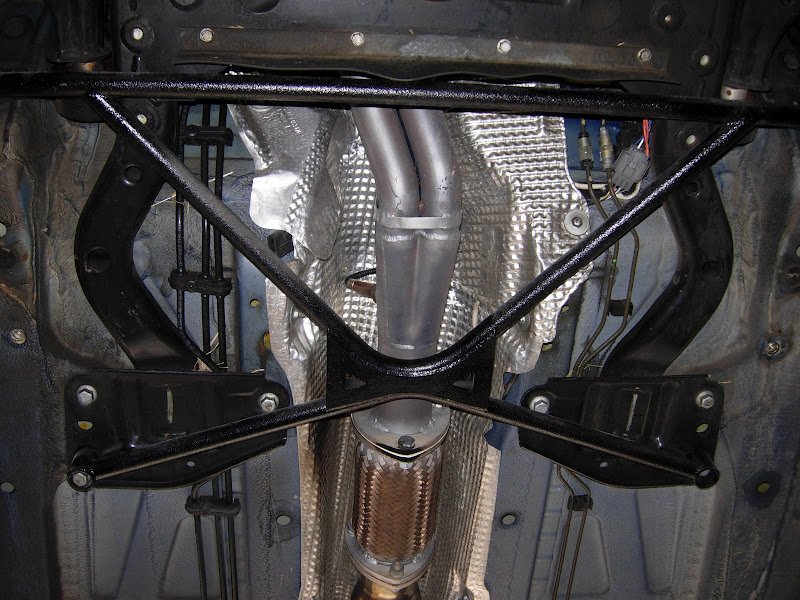
It might work but it looks like ***** to me. The o2 sensor looks badly placed, and the flex joint is in a totally useless location--it should be at the bend where the header changes orientation from vertical to horizontal (the place it flexes as the engine moves on its mounts.)
Of course, I'm one of those guys who only cares about looks and not performance. I personally see a lot unique in the CMC header and cat.
It might work but it looks like ***** to me. The o2 sensor looks badly placed, and the flex joint is in a totally useless location--it should be at the bend where the header changes orientation from vertical to horizontal (the place it flexes as the engine moves on its mounts.)
Of course, I'm one of those guys who only cares about looks and not performance. I personally see a lot unique in the CMC header and cat.

SO who makes this header?
It might work but it looks like ***** to me. The o2 sensor looks badly placed, and the flex joint is in a totally useless location--it should be at the bend where the header changes orientation from vertical to horizontal (the place it flexes as the engine moves on its mounts.)
It might work but it looks like ***** to me. The o2 sensor looks badly placed, and the flex joint is in a totally useless location--it should be at the bend where the header changes orientation from vertical to horizontal (the place it flexes as the engine moves on its mounts.)
That's Jan's header, Phil.
Originally Posted by DrPhilGandini
Of course, I'm one of those guys who only cares about looks and not performance. I personally see a lot unique in the CMC header and cat.
(at least i do)