


Drivetrain Operation Hot Air Intake
#1
 05-09-2004, 12:30 PM


#2
05-09-2004, 12:34 PM


#3
05-09-2004, 01:09 PM
Okay, here's some preliminary testing results. I did 3 runs at WOT from 2000-6500 RPM in 2nd gear.
ambient=22.5 C,ic in=109.5 C,ic out=54.0 C,RPM=6500,Speed= 65 mph,Gear= 2,Boost= 15.5 psi
ambient=22.5 C,ic in=111.0 C,ic out=53.5 C,RPM=6500,Speed= 65 mph,Gear= 2,Boost= 15.5 psi
ambient=22.5 C,ic in=112.0 C,ic out=51.0 C,RPM=6500,Speed= 65 mph,Gear= 2,Boost= 15.5 psi
Intercooler efficiency ranged from 64-68% (about what I expected). The supercharger heated air about 87-90 C over ambient (just like with the Alta intake). I need to do more testing (including reinstalling the Alta intake), but it doesn't look like air temperatures are much different than with the Alta.
Here's the best part, initial examination of the upstream pressure (between the throttle body and the supercharger inlet) shows the bare K&N flows a bit better than the Alta intake. The curves are very similar up to about 4500 rpm, where the HAI starts to outflow the Alta, giving over 0.1 psi less pressure drop by 6500 rpm.
ambient=22.5 C,ic in=109.5 C,ic out=54.0 C,RPM=6500,Speed= 65 mph,Gear= 2,Boost= 15.5 psi
ambient=22.5 C,ic in=111.0 C,ic out=53.5 C,RPM=6500,Speed= 65 mph,Gear= 2,Boost= 15.5 psi
ambient=22.5 C,ic in=112.0 C,ic out=51.0 C,RPM=6500,Speed= 65 mph,Gear= 2,Boost= 15.5 psi
Intercooler efficiency ranged from 64-68% (about what I expected). The supercharger heated air about 87-90 C over ambient (just like with the Alta intake). I need to do more testing (including reinstalling the Alta intake), but it doesn't look like air temperatures are much different than with the Alta.
Here's the best part, initial examination of the upstream pressure (between the throttle body and the supercharger inlet) shows the bare K&N flows a bit better than the Alta intake. The curves are very similar up to about 4500 rpm, where the HAI starts to outflow the Alta, giving over 0.1 psi less pressure drop by 6500 rpm.
#4
05-09-2004, 01:15 PM

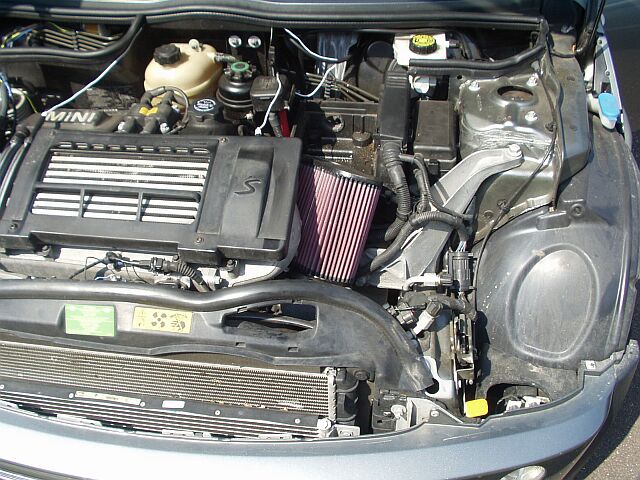
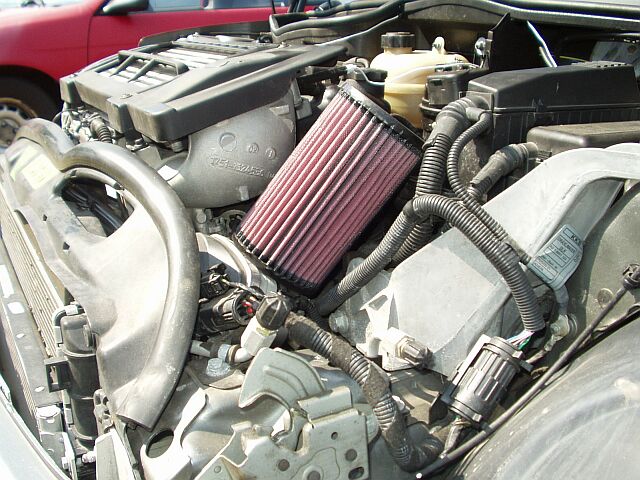
Interesting. Nice pictures. How did you get that idea?
It's simple and you lost a few extra parts and saved some weight.
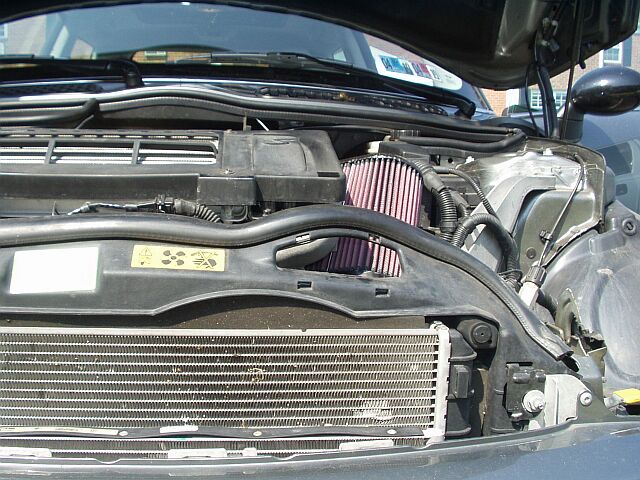
I'd like to see a better way of getting the fresh cooler air from the front of the car directly routed to the intake itself so I wonder about a tube to run from the front grill inlet at least to the point of the intake. I would also be concerned about the airflow pattern at the intake itself-seems that with the tight fit, the air is not really allowed all the way around the filter itself and that the full surface area of the intake would be affected.
Also heat from the engine cannot be separated from mixing with fresh air so a flexible cloth material might be something to fit but not take up too much space that could act as a partial heat barrier.
Let us know how the numbers look. Thanks for being creative.
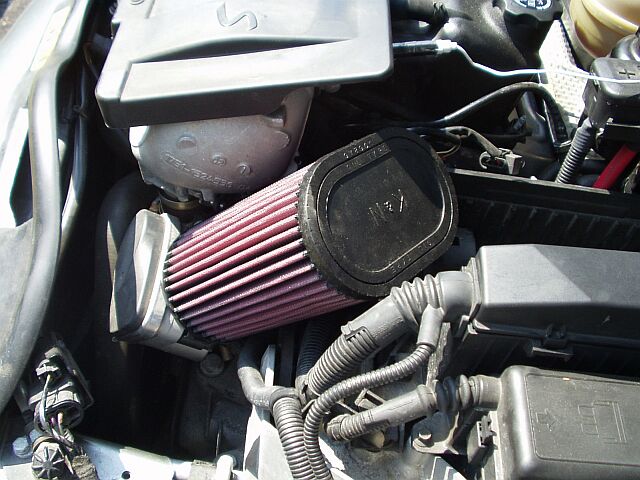
That's a huge "monster" filter.
It's simple and you lost a few extra parts and saved some weight.
I'd like to see a better way of getting the fresh cooler air from the front of the car directly routed to the intake itself so I wonder about a tube to run from the front grill inlet at least to the point of the intake. I would also be concerned about the airflow pattern at the intake itself-seems that with the tight fit, the air is not really allowed all the way around the filter itself and that the full surface area of the intake would be affected.
Also heat from the engine cannot be separated from mixing with fresh air so a flexible cloth material might be something to fit but not take up too much space that could act as a partial heat barrier.
Let us know how the numbers look. Thanks for being creative.
That's a huge "monster" filter.
#5
05-09-2004, 01:25 PM
Fantastic Andy! Interesting preliminary data. As I said in the other thread, our stock box most likely provides for cooler air than many, if not all CAI's. I think the power gains for these aftermkt intakes can be attributed to improved flow. While warmer air is not ideal, if increased flow is obtained as a trade-off, further gains might be had. There is something to be said for simplicity. Gosh, if this pans-out, how could we use stock box location? I have some ideas already  Keep it comin' Andy.
Keep it comin' Andy.
#6
05-09-2004, 02:54 PM
Andy,
Thanks for the numbers.
I wonder what help or detriment removing the stock intercooler cover would make on airflow to the intercooler (efficiency) and airflow to your Air filter.
If you think the MCS scoop could allow a bit more cooler air to flow to your intake that might help but only if the loss of cool air to the IC was not negating any gain. Just an idea. Hey, simplier setup and loose more weight.
Thanks for the numbers.
I wonder what help or detriment removing the stock intercooler cover would make on airflow to the intercooler (efficiency) and airflow to your Air filter.
If you think the MCS scoop could allow a bit more cooler air to flow to your intake that might help but only if the loss of cool air to the IC was not negating any gain. Just an idea. Hey, simplier setup and loose more weight.
#7
05-09-2004, 02:58 PM
Andy, did you mate the filter straight to the TB, or is there an adaptor there? It appears to be mounted on the TB... One more question, how much clearance would you say is there above the filter? There appears to be a couple inches. If so, one could go with a wider filter outlet diameter, and with a properly made adaptor, funnel it down to the TB's diameter. This should help increase the velocity...
There is a nice ram air option right there also! Just need to make sure there still is some type of down tube or something comparable so water does not enter the intake.
There is a nice ram air option right there also! Just need to make sure there still is some type of down tube or something comparable so water does not enter the intake.
Trending Topics
#8
05-09-2004, 03:08 PM
minhune, with a FMIC, the scoop could be used to get pleny of fresh air into this intake, as well as clearing the engine bay of heat in general.
Sure there is some weight saved, maybe couple pounds. That is good. But, I think even more beneficial is the real estate gained, and how that could be used for other goodies Plenty of room for a UNIChip, PB, or other creative possibilities...
_________________
2003 IB MCS
Sure there is some weight saved, maybe couple pounds. That is good. But, I think even more beneficial is the real estate gained, and how that could be used for other goodies
Plenty of room for a UNIChip, PB, or other creative possibilities..._________________
2003 IB MCS
#9
05-09-2004, 04:11 PM


#10
05-09-2004, 07:29 PM

6th Gear
Join Date: Jul 2003
Location: Atlanta/Amsterdam
Posts: 1,469
Likes: 0
Received 0 Likes
on
0 Posts
Andy,
Excited about seeing the other numbers. About time someone thought outside of the box and tried designing something different with real numbers. I was thinking of a design similiar to this months ago when I posted this in the BFP "True Cold air intake" post. What would take this one step further Andy is to connect the inlet tube in the grill to a tube around this type of a filter. This would give it a little more of a Ram Air function. I would be curious to see if this improved the design further.
I think the positive aspects of what Andy is testing is that it gets rid of the convoluted tubing and the opens the filter to the direct air coming from the grill. I was getting so tired of the other designs out there. I think if Andy's numbers are the same or better than the Alta, this is the way to go at a fraction of the costs. I couldn't understand how other members here were satisfied with the current intakes. Everyone has a cow about a slight 10 degrees extra bend in an exhaust design, but no one was every saying anything about the extremely convoluted design of the current cold air intakes. Also all the other intakes were not really cold air designs but were just relying on a filter that had some higher flow over the stock numbers and everyone was willing to pay $250 for the other "fake design" pieces. Also, I never saw any manufacturers provide any pressure numbers or temperature numbers for their intakes. Most people kept quoting some hp numbers Randy has thrown around for the last two years. There never seemed to be much testing for these intakes on the market. People spent $60 extra dollars for the Alta intake tube and I never saw any independent numbers from anyone even indicating there was a benefit, just a bunch of hypothetical stuff like a better insulator and smoother flow....
Andy keep up the good work on this design.
Excited about seeing the other numbers. About time someone thought outside of the box and tried designing something different with real numbers. I was thinking of a design similiar to this months ago when I posted this in the BFP "True Cold air intake" post. What would take this one step further Andy is to connect the inlet tube in the grill to a tube around this type of a filter. This would give it a little more of a Ram Air function. I would be curious to see if this improved the design further.
I think the positive aspects of what Andy is testing is that it gets rid of the convoluted tubing and the opens the filter to the direct air coming from the grill. I was getting so tired of the other designs out there. I think if Andy's numbers are the same or better than the Alta, this is the way to go at a fraction of the costs. I couldn't understand how other members here were satisfied with the current intakes. Everyone has a cow about a slight 10 degrees extra bend in an exhaust design, but no one was every saying anything about the extremely convoluted design of the current cold air intakes. Also all the other intakes were not really cold air designs but were just relying on a filter that had some higher flow over the stock numbers and everyone was willing to pay $250 for the other "fake design" pieces. Also, I never saw any manufacturers provide any pressure numbers or temperature numbers for their intakes. Most people kept quoting some hp numbers Randy has thrown around for the last two years. There never seemed to be much testing for these intakes on the market. People spent $60 extra dollars for the Alta intake tube and I never saw any independent numbers from anyone even indicating there was a benefit, just a bunch of hypothetical stuff like a better insulator and smoother flow....
Andy keep up the good work on this design.
#11
05-09-2004, 09:11 PM

Join Date: Jan 2003
Posts: 590
Likes: 0
Received 0 Likes
on
0 Posts
 andy,
andy,i swear, before i opened up this thread i thought from the title it was about these bogus intake hp claims, maxvelocity just being the latest.
keeping the filter medium dry is another intake design consideration.
after a couple of courses in jet engine inlet design, i'm also hung up on trying to keep/use the energy available in the oncoming air, which is why i keep harping about a redesigned hood/inlet.
keep up the experimenting and the measuring!
#12
05-10-2004, 06:27 AM

6th Gear
I guess the cat is out of the bag. I made more boost with this setup than any other configuration I tested, and I've owned/tested a lot of filters :smile:
The concept here is that the pumping losses that are associated with the tubing are greater than the losses associated with breathing in hot air. This is true ONLY because of the intercooler and this concept doesnt generally apply to NA applications (but there all always exceptions!).
I've hinted at this "intake" numerous times in the past but I never really told the whole story partially because I never had the whole story (I didnt have any intakes to compare it to). I gave Andy the filter a few months ago to see what he could figure out numberswise.
The filter installs directly on the TB. It's a 2.75" ID filter and it sorta sits cocked a little to clear some "stuff". The only other part you'll need to make this work is a right angle nipple to reconnect the emmissions hose that normally connects to that big rubber elbow. Then just drill a hole for it in the rubber bottom plate of the filter. I'll dig up the part numer of the nipples I used.
--
Cheese
The concept here is that the pumping losses that are associated with the tubing are greater than the losses associated with breathing in hot air. This is true ONLY because of the intercooler and this concept doesnt generally apply to NA applications (but there all always exceptions!).
I've hinted at this "intake" numerous times in the past but I never really told the whole story partially because I never had the whole story (I didnt have any intakes to compare it to). I gave Andy the filter a few months ago to see what he could figure out numberswise.
The filter installs directly on the TB. It's a 2.75" ID filter and it sorta sits cocked a little to clear some "stuff". The only other part you'll need to make this work is a right angle nipple to reconnect the emmissions hose that normally connects to that big rubber elbow. Then just drill a hole for it in the rubber bottom plate of the filter. I'll dig up the part numer of the nipples I used.
--
Cheese
The following users liked this post:
Cfchapman (07-07-2022)
#13
05-10-2004, 06:31 AM
6th Gear
Join Date: Jul 2003
Location: Atlanta/Amsterdam
Posts: 1,469
Likes: 0
Received 0 Likes
on
0 Posts
>>I guess the cat is out of the bag. I made more boost with this setup than any other configuration I tested, and I've owned/tested a lot of filters :smile:
>>
>>The concept here is that the pumping losses that are associated with the tubing are greater than the losses associated with breathing in hot air. This is true ONLY because of the intercooler and this concept doesnt generally apply to NA applications (but there all always exceptions!).
>>
>>I've hinted at this "intake" numerous times in the past but I never really told the whole story partially because I never had the whole story (I didnt have any intakes to compare it to). I gave Andy the filter a few months ago to see what he could figure out numberswise. The only other part you'll need to make this work is a right angle nipple to reconnect the emmissions hose that normally connects to that big rubber elbow. Then just drill a hole for it in the rubber bottom plate of the filter. I'll dig up the part numer of the nipples I used.
>>
>>--
>>Cheese
>>
Cheese,
One question I have. How do you keep water out of the filter element? I would assume that if it is raining a lot, that the filter would get soaked and water would enter into the intake.
>>
>>The concept here is that the pumping losses that are associated with the tubing are greater than the losses associated with breathing in hot air. This is true ONLY because of the intercooler and this concept doesnt generally apply to NA applications (but there all always exceptions!).
>>
>>I've hinted at this "intake" numerous times in the past but I never really told the whole story partially because I never had the whole story (I didnt have any intakes to compare it to). I gave Andy the filter a few months ago to see what he could figure out numberswise. The only other part you'll need to make this work is a right angle nipple to reconnect the emmissions hose that normally connects to that big rubber elbow. Then just drill a hole for it in the rubber bottom plate of the filter. I'll dig up the part numer of the nipples I used.
>>
>>--
>>Cheese
>>
Cheese,
One question I have. How do you keep water out of the filter element? I would assume that if it is raining a lot, that the filter would get soaked and water would enter into the intake.
#14
05-10-2004, 06:38 AM
6th Gear
Hopefully you drive slow in the rain :smile: The filter is pretty large and only one face of it is exposed to the fresh air inlet. As long as I wasnt pushing it hard in the rain, I didn't think the rain would get sucked through the filter (path of least resistance). I dont think there is any chance of hydrolock but I guess we'll let Andy test that, this is his project now :smile:
--
Cheese
--
Cheese
#15
05-10-2004, 06:55 AM
6th Gear
Join Date: Jul 2003
Location: Atlanta/Amsterdam
Posts: 1,469
Likes: 0
Received 0 Likes
on
0 Posts
Andy,
So basically in theory you can put on this intake for less than $50 and produce better temperatures and better pressure. As a side benefit this should save weight as well. I would be very interested in how much this saves. I would guess that this saves about 5 pounds as well.
Are you going to be posting any graphs soon? I would be curious to see results vs. Alta and vs. Stock. I think you will have been the only person to ever test their intake design based off of primary measurements. Hp gain is such a weak method of measurement for an intake. The primary measurements are temperature and pressure. HP is just a result of these is more more abstract than the temp and pressure readings.
Also will you test any water issues?
I would have assumed the temperatures are quite cool for this even though it is exposed more to underhood temperatures. After a long drive, most non heat generating components are quite cool to the touch. The only heat soak you get is idling, once the car gets moving the temperature is quite good under the hood.
Can you provide the part number of the nipple and pictures of it on the filter?
Did you try any other types of K&N filter or was the restriction due to clearance issues?
So basically in theory you can put on this intake for less than $50 and produce better temperatures and better pressure. As a side benefit this should save weight as well. I would be very interested in how much this saves. I would guess that this saves about 5 pounds as well.
Are you going to be posting any graphs soon? I would be curious to see results vs. Alta and vs. Stock. I think you will have been the only person to ever test their intake design based off of primary measurements. Hp gain is such a weak method of measurement for an intake. The primary measurements are temperature and pressure. HP is just a result of these is more more abstract than the temp and pressure readings.
Also will you test any water issues?
I would have assumed the temperatures are quite cool for this even though it is exposed more to underhood temperatures. After a long drive, most non heat generating components are quite cool to the touch. The only heat soak you get is idling, once the car gets moving the temperature is quite good under the hood.
Can you provide the part number of the nipple and pictures of it on the filter?
Did you try any other types of K&N filter or was the restriction due to clearance issues?
#16
05-10-2004, 07:13 AM

#17
05-10-2004, 07:14 AM

Banned
Join Date: Mar 2003
Location: Plymouth, MN
Posts: 2,859
Likes: 0
Received 0 Likes
on
0 Posts
I 'm really enjoying reading this thread.
It's nice to see someone post an idea, then some numbers and get the whole community excited about an inexpensive yet performance improving modification.
Thanks gang for giving out this information. (Now if I only had a supercharger....)
_________________
Team: Rational thought

It's nice to see someone post an idea, then some numbers and get the whole community excited about an inexpensive yet performance improving modification.
Thanks gang for giving out this information. (Now if I only had a supercharger....)
_________________
Team: Rational thought
#18
05-10-2004, 07:24 AM

5th Gear
Join Date: Sep 2003
Location: Geneva, Switzerland
Posts: 601
Likes: 0
Received 0 Likes
on
0 Posts
#19
05-10-2004, 07:27 AM
6th Gear
#20
05-10-2004, 08:54 AM
6th Gear
Join Date: Jul 2003
Location: Atlanta/Amsterdam
Posts: 1,469
Likes: 0
Received 0 Likes
on
0 Posts
>>
>>>>Also, for those that already have the alta, could we just use the foam thing and put it directly to the TB?
>>
>>The alta is too big in diameter to fit in this spot, thats why i got the flat oval.
>>
>>--
>>Cheese
>>
Cheese,
Do you have the larger TB? I would bet that this setup would accentuate the peformance increase of a larger throttle body. More so than the larger throttle body with the stock setup or Alta setup.
I am really glad someone has done this. $40 for a better performing intake than the $260 Alta intake. How is the sound compared to the Alta?
>>>>Also, for those that already have the alta, could we just use the foam thing and put it directly to the TB?
>>
>>The alta is too big in diameter to fit in this spot, thats why i got the flat oval.
>>
>>--
>>Cheese
>>
Cheese,
Do you have the larger TB? I would bet that this setup would accentuate the peformance increase of a larger throttle body. More so than the larger throttle body with the stock setup or Alta setup.
I am really glad someone has done this. $40 for a better performing intake than the $260 Alta intake. How is the sound compared to the Alta?

#22
05-10-2004, 09:06 AM

6th Gear
Join Date: Oct 2002
Location: Anaheim, CA
Posts: 1,731
Likes: 0
Received 0 Likes
on
0 Posts
This is good stuff!
I bet many other vendors are suddenly working on their own versions of this mod.
Isn't it interesting the positive response Andy got when he posted the concept, pictures, and results all at once?
_________________

Treasurer, SCMM | paul@scmm.org
I bet many other vendors are suddenly working on their own versions of this mod.
Isn't it interesting the positive response Andy got when he posted the concept, pictures, and results all at once?
_________________
Treasurer, SCMM | paul@scmm.org
#23
05-10-2004, 09:21 AM
I had asked earlier if the filter was directly mounted on the TB, but after re-reading what Andy had posted, he did say that this was the case.
This is really exciting to see something evolve from an idea, to a discussion (a few threads prior to this one), and now to some testing. A few of us had a hunch, and it is looking promising thus far. Suffice it to say, the significance of a CAI is meaning less and less...
At least for me, the first hint of this was that our stock box appears to be the best insulator on the market, yet after mkt intake units, seemingly less insulated ones (and ironically called CAI's), produce gains. It appears that they are indeed doing so by their filters having better flow characteristics, and that's it. So, Andy (with mac's assistance) is tyring to parlay this reality into further gains by still increasing flow by the elimination of the conovoluted air path...
Water is an issue of concern, but I can already visualize some possibilites to prevent such. A 5 lb weight-savings migh be had for those with after mkt intakes already. Compared to stock, I'd say more like 3 or so lbs. As I shared before, I like the space left behind where the stock was located. There might be some interesting future uses with that void. At least for those who like strut tower braces, the air box would no longer be an issue This is good stuff!
This is really exciting to see something evolve from an idea, to a discussion (a few threads prior to this one), and now to some testing. A few of us had a hunch, and it is looking promising thus far. Suffice it to say, the significance of a CAI is meaning less and less...
At least for me, the first hint of this was that our stock box appears to be the best insulator on the market, yet after mkt intake units, seemingly less insulated ones (and ironically called CAI's), produce gains. It appears that they are indeed doing so by their filters having better flow characteristics, and that's it. So, Andy (with mac's assistance) is tyring to parlay this reality into further gains by still increasing flow by the elimination of the conovoluted air path...
Water is an issue of concern, but I can already visualize some possibilites to prevent such. A 5 lb weight-savings migh be had for those with after mkt intakes already. Compared to stock, I'd say more like 3 or so lbs. As I shared before, I like the space left behind where the stock was located. There might be some interesting future uses with that void. At least for those who like strut tower braces, the air box would no longer be an issue
This is good stuff!
#24
05-10-2004, 09:23 AM

>>no heat shield required? won't that hurt performance for this modification?
The simplicity is the fun of this type of setup, and besides, so far it seems as though the temperatures are not much different than the Alta (which is like almost all other aftermarket intakes anyway). If you were sitting idle in traffic maybe it would be a different issue, but we don't know yet, hehe.
The simplicity is the fun of this type of setup, and besides, so far it seems as though the temperatures are not much different than the Alta (which is like almost all other aftermarket intakes anyway). If you were sitting idle in traffic maybe it would be a different issue, but we don't know yet, hehe.
#25
05-10-2004, 09:24 AM
6th Gear