


Suspension Strut Brace Experiment


Thread Starter
|
2nd Gear
Joined: Jul 2003
Posts: 82
Likes: 1
From: Central NJ
Strut Brace Experiment
Hey guys...
So, I got to thinking.....uht, oh!!
LOL
Before I proceed, I want you to know that I am a structural engineer. So this is the kind of thing I think about...regularly. LOL
With all of the opinions and controversy about the potential benefits of strut braces, I thought of a great experiment to be a pseudo Mythbusters test.
Each car brand/model is different in its layout. I am specifically referring to the positioning of the strut towers RELATIVE TO the positioning of cross-car stiffening elements of the unibody. For instance, some cars have the firewall sheetmetal tied into the strut towers. This is an inherent brace and will be many times stiffer than an aftermarket strut brace could ever wish to be. Some cars, however, have the strut towers marginally ahead of the firewall. In these cases, the strut towers are not braced laterally by the unibody. In these situations, a strut brace may prove useful to hold the dimension constant between the two towers and keep the chassis geometry correct.
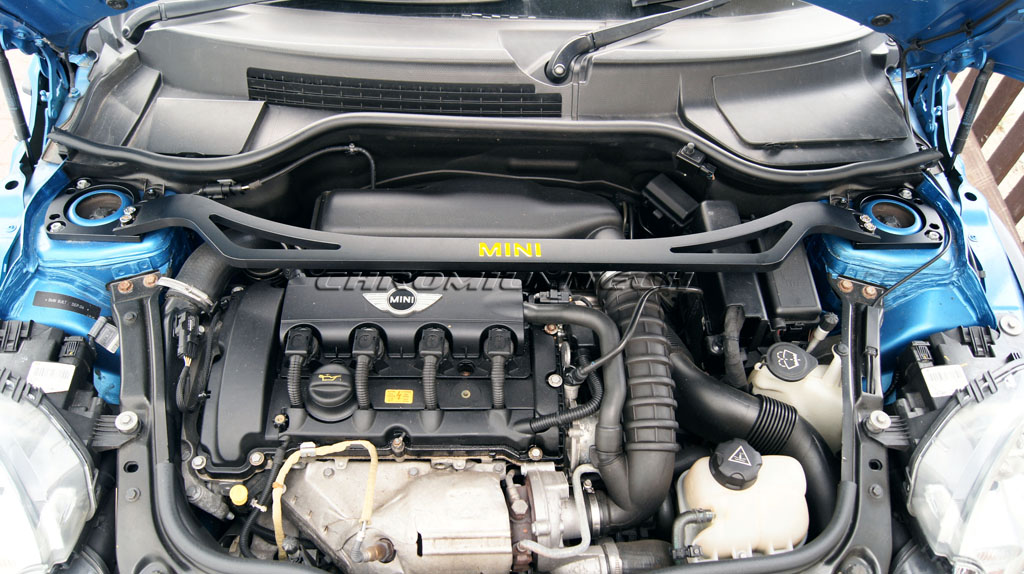
The Countryman has its firewall starting at the rear edge of the towers and then it forms a concave curve towards the rear of the car. See the photo below. So, the firewall in this case may need some stiffening "help" from a strut bar.
As an experiment, I thought of a cheap and straightforward way to check the real life response of the MINI's chassis. A simple telescoping curtain rod with an "o-ring" pressed against the joint should show movement if the towers are indeed flexing under cornering loads. The telescoping rods could be affixed to each tower and the O-ring pushed tight to the joint. Drive the car in a spirited manner, emphasizing hard cornering and then look at the O-ring afterwards. If it was pushed away from the joint, it indicates the towers have flexed towards each other. Therefore, a strut brace would be a useful addition. If the O-ring stays against the joint, the towers are inherently stiff enough and a strut brace would not help to stiffen the chassis.
It is 25 degrees and snowy here, so spirited cornering is not an immediate option. Anybody in a warmer climate wanna give this a shot??
So, I got to thinking.....uht, oh!!
LOL
Before I proceed, I want you to know that I am a structural engineer. So this is the kind of thing I think about...regularly. LOL
With all of the opinions and controversy about the potential benefits of strut braces, I thought of a great experiment to be a pseudo Mythbusters test.
Each car brand/model is different in its layout. I am specifically referring to the positioning of the strut towers RELATIVE TO the positioning of cross-car stiffening elements of the unibody. For instance, some cars have the firewall sheetmetal tied into the strut towers. This is an inherent brace and will be many times stiffer than an aftermarket strut brace could ever wish to be. Some cars, however, have the strut towers marginally ahead of the firewall. In these cases, the strut towers are not braced laterally by the unibody. In these situations, a strut brace may prove useful to hold the dimension constant between the two towers and keep the chassis geometry correct.
The Countryman has its firewall starting at the rear edge of the towers and then it forms a concave curve towards the rear of the car. See the photo below. So, the firewall in this case may need some stiffening "help" from a strut bar.
As an experiment, I thought of a cheap and straightforward way to check the real life response of the MINI's chassis. A simple telescoping curtain rod with an "o-ring" pressed against the joint should show movement if the towers are indeed flexing under cornering loads. The telescoping rods could be affixed to each tower and the O-ring pushed tight to the joint. Drive the car in a spirited manner, emphasizing hard cornering and then look at the O-ring afterwards. If it was pushed away from the joint, it indicates the towers have flexed towards each other. Therefore, a strut brace would be a useful addition. If the O-ring stays against the joint, the towers are inherently stiff enough and a strut brace would not help to stiffen the chassis.
It is 25 degrees and snowy here, so spirited cornering is not an immediate option. Anybody in a warmer climate wanna give this a shot??
Thread Starter
|
2nd Gear
Joined: Jul 2003
Posts: 82
Likes: 1
From: Central NJ
To make it clearer, here is a photoshopped image that shows the telescoping rod. Each end of the rod would need to be fastened to each tower. It would need to be a solid, unyielding, connection so as not to influence the experiment data.
The thin black line on the right is the O-ring. The dashed black line immediately to its right is the O-ring in its "presumably" deflected position.
The experiment accounts for inward flexing of the towers, but not outward. A little more thinking will allow for tweaking this setup to test for spreading of the towers as well.
The thin black line on the right is the O-ring. The dashed black line immediately to its right is the O-ring in its "presumably" deflected position.
The experiment accounts for inward flexing of the towers, but not outward. A little more thinking will allow for tweaking this setup to test for spreading of the towers as well.
Last edited by VolperCooper; Feb 20, 2014 at 11:25 AM.
6th Gear
Joined: Nov 2010
Posts: 2,466
Likes: 2
From: Savannah Georgia
I am an Air Traffic Controller/Ex-Army tank company commander (Desert Storm) and only know that I wanted my Mini to be the best it could be. I did "breathing" (in and out), "legs", and..."skeleton". The NM strut brace and WMW X-brace helps with the former. Was it REALLY needed from an engineer point of view? Who knows? I can't hurt and the red color kinda works!

OVERDRIVE
Joined: May 2005
Posts: 8,233
Likes: 128
From: San Francisco
I recall that years ago a very similar experiment was proposed for the R53. Something very simple (similar to your telescoping rod) can show the range of displacement between the shock towers. Honestly I don't remember what the result was, or whether anybody even did the experiment. Knowing how things often go on NAM, most likely it got into a heated argument about what conditions would make it a valid test, and in the end probably nothing happened.
I actually do have a very substantial strut brace on my R52, but over the years I've become skeptical that it does anything. The reason is that my (and most other) strut brace have such wimpy attachments to the strut tower. They are not bolted directly to the tower, but just secured with a few small nuts (torqued to only 25 ft lbs) onto bolts in the strut top plate. How could such a weak arrangement prevent movement (if it was happening)? I've only seen 1 or 2 braces that bolt directly to the chassis frame, and those seem more credible.
I actually do have a very substantial strut brace on my R52, but over the years I've become skeptical that it does anything. The reason is that my (and most other) strut brace have such wimpy attachments to the strut tower. They are not bolted directly to the tower, but just secured with a few small nuts (torqued to only 25 ft lbs) onto bolts in the strut top plate. How could such a weak arrangement prevent movement (if it was happening)? I've only seen 1 or 2 braces that bolt directly to the chassis frame, and those seem more credible.

Thread
Thread Starter
Forum
Replies
Last Post
patsum
R50/R53 :: Hatch Talk (2002-2006)
26
May 29, 2021 06:29 PM
M7Speed
1st Gen Countryman (R60) Talk (2010-2015)
0
Sep 4, 2015 10:47 AM
M7Speed
R58 :: Coupé Talk (2012+)
0
Sep 3, 2015 07:29 AM
M7Speed
R56 :: Hatch Talk (2007+)
0
Sep 3, 2015 07:27 AM