


Suspension Camber optical illusion?


Thread Starter
|
OVERDRIVE


Joined: Aug 2006
Posts: 7,201
Likes: 8
From: Norfolk, VA
Camber optical illusion?
Why is it that even though I have more negative camber in the front than in the rear, the rear wheels look like they're tilted so much more?
If I'm understanding correctly, the camber angle is just the angle between the vertical axis of the wheel and an invisible line perpendicular to the ground, regardless of whether it's the front or rear wheels being measured.
I'll have to double-check the specs from my last alignment, but I think I have about -1.6 degrees in the rear, and -2.3 degrees in the front, but the front wheels *look* like they're almost vertical, while the rear wheels look like something off of a 1970's baja bug!
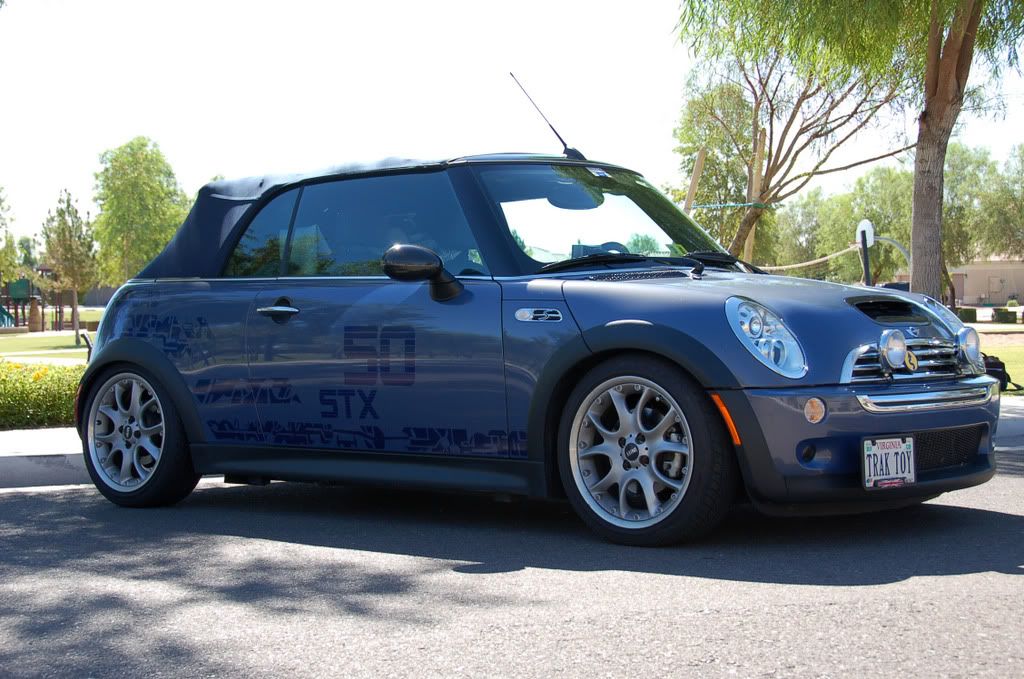
Is it just an optical illusion, or is there something different about how camber is measured depending on whether it's a front or a rear wheel?
If I'm understanding correctly, the camber angle is just the angle between the vertical axis of the wheel and an invisible line perpendicular to the ground, regardless of whether it's the front or rear wheels being measured.
I'll have to double-check the specs from my last alignment, but I think I have about -1.6 degrees in the rear, and -2.3 degrees in the front, but the front wheels *look* like they're almost vertical, while the rear wheels look like something off of a 1970's baja bug!
Is it just an optical illusion, or is there something different about how camber is measured depending on whether it's a front or a rear wheel?
Last edited by ScottRiqui; Jul 18, 2007 at 01:05 AM.


My little dose of LITHIUM
iTrader: (1)
Joined: Jul 2005
Posts: 2,435
Likes: 2
From: Albuquerque New Mexico
Looking at this photo and the other you posted on "lowered cars" thread, I'd say your rears *do* have way more camber than the fronts. You are pretty slammed, especially in the rear. Of all the possibilities, which include an optical illusion, others could be that your alignment guy lied to you (it's possible) or you have the numbers reversed.
btw, the question about camber plates is relevant. Without front camber plates you cannot achieve anything like -2.3deg. Also without adjustable control arms in the rear, you cannot get them as upright as -1.6 with the slam you have.
OK, ignore the last sentence...
Dont know what to tell you now! btw, what suspension allows you to get so low? Is there still travel in the shocks?
btw, the question about camber plates is relevant. Without front camber plates you cannot achieve anything like -2.3deg. Also without adjustable control arms in the rear, you cannot get them as upright as -1.6 with the slam you have.
OK, ignore the last sentence...
Dont know what to tell you now! btw, what suspension allows you to get so low? Is there still travel in the shocks?
Thread Starter
|
OVERDRIVE
Joined: Aug 2006
Posts: 7,201
Likes: 8
From: Norfolk, VA
They're the JIC/Cross coilovers. Both the front and rear are height-adjustable without having to adjust preload, so I still have full suspension travel at all four corners.
Perhaps I shouldn't have used my own car for this thread, since mine is an extreme example. But even on bone-stock cars, the rears always seem canted in more than the front, and I thought even the factory settings had a little more negative camber in the fronts.
Perhaps I shouldn't have used my own car for this thread, since mine is an extreme example. But even on bone-stock cars, the rears always seem canted in more than the front, and I thought even the factory settings had a little more negative camber in the fronts.

6th Gear
Joined: Jun 2003
Posts: 3,589
Likes: 2
From: Oregon, USA
Trending Topics


3rd Gear
Joined: Sep 2004
Posts: 297
Likes: 0
From: San Diego
My two cents
First off to prove to yourself the front & rear are different use a carpenter's square.. Set one edge on the ground with the other edge creating that vertical reference line.. Then you can use your fingers (or a ruler if you want to get high tech) and check the distance to the top of the rim to the vertical edge.. The bigger the gap from the vertical edge the more negative camber on that wheel..
Second I think there is optical tricks happening here.. the front wheels have a higher arch then the back (espically on your picture above). With the rear arch so close to the tire.. one has the guess the tire is more pushed in..
Either way, that *looks* great.. and if it corners great too... Then it is perfect..
Just my 2 cents
Second I think there is optical tricks happening here.. the front wheels have a higher arch then the back (espically on your picture above). With the rear arch so close to the tire.. one has the guess the tire is more pushed in..
Either way, that *looks* great.. and if it corners great too... Then it is perfect..
Just my 2 cents

OVERDRIVE - Racing Champion

Joined: Feb 2003
Posts: 15,262
Likes: 72
From: Mililani, Hawaii
For Stock MINIs the rear camber is more negative yes.
Front is about -0.5 and rear about -1.0 to -1.5
For your MINI with coilovers and aggressive alignment,
Your settings are probably corrent but there is an optical illusion happening.
First your alignment is done with weight in the front seat or seats to simulate the load so the reading is done under load and if there are no persons in your car at the time of the photograph then that is missing.
Second, the position of the wheels in each wheel well is different front to rear. Ride height can be different or not, you can measure it using the top of the wheel arch as a guide comparing front to rear.
Each wheel has it's position in the wheel well relative to the hub and I find that the rear wheel sits slightly closer to the outer edge while the front wheel lies slightly inside relative to the fender and arch so clearance is a little tight in the rear with a lowering MINI.
I have coilovers and similar camber settings on my MINI and it looks like I don't have the -2.4 degrees in the front I ordered. It's there, look at your inner front tire treadwear. If with heavy cornering you use the tires evenly on the fronts then you have lots of front camber. If you wear out the outer front edges rapidly then you probably don't have that much camber.
Front is about -0.5 and rear about -1.0 to -1.5
For your MINI with coilovers and aggressive alignment,
Your settings are probably corrent but there is an optical illusion happening.
First your alignment is done with weight in the front seat or seats to simulate the load so the reading is done under load and if there are no persons in your car at the time of the photograph then that is missing.
Second, the position of the wheels in each wheel well is different front to rear. Ride height can be different or not, you can measure it using the top of the wheel arch as a guide comparing front to rear.
Each wheel has it's position in the wheel well relative to the hub and I find that the rear wheel sits slightly closer to the outer edge while the front wheel lies slightly inside relative to the fender and arch so clearance is a little tight in the rear with a lowering MINI.
I have coilovers and similar camber settings on my MINI and it looks like I don't have the -2.4 degrees in the front I ordered. It's there, look at your inner front tire treadwear. If with heavy cornering you use the tires evenly on the fronts then you have lots of front camber. If you wear out the outer front edges rapidly then you probably don't have that much camber.

5th Gear
Joined: Nov 2003
Posts: 628
Likes: 0
From: Indianapolis
One more option, though probably unlikely. I had an early set of adjustable rear control arms, and the jamb nuts on the turnbuckle adjustment wouldn't stay tight. Over time, they would adjust themselves resulting in dramatically more rear camber. It was pretty spooky, as one of the tires got enough negative camber to make contact with the inner fender liner and rub a hole through it. I don't want to think about how much camber that was.
Scott
90SM
Scott
90SM

Thread
Thread Starter
Forum
Replies
Last Post
fkrowland
R50/R53 :: Hatch Talk (2002-2006)
5
Sep 30, 2015 10:30 AM