


R50/53 How often to change oil...anyone had their oil tested at 5K and 10K miles?


1st Gear
Joined: Mar 2012
Posts: 24
Likes: 0
From: Delanco, N.J.08075
OIL CHANGES- How often & How Much
I would just like to know how often most of you change your oil. Do all of you use their Synthetic ? How much does your dealer charge and does anyone have the oil changed at other places ?
Motogordo
I just saw a posting from Mini and they changed the oil changes from 15K to 10K on my 2007 Mini CooperS (Supercharged)
Motogordo
I just saw a posting from Mini and they changed the oil changes from 15K to 10K on my 2007 Mini CooperS (Supercharged)
Last edited by Motogordo; Jan 18, 2014 at 09:39 AM.

5th Gear

Joined: Jun 2009
Posts: 676
Likes: 36
From: West Seattle
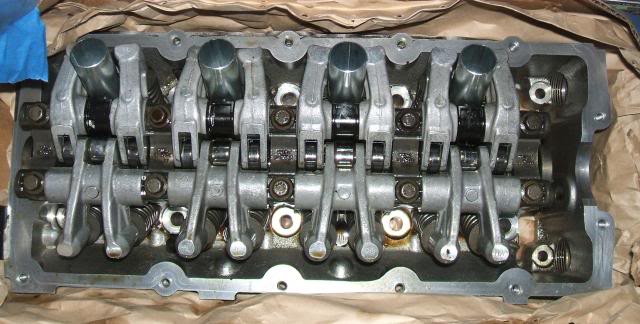
Both my wife and I have early R50's. We bought them used, both with about 50k on them. Mine now has 130k on it, hers 103k. I do the oil changes and follow the in-dash service thing, so it's about 15k between changes. I always use MINI oil, MOBIL1 or AMSOIL that meets the BMW LL-01 specs, meaning that it's specified for long life usage. Not all synthetics are rated for long life usage. Had to remove the head on her car last month to do a valve job. One of the exhaust valves was burnt and the exhaust guides were replaced as well. I do not believe this was a result of extended oil change intervals. The inside of her cylinder head was clean as a whistle, no sludge or residue buildup was seen.
Standby for others on here to tell me I'm crazy for going so long between oil changes. I am simply following the manufacturers recommendations and doing so with oil that meets their specifications.
Here is a pictures of the top side of the freshly removed head:
Val
Standby for others on here to tell me I'm crazy for going so long between oil changes. I am simply following the manufacturers recommendations and doing so with oil that meets their specifications.
Here is a pictures of the top side of the freshly removed head:

Val

Alliance Member


Joined: Apr 2003
Posts: 4,101
Likes: 230
From: York, Pennsylvania
I change oil and filter about every 7500 miles, both when the dash shows oil or inspection due,
and again 1/2 way until the next time it's due. Usually use Mobil 1 0W40 Euro forumula, although
I have used MINI 5W30 and Amsoil 5W30 Euro a few times in the past.
and again 1/2 way until the next time it's due. Usually use Mobil 1 0W40 Euro forumula, although
I have used MINI 5W30 and Amsoil 5W30 Euro a few times in the past.

6th Gear
Joined: Feb 2008
Posts: 2,358
Likes: 1
From: Graham, NC
I run intervals of anywhere between 12k - 20k depending on oil and usage. I've run the MINI oil, Royal Purple, Pennzoil and Mobil1. Currently running the Mobil1 as I have a leak and need to keep topping off regularly and Mobil1 is the easiest to get around here. If I get the leak fixed I plan to switch back to the Pennzoil.

6th Gear
Joined: Jul 2006
Posts: 1,604
Likes: 2
From: Over at the other site
+1 changing the oil between 5,000 and 7,000 has been my schedule.

1st Gear
Joined: Nov 2012
Posts: 44
Likes: 0
7500 for me. I also change the oil myself, although I got the oil changed by a local speedy lube type place last time. Some of these establishments will do a Mini, some won't-Valvoline will not here. I use Mann filters and Federated Synthetic.

6th Gear
Joined: Jul 2002
Posts: 2,228
Likes: 28
From: Bishop, Ca
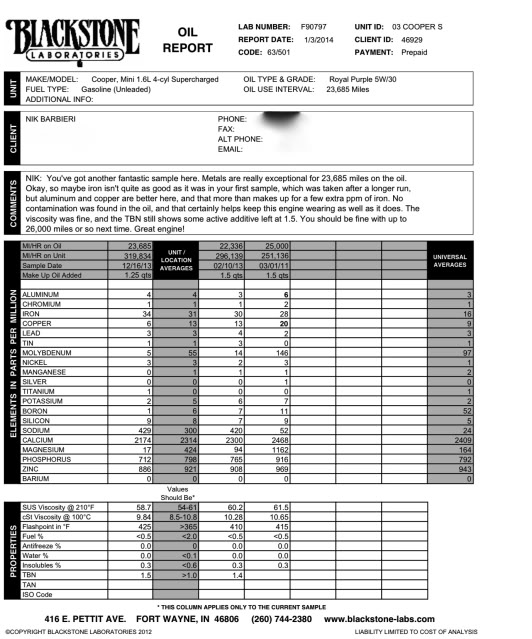
I've followed the OBC recommended change interval since I bought my Mini in 2002. The intervals seem to vary some, but usually between 20,000 and 24,000 miles. Currently have a little over 322,000 miles on the engine. Have had both the oil pan and valve cover off in the past, and everything looks like new.
Here is my latest oil analysis.
Nik
Here is my latest oil analysis.
Nik
1st Gear
Joined: Nov 2012
Posts: 44
Likes: 0
I would never go that many miles between changes-Just Me!
I've followed the OBC recommended change interval since I bought my Mini in 2002. The intervals seem to vary some, but usually between 20,000 and 24,000 miles. Currently have a little over 322,000 miles on the engine. Have had both the oil pan and valve cover off in the past, and everything looks like new.
Here is my latest oil analysis.

Nik
Here is my latest oil analysis.
Nik
6th Gear
Joined: Oct 2008
Posts: 4,965
Likes: 393
From: In the here and now, for now.
Every time the last three digits on the odometer turn into 0's with a 5 or 0 in front of them, the oil and filter gets changed and the tires get rotated. Every 6 months the fuel tank gets a dose of BG-44K. I let the local indie guru take care of that. I had bad dreams about cross threading the filter can and decided I need a good night's sleep worse. Besides, he gives the li'l guy a thorough 'turn your head and cough' inspection while he has it on the rack.

I'm changing my 10 MCS every 6-8k... 90% of my driving is highway for now, so there is lots and lots of runs at 60-65mph... tires will be rotated regularly now at Costco, as my dealer refused to do so ("we don't rotate as our alignment is aggressive and we can't guarantee equal wear")... honestly, I must have looked stupid with my mouth agape when he said that... oh, the dealer oil change set me back about $85...

5th Gear
Joined: Dec 2010
Posts: 706
Likes: 10
From: Hilliard, Ohio
While there has been a lot of debate on this topic over the years we do know now that MINI has dropped the change interval from 15k to 10k. So, we can see that some things are not carved in stone.
Personally, I think a more important maintenance habit would be checking the oil level. Many of these cars consume oil. So going 10k-15k between changes and never pulling the dipstick could just about toast your motor if you are losing 1 qt of oil to consumption per every 3000 miles then you could b 3 qts low on a 4.4 qt system in 10k miles. So if you are having to add a qt to make it to your next oil change is that cheaper than changing all the oil more often?
Even the good folks at Bentley manuals say that oil consumption is the norm not the oddity.
From Bentley Publishers wiki on R56
Dealing with Engine Oil Consumption
Modern engines can consume up to 0.63 US quart (0.6 liter) within 1000 miles (1600 km) of driving. Make a habit of checking you engine oil regularly, for example; each time you refill your fuel tank. An engine run low on oil can create additional stress on mechanical components, resulting in engine failure.
MINI recommends using: MINI Long Life engine oil. Check with your local MINI dealer for latest specification.
Technical Information on Oil Consumption
What does engine oil do?
Engine oil is one of the most important operating fluids in a combustion engine. Without engine oil, the engine cannot operate correctly. The principal functions of the engine oil are:
Lubrication
Cooling
Prevention of corrosion and sediment
Lubrication
The engine oil / lubricating film is subject to varying requirements. The engine oil must not have excessively high viscosity at low temperatures to guarantee optimum lubrication even when the engine is cold (cold start). On the other hand, the engine oil must not be too thin at high temperatures as this could cause have a negative effect on the lubricating film, even canceling the lubricating effect altogether.
The engine oil's most important job is to minimize friction between metallic surfaces. This is realized by a lubricating film that forms between the surfaces of moving engine parts while the engine is running. The thin film of oil greatly reduces friction, leading to reduced wear and less heat generation. Besides preventing pistons from seizing and bearings from being damaged, the service life of all engine parts involved is increased and fuel consumption is reduced.
Another function of the oil film is to seal the combustion chamber from the crankcase via the piston rings.
Cooling
The pistons reach their normal operating temperature just a few moments after the engine is started. Depending on the ambient temperature, engine configuration and driving style, it may take a few minutes until the engine block, and so the cylinder walls, to reach optimum operating temperature. To prevent the engine from exceeding the operating temperature, it needs a properly functioning cooling system. The engine oil is frequently underestimated or overlooked as an important cooling element, alongside air and coolant water. Yet the engine oil is responsible for a large degree of cooling inside the engine. To cool the piston crowns directly, nearly all MINI engines are equipped with oil spray jets that moisten the piston crowns with engine oil.
Prevention of corrosion and sediment
Not least, the engine oil has the job of protecting the engine against corrosion and sediment. Aggressive combustion residue is neutralized by the lubrication oil and appropriate additives. Other combustion residue is conveyed in the oil circuit to the oil filter where it is filtered out, or it deposits in the oil sump.
Engine oil consumption
Engine oil consumption is determined above all by the configuration of the individual construction groups and systems. It is system characteristic that every combustion engine consumes lubricating oil. The principal causes of this engine oil consumption are:
Pistons with piston rings
Valve stem seals
Crankcase ventilation
The surface topography of the cylinder liners and piston rings is the primary variable that directly influences engine oil consumption, as the piston rings do not provide perfect sealing, but rather form a metering mechanism. In the configuration, there is a conflict of interests between engine oil consumption and friction reduction. The latter has a direct effect on power output and fuel consumption. With every stroke of the piston, minimal quantities of engine oil remain on the cylinder walls. These are indispensable for lubricating the piston rings (see lubricating film above). As the piston moves downwards, the engine oil on the cylinder wall is plays a role in combustion close to the walls and is then expelled along with the combustion exhaust gases. The higher the engine speed, the greater the effect, because there are more combustion cycles for each time unit. For this reason, engines with a high-speed concept tend to have higher engine oil consumption than other engines. The same applies to the lubricating film on the valve stems.
The measurable result in engine oil consumption is primarily influenced by the quality of the fuel used and the driving profile. For example, if in the winter you drive a lot for short distances (= high fuel entrainment as the evaporation temperature is mostly only reached briefly) and then a long distance (fuel can then evaporate readily), this journey will cause a considerable drop in engine oil level. This is not engine oil consumption, but rather a change in engine oil level caused by the fuel content in the engine oil. Customer complaints are often the result of this effect. It can happen that the engine oil level drops by more than 1.05 US quart (1 liter) after driving just a few hundred miles (kilometers). Moreover, the measuring system on some engines (dipstick / QLT) have a tolerance of up to 0.31 US quart (0.3 liters).
But evaporated particles of oil also escape through the crankcase ventilation (expulsion level technically never 100 %) and plays a role in combustion with the intake air. Configuration is especially difficult here. On the one hand, the engine oil should be expelled as completely as possible. On the other hand, crankcase pressure requirements must be satisfied. Other expulsion systems only work optimally with a certain gas throughput, the expulsion effect deteriorating with greater or lesser gas volumes.
Summary
It is a technical necessity that very combustion engine consumes engine oil. The level of the engine oil consumption is greatly influenced by driving style and by the fuel used.
Measuring oil consumption
Oil consumption rate of an engine can only be determined by the by the amount of engine oil needed to top up.
Engine oil is added as soon as the level drops below the max. mark on the dipstick, regardless of certain fundamental rules such as horizontal vehicle position, drain time etc. This can easily cause the level to become too high due to the size of the container which happens to be available.
Excess engine oil can damage the engine and is consumed more quickly due to the splash effect.
For this reason, allow the engine oil level to drop as far as the min. mark before adding the required topping up quantity, (only when checking engine oil consumption amount).
The difference between the two marks corresponds to about 1.05 - 1.6 US quarts (1.0 - 1.5 liters).
Personally, I think a more important maintenance habit would be checking the oil level. Many of these cars consume oil. So going 10k-15k between changes and never pulling the dipstick could just about toast your motor if you are losing 1 qt of oil to consumption per every 3000 miles then you could b 3 qts low on a 4.4 qt system in 10k miles. So if you are having to add a qt to make it to your next oil change is that cheaper than changing all the oil more often?
Even the good folks at Bentley manuals say that oil consumption is the norm not the oddity.
From Bentley Publishers wiki on R56
Dealing with Engine Oil Consumption
Modern engines can consume up to 0.63 US quart (0.6 liter) within 1000 miles (1600 km) of driving. Make a habit of checking you engine oil regularly, for example; each time you refill your fuel tank. An engine run low on oil can create additional stress on mechanical components, resulting in engine failure.
MINI recommends using: MINI Long Life engine oil. Check with your local MINI dealer for latest specification.
Technical Information on Oil Consumption
What does engine oil do?
Engine oil is one of the most important operating fluids in a combustion engine. Without engine oil, the engine cannot operate correctly. The principal functions of the engine oil are:
Lubrication
Cooling
Prevention of corrosion and sediment
Lubrication
The engine oil / lubricating film is subject to varying requirements. The engine oil must not have excessively high viscosity at low temperatures to guarantee optimum lubrication even when the engine is cold (cold start). On the other hand, the engine oil must not be too thin at high temperatures as this could cause have a negative effect on the lubricating film, even canceling the lubricating effect altogether.
The engine oil's most important job is to minimize friction between metallic surfaces. This is realized by a lubricating film that forms between the surfaces of moving engine parts while the engine is running. The thin film of oil greatly reduces friction, leading to reduced wear and less heat generation. Besides preventing pistons from seizing and bearings from being damaged, the service life of all engine parts involved is increased and fuel consumption is reduced.
Another function of the oil film is to seal the combustion chamber from the crankcase via the piston rings.
Cooling
The pistons reach their normal operating temperature just a few moments after the engine is started. Depending on the ambient temperature, engine configuration and driving style, it may take a few minutes until the engine block, and so the cylinder walls, to reach optimum operating temperature. To prevent the engine from exceeding the operating temperature, it needs a properly functioning cooling system. The engine oil is frequently underestimated or overlooked as an important cooling element, alongside air and coolant water. Yet the engine oil is responsible for a large degree of cooling inside the engine. To cool the piston crowns directly, nearly all MINI engines are equipped with oil spray jets that moisten the piston crowns with engine oil.
Prevention of corrosion and sediment
Not least, the engine oil has the job of protecting the engine against corrosion and sediment. Aggressive combustion residue is neutralized by the lubrication oil and appropriate additives. Other combustion residue is conveyed in the oil circuit to the oil filter where it is filtered out, or it deposits in the oil sump.
Engine oil consumption
Engine oil consumption is determined above all by the configuration of the individual construction groups and systems. It is system characteristic that every combustion engine consumes lubricating oil. The principal causes of this engine oil consumption are:
Pistons with piston rings
Valve stem seals
Crankcase ventilation
The surface topography of the cylinder liners and piston rings is the primary variable that directly influences engine oil consumption, as the piston rings do not provide perfect sealing, but rather form a metering mechanism. In the configuration, there is a conflict of interests between engine oil consumption and friction reduction. The latter has a direct effect on power output and fuel consumption. With every stroke of the piston, minimal quantities of engine oil remain on the cylinder walls. These are indispensable for lubricating the piston rings (see lubricating film above). As the piston moves downwards, the engine oil on the cylinder wall is plays a role in combustion close to the walls and is then expelled along with the combustion exhaust gases. The higher the engine speed, the greater the effect, because there are more combustion cycles for each time unit. For this reason, engines with a high-speed concept tend to have higher engine oil consumption than other engines. The same applies to the lubricating film on the valve stems.
The measurable result in engine oil consumption is primarily influenced by the quality of the fuel used and the driving profile. For example, if in the winter you drive a lot for short distances (= high fuel entrainment as the evaporation temperature is mostly only reached briefly) and then a long distance (fuel can then evaporate readily), this journey will cause a considerable drop in engine oil level. This is not engine oil consumption, but rather a change in engine oil level caused by the fuel content in the engine oil. Customer complaints are often the result of this effect. It can happen that the engine oil level drops by more than 1.05 US quart (1 liter) after driving just a few hundred miles (kilometers). Moreover, the measuring system on some engines (dipstick / QLT) have a tolerance of up to 0.31 US quart (0.3 liters).
But evaporated particles of oil also escape through the crankcase ventilation (expulsion level technically never 100 %) and plays a role in combustion with the intake air. Configuration is especially difficult here. On the one hand, the engine oil should be expelled as completely as possible. On the other hand, crankcase pressure requirements must be satisfied. Other expulsion systems only work optimally with a certain gas throughput, the expulsion effect deteriorating with greater or lesser gas volumes.
Summary
It is a technical necessity that very combustion engine consumes engine oil. The level of the engine oil consumption is greatly influenced by driving style and by the fuel used.
Measuring oil consumption
Oil consumption rate of an engine can only be determined by the by the amount of engine oil needed to top up.
Engine oil is added as soon as the level drops below the max. mark on the dipstick, regardless of certain fundamental rules such as horizontal vehicle position, drain time etc. This can easily cause the level to become too high due to the size of the container which happens to be available.
Excess engine oil can damage the engine and is consumed more quickly due to the splash effect.
For this reason, allow the engine oil level to drop as far as the min. mark before adding the required topping up quantity, (only when checking engine oil consumption amount).
The difference between the two marks corresponds to about 1.05 - 1.6 US quarts (1.0 - 1.5 liters).


1st Gear
Joined: Mar 2013
Posts: 43
Likes: 1
From: Long Beach, CA
I either take it in for service or do it myself every 5k, sometimes a little longer if my service light is showing <1k due. My dad had a box of Shell Helix Ultra 5W-40 that I've been working my way through (same as Pennzoil Ultra Euro) but I recently used that up, so last week was my first switch to Mobil 1 0W-40 (5 qts at Walmart, $25). And I bought a few OEM Purflux filters off of eBay a while back, like $14 for two.
My dealership charges $60, which is what my grandmother would call "quite dear" (though not too bad, I suppose) but I'm happy to do it myself. And it's pretty easy.
The only thing that worries me is, according to the service record, the previous owner waited until 20k miles to get their first oil change. I have a feeling it was one of those people who only bought a MINI for the way it looked
My dealership charges $60, which is what my grandmother would call "quite dear" (though not too bad, I suppose) but I'm happy to do it myself. And it's pretty easy.
The only thing that worries me is, according to the service record, the previous owner waited until 20k miles to get their first oil change. I have a feeling it was one of those people who only bought a MINI for the way it looked
Last edited by speedbird_1; Jan 20, 2014 at 07:28 PM.

5th Gear
Joined: Oct 2012
Posts: 999
Likes: 10
From: Nunavut
[QUOTE=05r50;3869326]While there has been a lot of debate on this topic over the years we do know now that MINI has dropped the change interval from 15k to 10k. So, we can see that some things are not carved in stone.
Personally, I think a more important maintenance habit would be checking the oil level. Many of these cars consume oil. So going 10k-15k between changes and never pulling the dipstick could just about toast your motor if you are losing 1 qt of oil to consumption per every 3000 miles then you could b 3 qts low on a 4.4 qt system in 10k miles. So if you are having to add a qt to make it to your next oil change is that cheaper than changing all the oil more often?
Even the good folks at Bentley manuals say that oil consumption is the norm not the oddity.
/QUOTE]
Very good points made here ^^^.
Personally, I think a more important maintenance habit would be checking the oil level. Many of these cars consume oil. So going 10k-15k between changes and never pulling the dipstick could just about toast your motor if you are losing 1 qt of oil to consumption per every 3000 miles then you could b 3 qts low on a 4.4 qt system in 10k miles. So if you are having to add a qt to make it to your next oil change is that cheaper than changing all the oil more often?
Even the good folks at Bentley manuals say that oil consumption is the norm not the oddity.
/QUOTE]
Very good points made here ^^^.

4th Gear

Joined: Apr 2013
Posts: 377
Likes: 15
From: Salem County, NJ, USA
My '13 MCS has 7500 miles on it and has used about 1/2 quart of oil so far. I'm planning to change the oil at 8k -- was a little concerned about the amount of gray sludge I found inside the filler cap.

6th Gear
Joined: Apr 2013
Posts: 1,894
Likes: 8
From: Philly PA
It's been pretty cold here in NJ!

Thread
Thread Starter
Forum
Replies
Last Post
Kimolaoha
R56 :: Hatch Talk (2007+)
70
Jul 5, 2023 01:04 PM