


R56 Torque?


Thread Starter
|
5th Gear
Joined: Oct 2005
Posts: 717
Likes: 0
From: Seattle, WA
Torque?
I'm looking all over for any facts and/or predictions on torque values for the new MCT. Something like 160lbft @ 3000rpm.. ?
Feel free to linky and slap me in the face if I've missed something obvious somewhere.
The reason I ask is because everything seems to talk over and over about horsepower. Well, that's great, but it doesn't give me that start-off-the-line-in-a-go-kart feel. Since the new engine is a turbo, i would expect greater torque even without much bump in horsepower (168 vs 170) and with minimizing turbo lag (twin scroll) perhaps max torque (or near max torque) can be made at a reasonable RPM (rather than the current MCS's 4000rpm).
Any thoughts?
Feel free to linky and slap me in the face if I've missed something obvious somewhere.
The reason I ask is because everything seems to talk over and over about horsepower. Well, that's great, but it doesn't give me that start-off-the-line-in-a-go-kart feel. Since the new engine is a turbo, i would expect greater torque even without much bump in horsepower (168 vs 170) and with minimizing turbo lag (twin scroll) perhaps max torque (or near max torque) can be made at a reasonable RPM (rather than the current MCS's 4000rpm).
Any thoughts?

According to MotoringFile here
http://www.motoringfile.com/2004/12/...ange_in_detail
"The turbocharged fuel injection power unit combines the torque curve of a diesel with the benefits of a modern reciprocating-piston engine. Maximum torque of 240 Nm or 177 lb-ft comes at just 1,400 rpm, remaining virtually unchanged all the way to 4,000 rpm."
And this is for the 143 HP ??? variant
"Together with its maximum output of 105 kW/143 bhp at 5,500 rpm, this engine guarantees sporting performance wherever you go."
But the "S" will actually have 170 HP?? - So we shall see......
http://www.motoringfile.com/2004/12/...ange_in_detail
"The turbocharged fuel injection power unit combines the torque curve of a diesel with the benefits of a modern reciprocating-piston engine. Maximum torque of 240 Nm or 177 lb-ft comes at just 1,400 rpm, remaining virtually unchanged all the way to 4,000 rpm."
And this is for the 143 HP ??? variant
"Together with its maximum output of 105 kW/143 bhp at 5,500 rpm, this engine guarantees sporting performance wherever you go."
But the "S" will actually have 170 HP?? - So we shall see......

6th Gear
Joined: Jan 2003
Posts: 2,319
Likes: 94
From: Tsunami Zone
I thought the Cooper was getting the normally aspirated version of the new motor:
The above more motor matches the horsepower rating of the current motor. Having the Cooper at 143 hp and the "S" at 170 hp doesn't leave much of a "power difference" between the two 
With its compression ratio of 11:1, the naturally aspirated power unit develops maximum output of 85 kW/115 bhp at 5,700 rpm and revs up to a maximum speed of 6,500 rpm. Engine displacement of this four-cylinder is 1.6 litres, with torque reaching 140 Nm or 103 lb-ft at just 2,000 rpm and peaking at 160 Nm/118 lb-ft at 4,250 rpm.
Thread Starter
|
5th Gear
Joined: Oct 2005
Posts: 717
Likes: 0
From: Seattle, WA
Yeah, the 140hp is the "less" turboed version, but BMW is apparently going to use the NA 115 for that exact reason (greater difference from the "S"). Probably the Europeans will get 17 different engine versions with multiple flavors to boot! 
Anyway, that's frickin AWESOME news! MORE torque than HP *AND* it all starts at 1500 RPM *AND* that's for the 140hp variant. Probably that translates into somewhere near 200lbft for the MCT....
*very excited*
Anyway, that's frickin AWESOME news! MORE torque than HP *AND* it all starts at 1500 RPM *AND* that's for the 140hp variant. Probably that translates into somewhere near 200lbft for the MCT....
*very excited*

4th Gear
Joined: Aug 2005
Posts: 409
Likes: 1
From: Festus, MO
I would expect then with the 07 possibly a lighter vehicle with this nice increase in torque a potentially quicker Mini then the current super-charged version and bette fuel economy too. This is looking better all the time with more info coming out on the new engine.

4th Gear
Joined: Aug 2005
Posts: 305
Likes: 0
From: Rochester, MN
Why does a turbocharged engine make more torque than a supercharged engine? Is it because you have to subtract the torque required to drive the supercharger from the total crankshaft torque, where in a turbocharged engine the entire crankshaft torque is available?
Trending Topics

6th Gear
Joined: Oct 2002
Posts: 3,652
Likes: 6
From: Lansdale, PA
Typically, OEM turbos are sized small to reduce lag and provide plenty of low-rpm acceleration. With a supercharger, the faster you spin the engine, the faster the supercharger spins. Here's how different the stock boost curves of a VW 1.8T and the '03 MCS look:

Thread Starter
|
5th Gear
Joined: Oct 2005
Posts: 717
Likes: 0
From: Seattle, WA
Originally Posted by andy@ross-tech.com
Here's how different the stock boost curves of a VW 1.8T and the '03 MCS look:
And this is why the GTI feels more like a "kick in the pants" compared to a MCS. Although the continued pull of the sc can be fun if you rev it way out.
To me, there's plusses and minuses to both. But if I had to sacrifice one for the other, I'd choose low-end POW over gradual build. It's just fun
 (but i'd still buy a mini over a gti!!)

4th Gear
Joined: Nov 2005
Posts: 350
Likes: 2
From: MA
Hmmm... wheres this notion of less weight coming from. The talk in the above link puts the new engine slightly heavier than the current one and I thought the new car was being stretched in size in several dimensions. I'd be very happily surprised if the next MINI shed any pounds over the current one, but I haven't run across anything yet that suggests that the case. 

6th Gear
Joined: Nov 2005
Posts: 1,245
Likes: 0
From: Shasta, CA
Torque, HP,a nd BMEP
The term BMEP is an engineering term that means Brake Mean Effective Pressure. Mean is another word for average, which in this case means average effective pressure of all stroke cycles. This is used to evaluate all engines whether they are Two or Four Cycle.
BMEP is a function of temperature of the gases in the cylinder. To increase the temperature you need to burn more fuel, thus making more heat. Or another way is to make better use of the existing fuel.
Torque is a function of BMEP and displacement only. HP is a function of torque and rpm.
It can be said a high BMEP and a low rpm, or a low BMEP and a high rpm, can equal the same power. Larger valves, ports, pipes, compression, etc. all come into play to increase the volumetric efficiency of the engine. The most effective is to increase the number of cylinders. The more efficient it is, the higher the average pressure or BMEP.
Pressure increases by compression alone can do wonders to a stock engine, it is, by factory choice, usually a low number. Note that after compression gets very high it starts to work against you in pumping losses, and in the amount of heat lost to the surrounding parts.
Four Cycle:...BMEP = ( HP * 13000 ) / ( L * RPM ) = Displacement in Liters
Brake Mean Effective Pressure (BMEP) is a common yardstick for comparing the performance of one engine to another and for evaluating the reasonableness of performance claims. The definition of BMEP is: the average (mean) pressure which, if imposed on the pistons evenly during each power stroke, would produce the measured (brake) power output. Note that BMEP is purely theoretical and has little to do with actual cylinder pressures. It is simply an effective comparison tool.
If you work through the numbers, you find that BMEP is simply a multiple of the torque per cubic inch of displacement. In fact, a BMEP of 150.8 psi is equivalent to 1.0 ft-lb of torque per cubic inch of displacement. So a very practical way to calculate BMEP is:
This tool is extremely handy to evaluate the performance which is claimed for any particular engine. For example, the 200 HP IO-360 and 300 HP IO-540 Lycomings operate at a BMEP of about 163 psi. (1.08 lb-ft of torque per cubic inch) at peak power and slightly more at peak torque. That is a respectable figure.
For contemporary naturally-aspirated, gasoline-fueled, two-valve-per-cylinder, pushrod engine technology, BMEP's over 200 PSI are quite difficult to achieve and require a serious development program and very specialized components.
The upper end of the normally-aspirated BMEP spectrum is shown by a couple of race engines that have been tested.
One was a 358 cubic inch circle track motor (pushrod V8) which made 531 lb-ft of torque at 6400 RPM (647 HP) and 503 lb-ft of torque at 7600 RPM (729 HP). Those data points represent BMEP figures of 223.5 at peak torque and 211.4 at peak power. Those numbers are truly excellent, and require very-highly developed components.
One of the that has been seen was a 268 cubic inch drag-race motor (pushrod V8) which made 413 lb-ft of torque at 7800 RPM (613 HP) and 372 lb-ft of torque at 9200 RPM (652 HP) for BMEP figures of 232.7 at peak torque and 209.6 at peak power. The 232.7 number is astonishing at any RPM, and the 209.6 figure at 9200 RPM is nothing short of phenomenal for a two-valve pushrod engine.
To appreciate the value of this tool, suppose someone offers to sell you a 2.8 liter (171 cu.in.) Ford V6 which allegedly makes 230 HP at 5000 RPM, and is equipped with the standard iron heads and an aftermarket intake manifold and camshaft. You would evaluate the reasonableness of this claim by calculating that 230 HP at 5000 RPM requires 242 lb-ft of torque (230 x 5252 ÷ 5000), and that 242 lb-ft of torque from 171 cubic inches requires a BMEP of 213 PSI (151 x 242 ÷ 171).
You would then dismiss the claim as preposterous because you know that if a guy could do the magic required to make that kind of performance with the stock heads and intake design, he would be renowned as one of the preeminent engine gurus in the world.
As a matter of fact, in order to get a BMEP value of 214 from an aircraft V8, it needed to use extremely well developed, high-flowing, high velocity heads, a specially-developed tuned intake and fuel injection system, very well developed cam profiles and valve train components, and a host of very specialized components which we designed and manufactured.
You can use these formulas on your Mini engine and see where you stack up.
BMEP is a function of temperature of the gases in the cylinder. To increase the temperature you need to burn more fuel, thus making more heat. Or another way is to make better use of the existing fuel.
Torque is a function of BMEP and displacement only. HP is a function of torque and rpm.
It can be said a high BMEP and a low rpm, or a low BMEP and a high rpm, can equal the same power. Larger valves, ports, pipes, compression, etc. all come into play to increase the volumetric efficiency of the engine. The most effective is to increase the number of cylinders. The more efficient it is, the higher the average pressure or BMEP.
Pressure increases by compression alone can do wonders to a stock engine, it is, by factory choice, usually a low number. Note that after compression gets very high it starts to work against you in pumping losses, and in the amount of heat lost to the surrounding parts.
Four Cycle:...BMEP = ( HP * 13000 ) / ( L * RPM ) = Displacement in Liters
i.e. :.. 80cc would be .08 Liters
500cc would be .5 Liters
1 cu.in. = 16.39 cc
500cc would be .5 Liters
1 cu.in. = 16.39 cc
Brake Mean Effective Pressure (BMEP) is a common yardstick for comparing the performance of one engine to another and for evaluating the reasonableness of performance claims. The definition of BMEP is: the average (mean) pressure which, if imposed on the pistons evenly during each power stroke, would produce the measured (brake) power output. Note that BMEP is purely theoretical and has little to do with actual cylinder pressures. It is simply an effective comparison tool.
If you work through the numbers, you find that BMEP is simply a multiple of the torque per cubic inch of displacement. In fact, a BMEP of 150.8 psi is equivalent to 1.0 ft-lb of torque per cubic inch of displacement. So a very practical way to calculate BMEP is:
BMEP = 150.8 x TORQUE ÷ DISPLACEMENT
This tool is extremely handy to evaluate the performance which is claimed for any particular engine. For example, the 200 HP IO-360 and 300 HP IO-540 Lycomings operate at a BMEP of about 163 psi. (1.08 lb-ft of torque per cubic inch) at peak power and slightly more at peak torque. That is a respectable figure.
For contemporary naturally-aspirated, gasoline-fueled, two-valve-per-cylinder, pushrod engine technology, BMEP's over 200 PSI are quite difficult to achieve and require a serious development program and very specialized components.
The upper end of the normally-aspirated BMEP spectrum is shown by a couple of race engines that have been tested.
One was a 358 cubic inch circle track motor (pushrod V8) which made 531 lb-ft of torque at 6400 RPM (647 HP) and 503 lb-ft of torque at 7600 RPM (729 HP). Those data points represent BMEP figures of 223.5 at peak torque and 211.4 at peak power. Those numbers are truly excellent, and require very-highly developed components.
One of the that has been seen was a 268 cubic inch drag-race motor (pushrod V8) which made 413 lb-ft of torque at 7800 RPM (613 HP) and 372 lb-ft of torque at 9200 RPM (652 HP) for BMEP figures of 232.7 at peak torque and 209.6 at peak power. The 232.7 number is astonishing at any RPM, and the 209.6 figure at 9200 RPM is nothing short of phenomenal for a two-valve pushrod engine.
To appreciate the value of this tool, suppose someone offers to sell you a 2.8 liter (171 cu.in.) Ford V6 which allegedly makes 230 HP at 5000 RPM, and is equipped with the standard iron heads and an aftermarket intake manifold and camshaft. You would evaluate the reasonableness of this claim by calculating that 230 HP at 5000 RPM requires 242 lb-ft of torque (230 x 5252 ÷ 5000), and that 242 lb-ft of torque from 171 cubic inches requires a BMEP of 213 PSI (151 x 242 ÷ 171).
You would then dismiss the claim as preposterous because you know that if a guy could do the magic required to make that kind of performance with the stock heads and intake design, he would be renowned as one of the preeminent engine gurus in the world.
As a matter of fact, in order to get a BMEP value of 214 from an aircraft V8, it needed to use extremely well developed, high-flowing, high velocity heads, a specially-developed tuned intake and fuel injection system, very well developed cam profiles and valve train components, and a host of very specialized components which we designed and manufactured.
You can use these formulas on your Mini engine and see where you stack up.
4th Gear
Joined: Aug 2005
Posts: 305
Likes: 0
From: Rochester, MN
Ok, combining and summarizing Andy's graph and Pooper's text to see if I have it.
Torque is a measurement of force and power is a measurement of force/time (physics 101 ).
A small scroll turbo lets you make more power at a lower rpm than a supercharger, as its output is dependent on the scroll pattern and exhaust gas flow rather than engine rpm.
BMEP = ( HP * 13000 ) / ( L * RPM )
= ((ft-lb/s) / (L * rev/s)) * some constant
= ((ft-lb) / (rev)) * some constant for a specific engine
The non-linear power increase of the turbo vs engine rpm causes more torque lower in the rev range than a supercharger, as o-ron stated.
Torque is a measurement of force and power is a measurement of force/time (physics 101
).A small scroll turbo lets you make more power at a lower rpm than a supercharger, as its output is dependent on the scroll pattern and exhaust gas flow rather than engine rpm.
BMEP = ( HP * 13000 ) / ( L * RPM )
= ((ft-lb/s) / (L * rev/s)) * some constant
= ((ft-lb) / (rev)) * some constant for a specific engine
The non-linear power increase of the turbo vs engine rpm causes more torque lower in the rev range than a supercharger, as o-ron stated.
6th Gear
Joined: Nov 2005
Posts: 1,245
Likes: 0
From: Shasta, CA
Supercharging vs. Natural Aspirated
TooTall
Although the following paper (abreviated due to space limitations) applies to our diesel engine and also includes the additional feature of variable inlet timing, it does illustrate the many of the principles of engines in general and thus to the MINI engine
THE SUPAIRTHERMAL NORDBERG ENGINE
The Nordberg Engine has a unique system of high pressure supercharging. While high pressure supercharging is not limited to Nordberg Engines, the Nordberg engine has exclusive mechanical features that enable it to operate over a large range of loads and speeds with the engine automatically adjusting itself to each load condition to maintain nominal temperatures, pressures and clean combustion of fuel. This system is vital to the performance of the engine and it is necessary that operators of "Supairthermal Engines" understand the basic principles of the system. Without the understanding it would, at times, be difficult to determine if the engine is adjusted and operating properly.
The devices on the engine are quite simple in themselves and need little explanation. However, to understand the proper functioning of the equipment it is necessary to delve into what they are intended to do. A thorough study of the principles would involve rigorous mathematics and thermodynamics which are far beyond the scope and intent of this paper. Rather, we will attempt the explanation in simple terms and using the least complex mathematics although some is required to emphasize certain points.
Supercharging occurs when the density of the cylinder air charge is increased thereby providing more oxygen to burn a greater amount of fuel. The object is to increase the power capability of the engine beyond that obtainable when the engine is naturally aspirated. The naturally aspirated engine can obtain only as much air in the cylinder as the piston can draw in while the inlet valve is open and the piston moves downward from the top of the stroke to bottom of the stroke. To better understand and appreciate the supercharged and SUPAIRTHERMAL Engine we will begin by taking a closer look at the naturally aspirated engine.
A few degrees before TDC firing the fuel is injected and begins to burn. As the piston passes TDC and moves downward the burning fuel raises the pressure in the cylinder to about 1.4 times the compression pressure and as the piston moves downward the force of this high pressure gas imparts high turning effort to the crankshaft. This is the source of the engines power. Before BDC is reached, the exhaust valve opens and as the gas rushes out of the cylinder its pressure rapidly falls to near zero gauge pressure. Opening the exhaust valve well before the bottom of the stroke appears, at first, to be wasting energy. However, you will notice that as the piston nears BDC relation between crankshaft and connecting rod is such that the force in the connecting rod applies very little turning effort, or torque, to the crankshaft. Also while we are observing the engine in slow motion here, actually, a very small fraction of a second is all the time available to blow down the pressure in the cylinder. If the exhaust valves were held closed until the bottom of the stroke then relatively high pressure would exist in the cylinder as the piston starts its upward stroke and the force of this pressure would oppose the motion of the piston and nullify any advantage in later opening of the exhaust valve. Further, the valves cannot be opened and closed instantly and while the valve begins to open at one point the crankshaft must turn through several more degrees before the valve has opened sufficiently to permit free flow of gas.
As the piston starts its upward stroke the exhaust valve is wide open and the motion of the piston forces the spent hot exhaust gas out of the cylinder. Near TDC the inlet valve begins to open and the exhaust valve has started to close. For a short period near TDC both valves are open. The piston is moving very slowly near TDC and there is little flow of gas either into or out of the cylinder. Just after passing TDC the exhaust valve is closed and inlet fully open. The downward motion of the piston draws in a fresh air charge through the inlet valve. You will notice that the inlet valve is held open well past BDC. The downward motion of the piston on intake strokes creates a partial vacuum in the cylinder which causes air outside the engine to rush in, in an attempt to bring the air pressure in the cylinder up to atmospheric or zero gauge pressure. Thus, while the piston is slowed to a stop near BDC we leave the inlet valve open so that the pressure in the cylinder will come up as near as possible to atmospheric pressure. Obviously, the higher the air pressure in the cylinder the more air and oxygen available to burn the fuel.
As the piston starts its upward stroke the inlet valve closes and the air is trapped and compressed. Compressing the air increases its temperature to the order of 1000F. so that when the fuel is injected just before TDC it ignites and burns spontaneously to further raise the pressure for the power stroke which starts as the piston passes TDC.
Now, imagine that our engine is running and lets see if we can find any shortcoming in the naturally aspirated engine and what we can do to increase its power. First, lets assume the engine is running at constant speed and rather a light load and there is plenty of air in the cylinder to burn the amount of fuel required at this load. For the sake of illustration, we will assume that combustion is nearly complete such that the exhaust gas contains a high percentage of completely burned fuel in the form of C02 (Carbon Dioxide). The fuel provides carbon (Symbol C) and the air supplies oxygen (Symbol 02). Thus, combustion would be:
(Cylinder) (Yields) (Exhaust)
C + 02 C02 + CO + 02
Free oxygen in the exhaust is the result of having excess oxygen available and C0 (carbon monoxide) and free carbon in the exhaust combustion is not complete. It is virtually impossible to disperse and mix the fuel and air in a manner to obtain ideal combustion and we will always find some C0 and C in the exhaust but they should be present in small amounts.
If we now increase the load on our engine then to maintain speed we must increase the amount of fuel. With increases in load and fuel we would find the 02in exhaust decreasing and C02 increasing. The C0 and C content would increase slightly. We can continue to increase load until we note a sharp reduction in exhaust 02 and marked increase in C0 and C. We have now applied about all of the load the engine can carry for while we can continue to increase fuel, the amount of air available is fixed at that amount the pistons can pull in on intake stroke. Continuing to increase load and fuel will so increase the free carbon in the exhaust that the exhaust gas will appear black. At this point we say that the engine has reached its smoke limit or torque limit.
Further increase in fuel causes the combustion process to deteriorate badly and to the extent that the engines power will decrease. At some point just below the smoke limit we reached the maximum power capability of our naturally aspirated engine
Now lets look at some of the reasons why our engine ran out of air for proper combustion. First, we know that the engine can only draw in as much air as the piston displaces on the intake stroke. However, at the bottom of the intake stroke we do not have the cylinder as full of clean cool, dense air as we might suspect. The engine has a volume ratio (compression ratio) of 11:1 which means that the volume of the cylinder at bottom of the stroke is twelve times the volume at top of the stroke. This means that the piston starts the intake stroke there is trapped in the cylinder hot, spent gas from the previous power stroke. When the piston reaches bottom of intake stroke then about 1/11 of the gas (9%) is spent gas from previous combustion. Additionally, this residual exhaust gas is hot and it mixes with the incoming air, raising its temperature and lowering the air charge density which further reduces the amount of oxygen in the air charge. Obviously, if we are to increase the engines power capacity we will have to supply more air for combustion.
The first step is to provide an air pump to force air into the engine during the intake stroke. This could be either an engine driven or electric motor driven pump but either of these requires large amounts of power which must be supplied from the crankshaft and absorbs a great deal of the additional power to be gained by supercharging. Instead, the exhaust gas driven turbo-compressor (turbocharger) is used as it utilizes waste energy in exhaust and takes very little power from the crankshaft in the form of exhaust back pressure. Now, lets suppose that we have applied a turbocharger that will provide, say 3 PSIG inlet air manifold pressure at the load at which the naturally aspirated engine had run short of air as evidenced by smokey exhaust. Lets see if we can determine if this degree of supercharging will enable the engine to produce a significant increase in power.
First, consider the following equation which defines all the conditions of a gas at the amount we are observing it:
I have deleted the equations as space does not allow.
This shows that by raising the inlet manifold pressure from zero gauge to 3 PSIG we can place 20% more air in the cylinder which would enable us to place a significantly larger load on the engine. But there is still another benefit to supercharging. Recall that there is a period near TDC after exhaust when both inlet and exhaust valves are open. By properly timing this overlap period in the supercharged engine we can use the positive manifold air pressure to scavenge the cylinder, i.e., force all the spent exhaust gases out of the cylinder and into the exhaust manifold. Also recall that we showed earlier that the trapped exhaust gases constituted 9% of the intake air charge in our naturally aspirated engine. Thus, by supercharging to a manifold pressure of only 3 PSIG we have given the engine nearly 30% additional air and the advantage of even low supercharging are obvious.
By careful design of the exhaust manifold system and sizing of the turbocharger we are able to develop intake manifold pressures of 30 PSIG. The temperature of this air is more than 300F but we cool it down to a usable temperature by placing a (inter)cooler between the turbocharger and engine.....
This paper goes on to explain the theory & principals of variable inlet timing and how this allows you to achieve even greater power while keeping the combution temperatures and pressure within acceptable limits.
Although the following paper (abreviated due to space limitations) applies to our diesel engine and also includes the additional feature of variable inlet timing, it does illustrate the many of the principles of engines in general and thus to the MINI engine
THE SUPAIRTHERMAL NORDBERG ENGINE
The Nordberg Engine has a unique system of high pressure supercharging. While high pressure supercharging is not limited to Nordberg Engines, the Nordberg engine has exclusive mechanical features that enable it to operate over a large range of loads and speeds with the engine automatically adjusting itself to each load condition to maintain nominal temperatures, pressures and clean combustion of fuel. This system is vital to the performance of the engine and it is necessary that operators of "Supairthermal Engines" understand the basic principles of the system. Without the understanding it would, at times, be difficult to determine if the engine is adjusted and operating properly.
The devices on the engine are quite simple in themselves and need little explanation. However, to understand the proper functioning of the equipment it is necessary to delve into what they are intended to do. A thorough study of the principles would involve rigorous mathematics and thermodynamics which are far beyond the scope and intent of this paper. Rather, we will attempt the explanation in simple terms and using the least complex mathematics although some is required to emphasize certain points.
Supercharging occurs when the density of the cylinder air charge is increased thereby providing more oxygen to burn a greater amount of fuel. The object is to increase the power capability of the engine beyond that obtainable when the engine is naturally aspirated. The naturally aspirated engine can obtain only as much air in the cylinder as the piston can draw in while the inlet valve is open and the piston moves downward from the top of the stroke to bottom of the stroke. To better understand and appreciate the supercharged and SUPAIRTHERMAL Engine we will begin by taking a closer look at the naturally aspirated engine.
A few degrees before TDC firing the fuel is injected and begins to burn. As the piston passes TDC and moves downward the burning fuel raises the pressure in the cylinder to about 1.4 times the compression pressure and as the piston moves downward the force of this high pressure gas imparts high turning effort to the crankshaft. This is the source of the engines power. Before BDC is reached, the exhaust valve opens and as the gas rushes out of the cylinder its pressure rapidly falls to near zero gauge pressure. Opening the exhaust valve well before the bottom of the stroke appears, at first, to be wasting energy. However, you will notice that as the piston nears BDC relation between crankshaft and connecting rod is such that the force in the connecting rod applies very little turning effort, or torque, to the crankshaft. Also while we are observing the engine in slow motion here, actually, a very small fraction of a second is all the time available to blow down the pressure in the cylinder. If the exhaust valves were held closed until the bottom of the stroke then relatively high pressure would exist in the cylinder as the piston starts its upward stroke and the force of this pressure would oppose the motion of the piston and nullify any advantage in later opening of the exhaust valve. Further, the valves cannot be opened and closed instantly and while the valve begins to open at one point the crankshaft must turn through several more degrees before the valve has opened sufficiently to permit free flow of gas.
As the piston starts its upward stroke the exhaust valve is wide open and the motion of the piston forces the spent hot exhaust gas out of the cylinder. Near TDC the inlet valve begins to open and the exhaust valve has started to close. For a short period near TDC both valves are open. The piston is moving very slowly near TDC and there is little flow of gas either into or out of the cylinder. Just after passing TDC the exhaust valve is closed and inlet fully open. The downward motion of the piston draws in a fresh air charge through the inlet valve. You will notice that the inlet valve is held open well past BDC. The downward motion of the piston on intake strokes creates a partial vacuum in the cylinder which causes air outside the engine to rush in, in an attempt to bring the air pressure in the cylinder up to atmospheric or zero gauge pressure. Thus, while the piston is slowed to a stop near BDC we leave the inlet valve open so that the pressure in the cylinder will come up as near as possible to atmospheric pressure. Obviously, the higher the air pressure in the cylinder the more air and oxygen available to burn the fuel.
As the piston starts its upward stroke the inlet valve closes and the air is trapped and compressed. Compressing the air increases its temperature to the order of 1000F. so that when the fuel is injected just before TDC it ignites and burns spontaneously to further raise the pressure for the power stroke which starts as the piston passes TDC.
Now, imagine that our engine is running and lets see if we can find any shortcoming in the naturally aspirated engine and what we can do to increase its power. First, lets assume the engine is running at constant speed and rather a light load and there is plenty of air in the cylinder to burn the amount of fuel required at this load. For the sake of illustration, we will assume that combustion is nearly complete such that the exhaust gas contains a high percentage of completely burned fuel in the form of C02 (Carbon Dioxide). The fuel provides carbon (Symbol C) and the air supplies oxygen (Symbol 02). Thus, combustion would be:
(Cylinder) (Yields) (Exhaust)
C + 02 C02 + CO + 02
Free oxygen in the exhaust is the result of having excess oxygen available and C0 (carbon monoxide) and free carbon in the exhaust combustion is not complete. It is virtually impossible to disperse and mix the fuel and air in a manner to obtain ideal combustion and we will always find some C0 and C in the exhaust but they should be present in small amounts.
If we now increase the load on our engine then to maintain speed we must increase the amount of fuel. With increases in load and fuel we would find the 02in exhaust decreasing and C02 increasing. The C0 and C content would increase slightly. We can continue to increase load until we note a sharp reduction in exhaust 02 and marked increase in C0 and C. We have now applied about all of the load the engine can carry for while we can continue to increase fuel, the amount of air available is fixed at that amount the pistons can pull in on intake stroke. Continuing to increase load and fuel will so increase the free carbon in the exhaust that the exhaust gas will appear black. At this point we say that the engine has reached its smoke limit or torque limit.
Further increase in fuel causes the combustion process to deteriorate badly and to the extent that the engines power will decrease. At some point just below the smoke limit we reached the maximum power capability of our naturally aspirated engine
Now lets look at some of the reasons why our engine ran out of air for proper combustion. First, we know that the engine can only draw in as much air as the piston displaces on the intake stroke. However, at the bottom of the intake stroke we do not have the cylinder as full of clean cool, dense air as we might suspect. The engine has a volume ratio (compression ratio) of 11:1 which means that the volume of the cylinder at bottom of the stroke is twelve times the volume at top of the stroke. This means that the piston starts the intake stroke there is trapped in the cylinder hot, spent gas from the previous power stroke. When the piston reaches bottom of intake stroke then about 1/11 of the gas (9%) is spent gas from previous combustion. Additionally, this residual exhaust gas is hot and it mixes with the incoming air, raising its temperature and lowering the air charge density which further reduces the amount of oxygen in the air charge. Obviously, if we are to increase the engines power capacity we will have to supply more air for combustion.
The first step is to provide an air pump to force air into the engine during the intake stroke. This could be either an engine driven or electric motor driven pump but either of these requires large amounts of power which must be supplied from the crankshaft and absorbs a great deal of the additional power to be gained by supercharging. Instead, the exhaust gas driven turbo-compressor (turbocharger) is used as it utilizes waste energy in exhaust and takes very little power from the crankshaft in the form of exhaust back pressure. Now, lets suppose that we have applied a turbocharger that will provide, say 3 PSIG inlet air manifold pressure at the load at which the naturally aspirated engine had run short of air as evidenced by smokey exhaust. Lets see if we can determine if this degree of supercharging will enable the engine to produce a significant increase in power.
First, consider the following equation which defines all the conditions of a gas at the amount we are observing it:
I have deleted the equations as space does not allow.
This shows that by raising the inlet manifold pressure from zero gauge to 3 PSIG we can place 20% more air in the cylinder which would enable us to place a significantly larger load on the engine. But there is still another benefit to supercharging. Recall that there is a period near TDC after exhaust when both inlet and exhaust valves are open. By properly timing this overlap period in the supercharged engine we can use the positive manifold air pressure to scavenge the cylinder, i.e., force all the spent exhaust gases out of the cylinder and into the exhaust manifold. Also recall that we showed earlier that the trapped exhaust gases constituted 9% of the intake air charge in our naturally aspirated engine. Thus, by supercharging to a manifold pressure of only 3 PSIG we have given the engine nearly 30% additional air and the advantage of even low supercharging are obvious.
By careful design of the exhaust manifold system and sizing of the turbocharger we are able to develop intake manifold pressures of 30 PSIG. The temperature of this air is more than 300F but we cool it down to a usable temperature by placing a (inter)cooler between the turbocharger and engine.....
This paper goes on to explain the theory & principals of variable inlet timing and how this allows you to achieve even greater power while keeping the combution temperatures and pressure within acceptable limits.
4th Gear
Joined: Aug 2005
Posts: 305
Likes: 0
From: Rochester, MN
Thanks, I'm familiar with the attributes of forced-induction engines compared to naturally aspirated engines. I was specifically interested in why, when comparing forced-induction systems, a turbo would make more torque than a supercharger. What I understand now is it is more a statement of how a turbo's design can alter where the torque is made in the rpm range, whereas in my experience torque output was an attribute of stroke and crankshaft throw.
As for variable inlet timing, most of my experience has been with reciprocating steam engines, which have had variable inlet timing since about 1850. They're a little different though, as instead of trying to optimize the purge/recharge cycle of a gas engine for high-rpm power, they're trying to use the expansive properties of steam for high-rpm economy.
Good stuff
As for variable inlet timing, most of my experience has been with reciprocating steam engines, which have had variable inlet timing since about 1850. They're a little different though, as instead of trying to optimize the purge/recharge cycle of a gas engine for high-rpm power, they're trying to use the expansive properties of steam for high-rpm economy.
Good stuff
6th Gear
Joined: Oct 2002
Posts: 3,652
Likes: 6
From: Lansdale, PA
You guys might appreciate these graphs. Back when I had my 1.8T, this was what my boost curve looked like (chipped):
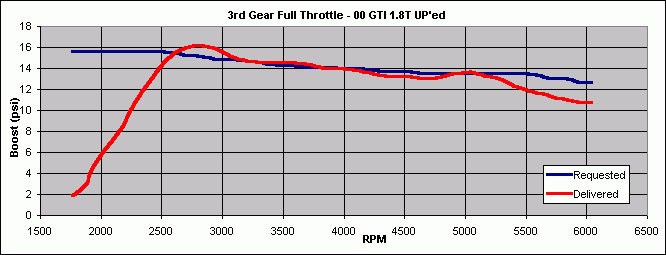
I plotted the pressure ratios and airflow (which I had logged versus RPM) onto the compressor map for the k03 turbo. It shows the turbo spooling up to over 140,000 rpm by 2500 engine rpm and reaching a peak of close to 160,000 rpm:
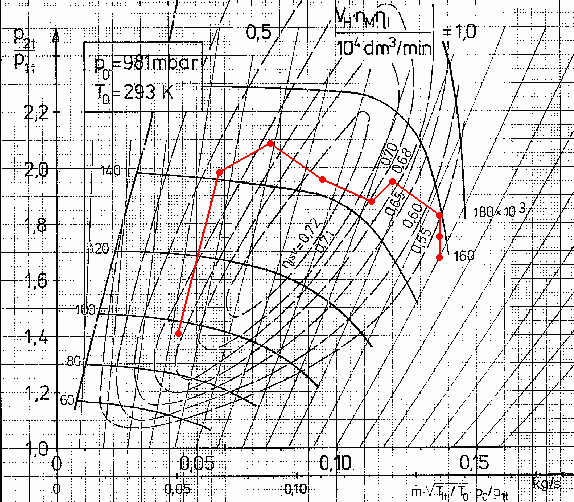
I plotted the pressure ratios and airflow (which I had logged versus RPM) onto the compressor map for the k03 turbo. It shows the turbo spooling up to over 140,000 rpm by 2500 engine rpm and reaching a peak of close to 160,000 rpm:
3rd Gear
Joined: Sep 2005
Posts: 178
Likes: 0
wow.. thanks for the info!
Originally Posted by mini pooper
TooTall
Although the following paper (abreviated due to space limitations) applies to our diesel engine and also includes the additional feature of variable inlet timing, it does illustrate the many of the principles of engines in general and thus to the MINI engine
THE SUPAIRTHERMAL NORDBERG ENGINE
The Nordberg Engine has a unique system of high pressure supercharging. While high pressure supercharging is not limited to Nordberg Engines, the Nordberg engine has exclusive mechanical features that enable it to operate over a large range of loads and speeds with the engine automatically adjusting itself to each load condition to maintain nominal temperatures, pressures and clean combustion of fuel. This system is vital to the performance of the engine and it is necessary that operators of "Supairthermal Engines" understand the basic principles of the system. Without the understanding it would, at times, be difficult to determine if the engine is adjusted and operating properly.
The devices on the engine are quite simple in themselves and need little explanation. However, to understand the proper functioning of the equipment it is necessary to delve into what they are intended to do. A thorough study of the principles would involve rigorous mathematics and thermodynamics which are far beyond the scope and intent of this paper. Rather, we will attempt the explanation in simple terms and using the least complex mathematics although some is required to emphasize certain points.
Supercharging occurs when the density of the cylinder air charge is increased thereby providing more oxygen to burn a greater amount of fuel. The object is to increase the power capability of the engine beyond that obtainable when the engine is naturally aspirated. The naturally aspirated engine can obtain only as much air in the cylinder as the piston can draw in while the inlet valve is open and the piston moves downward from the top of the stroke to bottom of the stroke. To better understand and appreciate the supercharged and SUPAIRTHERMAL Engine we will begin by taking a closer look at the naturally aspirated engine.
A few degrees before TDC firing the fuel is injected and begins to burn. As the piston passes TDC and moves downward the burning fuel raises the pressure in the cylinder to about 1.4 times the compression pressure and as the piston moves downward the force of this high pressure gas imparts high turning effort to the crankshaft. This is the source of the engines power. Before BDC is reached, the exhaust valve opens and as the gas rushes out of the cylinder its pressure rapidly falls to near zero gauge pressure. Opening the exhaust valve well before the bottom of the stroke appears, at first, to be wasting energy. However, you will notice that as the piston nears BDC relation between crankshaft and connecting rod is such that the force in the connecting rod applies very little turning effort, or torque, to the crankshaft. Also while we are observing the engine in slow motion here, actually, a very small fraction of a second is all the time available to blow down the pressure in the cylinder. If the exhaust valves were held closed until the bottom of the stroke then relatively high pressure would exist in the cylinder as the piston starts its upward stroke and the force of this pressure would oppose the motion of the piston and nullify any advantage in later opening of the exhaust valve. Further, the valves cannot be opened and closed instantly and while the valve begins to open at one point the crankshaft must turn through several more degrees before the valve has opened sufficiently to permit free flow of gas.
As the piston starts its upward stroke the exhaust valve is wide open and the motion of the piston forces the spent hot exhaust gas out of the cylinder. Near TDC the inlet valve begins to open and the exhaust valve has started to close. For a short period near TDC both valves are open. The piston is moving very slowly near TDC and there is little flow of gas either into or out of the cylinder. Just after passing TDC the exhaust valve is closed and inlet fully open. The downward motion of the piston draws in a fresh air charge through the inlet valve. You will notice that the inlet valve is held open well past BDC. The downward motion of the piston on intake strokes creates a partial vacuum in the cylinder which causes air outside the engine to rush in, in an attempt to bring the air pressure in the cylinder up to atmospheric or zero gauge pressure. Thus, while the piston is slowed to a stop near BDC we leave the inlet valve open so that the pressure in the cylinder will come up as near as possible to atmospheric pressure. Obviously, the higher the air pressure in the cylinder the more air and oxygen available to burn the fuel.
As the piston starts its upward stroke the inlet valve closes and the air is trapped and compressed. Compressing the air increases its temperature to the order of 1000F. so that when the fuel is injected just before TDC it ignites and burns spontaneously to further raise the pressure for the power stroke which starts as the piston passes TDC.
Now, imagine that our engine is running and lets see if we can find any shortcoming in the naturally aspirated engine and what we can do to increase its power. First, lets assume the engine is running at constant speed and rather a light load and there is plenty of air in the cylinder to burn the amount of fuel required at this load. For the sake of illustration, we will assume that combustion is nearly complete such that the exhaust gas contains a high percentage of completely burned fuel in the form of C02 (Carbon Dioxide). The fuel provides carbon (Symbol C) and the air supplies oxygen (Symbol 02). Thus, combustion would be:
(Cylinder) (Yields) (Exhaust)
C + 02 C02 + CO + 02
Free oxygen in the exhaust is the result of having excess oxygen available and C0 (carbon monoxide) and free carbon in the exhaust combustion is not complete. It is virtually impossible to disperse and mix the fuel and air in a manner to obtain ideal combustion and we will always find some C0 and C in the exhaust but they should be present in small amounts.
If we now increase the load on our engine then to maintain speed we must increase the amount of fuel. With increases in load and fuel we would find the 02in exhaust decreasing and C02 increasing. The C0 and C content would increase slightly. We can continue to increase load until we note a sharp reduction in exhaust 02 and marked increase in C0 and C. We have now applied about all of the load the engine can carry for while we can continue to increase fuel, the amount of air available is fixed at that amount the pistons can pull in on intake stroke. Continuing to increase load and fuel will so increase the free carbon in the exhaust that the exhaust gas will appear black. At this point we say that the engine has reached its smoke limit or torque limit.
Further increase in fuel causes the combustion process to deteriorate badly and to the extent that the engines power will decrease. At some point just below the smoke limit we reached the maximum power capability of our naturally aspirated engine
Now lets look at some of the reasons why our engine ran out of air for proper combustion. First, we know that the engine can only draw in as much air as the piston displaces on the intake stroke. However, at the bottom of the intake stroke we do not have the cylinder as full of clean cool, dense air as we might suspect. The engine has a volume ratio (compression ratio) of 11:1 which means that the volume of the cylinder at bottom of the stroke is twelve times the volume at top of the stroke. This means that the piston starts the intake stroke there is trapped in the cylinder hot, spent gas from the previous power stroke. When the piston reaches bottom of intake stroke then about 1/11 of the gas (9%) is spent gas from previous combustion. Additionally, this residual exhaust gas is hot and it mixes with the incoming air, raising its temperature and lowering the air charge density which further reduces the amount of oxygen in the air charge. Obviously, if we are to increase the engines power capacity we will have to supply more air for combustion.
The first step is to provide an air pump to force air into the engine during the intake stroke. This could be either an engine driven or electric motor driven pump but either of these requires large amounts of power which must be supplied from the crankshaft and absorbs a great deal of the additional power to be gained by supercharging. Instead, the exhaust gas driven turbo-compressor (turbocharger) is used as it utilizes waste energy in exhaust and takes very little power from the crankshaft in the form of exhaust back pressure. Now, lets suppose that we have applied a turbocharger that will provide, say 3 PSIG inlet air manifold pressure at the load at which the naturally aspirated engine had run short of air as evidenced by smokey exhaust. Lets see if we can determine if this degree of supercharging will enable the engine to produce a significant increase in power.
First, consider the following equation which defines all the conditions of a gas at the amount we are observing it:
I have deleted the equations as space does not allow.
This shows that by raising the inlet manifold pressure from zero gauge to 3 PSIG we can place 20% more air in the cylinder which would enable us to place a significantly larger load on the engine. But there is still another benefit to supercharging. Recall that there is a period near TDC after exhaust when both inlet and exhaust valves are open. By properly timing this overlap period in the supercharged engine we can use the positive manifold air pressure to scavenge the cylinder, i.e., force all the spent exhaust gases out of the cylinder and into the exhaust manifold. Also recall that we showed earlier that the trapped exhaust gases constituted 9% of the intake air charge in our naturally aspirated engine. Thus, by supercharging to a manifold pressure of only 3 PSIG we have given the engine nearly 30% additional air and the advantage of even low supercharging are obvious.
By careful design of the exhaust manifold system and sizing of the turbocharger we are able to develop intake manifold pressures of 30 PSIG. The temperature of this air is more than 300F but we cool it down to a usable temperature by placing a (inter)cooler between the turbocharger and engine.....
This paper goes on to explain the theory & principals of variable inlet timing and how this allows you to achieve even greater power while keeping the combution temperatures and pressure within acceptable limits.
Although the following paper (abreviated due to space limitations) applies to our diesel engine and also includes the additional feature of variable inlet timing, it does illustrate the many of the principles of engines in general and thus to the MINI engine
THE SUPAIRTHERMAL NORDBERG ENGINE
The Nordberg Engine has a unique system of high pressure supercharging. While high pressure supercharging is not limited to Nordberg Engines, the Nordberg engine has exclusive mechanical features that enable it to operate over a large range of loads and speeds with the engine automatically adjusting itself to each load condition to maintain nominal temperatures, pressures and clean combustion of fuel. This system is vital to the performance of the engine and it is necessary that operators of "Supairthermal Engines" understand the basic principles of the system. Without the understanding it would, at times, be difficult to determine if the engine is adjusted and operating properly.
The devices on the engine are quite simple in themselves and need little explanation. However, to understand the proper functioning of the equipment it is necessary to delve into what they are intended to do. A thorough study of the principles would involve rigorous mathematics and thermodynamics which are far beyond the scope and intent of this paper. Rather, we will attempt the explanation in simple terms and using the least complex mathematics although some is required to emphasize certain points.
Supercharging occurs when the density of the cylinder air charge is increased thereby providing more oxygen to burn a greater amount of fuel. The object is to increase the power capability of the engine beyond that obtainable when the engine is naturally aspirated. The naturally aspirated engine can obtain only as much air in the cylinder as the piston can draw in while the inlet valve is open and the piston moves downward from the top of the stroke to bottom of the stroke. To better understand and appreciate the supercharged and SUPAIRTHERMAL Engine we will begin by taking a closer look at the naturally aspirated engine.
A few degrees before TDC firing the fuel is injected and begins to burn. As the piston passes TDC and moves downward the burning fuel raises the pressure in the cylinder to about 1.4 times the compression pressure and as the piston moves downward the force of this high pressure gas imparts high turning effort to the crankshaft. This is the source of the engines power. Before BDC is reached, the exhaust valve opens and as the gas rushes out of the cylinder its pressure rapidly falls to near zero gauge pressure. Opening the exhaust valve well before the bottom of the stroke appears, at first, to be wasting energy. However, you will notice that as the piston nears BDC relation between crankshaft and connecting rod is such that the force in the connecting rod applies very little turning effort, or torque, to the crankshaft. Also while we are observing the engine in slow motion here, actually, a very small fraction of a second is all the time available to blow down the pressure in the cylinder. If the exhaust valves were held closed until the bottom of the stroke then relatively high pressure would exist in the cylinder as the piston starts its upward stroke and the force of this pressure would oppose the motion of the piston and nullify any advantage in later opening of the exhaust valve. Further, the valves cannot be opened and closed instantly and while the valve begins to open at one point the crankshaft must turn through several more degrees before the valve has opened sufficiently to permit free flow of gas.
As the piston starts its upward stroke the exhaust valve is wide open and the motion of the piston forces the spent hot exhaust gas out of the cylinder. Near TDC the inlet valve begins to open and the exhaust valve has started to close. For a short period near TDC both valves are open. The piston is moving very slowly near TDC and there is little flow of gas either into or out of the cylinder. Just after passing TDC the exhaust valve is closed and inlet fully open. The downward motion of the piston draws in a fresh air charge through the inlet valve. You will notice that the inlet valve is held open well past BDC. The downward motion of the piston on intake strokes creates a partial vacuum in the cylinder which causes air outside the engine to rush in, in an attempt to bring the air pressure in the cylinder up to atmospheric or zero gauge pressure. Thus, while the piston is slowed to a stop near BDC we leave the inlet valve open so that the pressure in the cylinder will come up as near as possible to atmospheric pressure. Obviously, the higher the air pressure in the cylinder the more air and oxygen available to burn the fuel.
As the piston starts its upward stroke the inlet valve closes and the air is trapped and compressed. Compressing the air increases its temperature to the order of 1000F. so that when the fuel is injected just before TDC it ignites and burns spontaneously to further raise the pressure for the power stroke which starts as the piston passes TDC.
Now, imagine that our engine is running and lets see if we can find any shortcoming in the naturally aspirated engine and what we can do to increase its power. First, lets assume the engine is running at constant speed and rather a light load and there is plenty of air in the cylinder to burn the amount of fuel required at this load. For the sake of illustration, we will assume that combustion is nearly complete such that the exhaust gas contains a high percentage of completely burned fuel in the form of C02 (Carbon Dioxide). The fuel provides carbon (Symbol C) and the air supplies oxygen (Symbol 02). Thus, combustion would be:
(Cylinder) (Yields) (Exhaust)
C + 02 C02 + CO + 02
Free oxygen in the exhaust is the result of having excess oxygen available and C0 (carbon monoxide) and free carbon in the exhaust combustion is not complete. It is virtually impossible to disperse and mix the fuel and air in a manner to obtain ideal combustion and we will always find some C0 and C in the exhaust but they should be present in small amounts.
If we now increase the load on our engine then to maintain speed we must increase the amount of fuel. With increases in load and fuel we would find the 02in exhaust decreasing and C02 increasing. The C0 and C content would increase slightly. We can continue to increase load until we note a sharp reduction in exhaust 02 and marked increase in C0 and C. We have now applied about all of the load the engine can carry for while we can continue to increase fuel, the amount of air available is fixed at that amount the pistons can pull in on intake stroke. Continuing to increase load and fuel will so increase the free carbon in the exhaust that the exhaust gas will appear black. At this point we say that the engine has reached its smoke limit or torque limit.
Further increase in fuel causes the combustion process to deteriorate badly and to the extent that the engines power will decrease. At some point just below the smoke limit we reached the maximum power capability of our naturally aspirated engine
Now lets look at some of the reasons why our engine ran out of air for proper combustion. First, we know that the engine can only draw in as much air as the piston displaces on the intake stroke. However, at the bottom of the intake stroke we do not have the cylinder as full of clean cool, dense air as we might suspect. The engine has a volume ratio (compression ratio) of 11:1 which means that the volume of the cylinder at bottom of the stroke is twelve times the volume at top of the stroke. This means that the piston starts the intake stroke there is trapped in the cylinder hot, spent gas from the previous power stroke. When the piston reaches bottom of intake stroke then about 1/11 of the gas (9%) is spent gas from previous combustion. Additionally, this residual exhaust gas is hot and it mixes with the incoming air, raising its temperature and lowering the air charge density which further reduces the amount of oxygen in the air charge. Obviously, if we are to increase the engines power capacity we will have to supply more air for combustion.
The first step is to provide an air pump to force air into the engine during the intake stroke. This could be either an engine driven or electric motor driven pump but either of these requires large amounts of power which must be supplied from the crankshaft and absorbs a great deal of the additional power to be gained by supercharging. Instead, the exhaust gas driven turbo-compressor (turbocharger) is used as it utilizes waste energy in exhaust and takes very little power from the crankshaft in the form of exhaust back pressure. Now, lets suppose that we have applied a turbocharger that will provide, say 3 PSIG inlet air manifold pressure at the load at which the naturally aspirated engine had run short of air as evidenced by smokey exhaust. Lets see if we can determine if this degree of supercharging will enable the engine to produce a significant increase in power.
First, consider the following equation which defines all the conditions of a gas at the amount we are observing it:
I have deleted the equations as space does not allow.
This shows that by raising the inlet manifold pressure from zero gauge to 3 PSIG we can place 20% more air in the cylinder which would enable us to place a significantly larger load on the engine. But there is still another benefit to supercharging. Recall that there is a period near TDC after exhaust when both inlet and exhaust valves are open. By properly timing this overlap period in the supercharged engine we can use the positive manifold air pressure to scavenge the cylinder, i.e., force all the spent exhaust gases out of the cylinder and into the exhaust manifold. Also recall that we showed earlier that the trapped exhaust gases constituted 9% of the intake air charge in our naturally aspirated engine. Thus, by supercharging to a manifold pressure of only 3 PSIG we have given the engine nearly 30% additional air and the advantage of even low supercharging are obvious.
By careful design of the exhaust manifold system and sizing of the turbocharger we are able to develop intake manifold pressures of 30 PSIG. The temperature of this air is more than 300F but we cool it down to a usable temperature by placing a (inter)cooler between the turbocharger and engine.....
This paper goes on to explain the theory & principals of variable inlet timing and how this allows you to achieve even greater power while keeping the combution temperatures and pressure within acceptable limits.
6th Gear
Joined: Jun 2002
Posts: 3,359
Likes: 1
From: New Jersey
Originally Posted by o-ron
Anyway, that's frickin AWESOME news! MORE torque than HP *AND* it all starts at 1500 RPM *AND* that's for the 140hp variant. Probably that translates into somewhere near 200lbft for the MCT....
*very excited*
*very excited*

Thread
Thread Starter
Forum
Replies
Last Post
EVMini
R56 :: Hatch Talk (2007+)
4
Sep 28, 2015 10:20 AM
Mini Mania
Vendor Announcements
0
Sep 25, 2015 12:32 PM