


R56 2009 MINI E Revealed: Electric-Cooper gets 150 miles


Thread Starter
|
Neutral
Joined: Oct 2008
Posts: 2
Likes: 0
2009 MINI E Revealed: Electric-Cooper gets 150 miles
Sorry posted this in 2009 Cabrios first by mistake... just revealed...
We’ve heard about it and we’ve seen spy shots of it and now here it is - the 2009 MINI E. Mini is producing 500 units of the electric-Cooper that will be available to companies and individuals in California, New York and New Jersey early next year. We’ll also get to see it at the LA Auto Show in November so stay tuned for live images.
Power comes from a lithium-ion battery that provides a total of 38 kilowatts per-hour allowing for 150 miles on a full charge (that’s less than 3 cents per mile). The 573 pound battery sits in the back seat so the MINI E has room for only two (total weight is 3,230 pounds compared to a regular MINI Cooper which weight 2,634). The battery can be charged from any outlet but the MINI E does come with a wallbox that allows for a quick full charge in two and half hours.
The lithium-ion battery pack feeds power to an electric motor that turns the front wheels pumping out 204-hp with a maximum torque of 162 lb-ft. 0 to 60 mph comes in 8.5 seconds with a top speed of 95 mph.
Click through for more high-res photos.
Source: eGMCarTech

We’ve heard about it and we’ve seen spy shots of it and now here it is - the 2009 MINI E. Mini is producing 500 units of the electric-Cooper that will be available to companies and individuals in California, New York and New Jersey early next year. We’ll also get to see it at the LA Auto Show in November so stay tuned for live images.
Power comes from a lithium-ion battery that provides a total of 38 kilowatts per-hour allowing for 150 miles on a full charge (that’s less than 3 cents per mile). The 573 pound battery sits in the back seat so the MINI E has room for only two (total weight is 3,230 pounds compared to a regular MINI Cooper which weight 2,634). The battery can be charged from any outlet but the MINI E does come with a wallbox that allows for a quick full charge in two and half hours.
The lithium-ion battery pack feeds power to an electric motor that turns the front wheels pumping out 204-hp with a maximum torque of 162 lb-ft. 0 to 60 mph comes in 8.5 seconds with a top speed of 95 mph.
Click through for more high-res photos.
Source: eGMCarTech

6th Gear
Joined: Jan 2003
Posts: 38,578
Likes: 2
Well, I think it's great!!!  It may not be the final solution, but I applaud any step in the right direction. As least the ball is rolling that will hopefully lead to advancment in technology. Glad MINI is willing to do something like this, inspite of the loss of the back seat.
It may not be the final solution, but I applaud any step in the right direction. As least the ball is rolling that will hopefully lead to advancment in technology. Glad MINI is willing to do something like this, inspite of the loss of the back seat.


Coordinator :: Eastern Iowa MINIs
Joined: Dec 2006
Posts: 5,520
Likes: 4
From: Decorah, IA
This is actually pretty sweet, and they're likely to get snatched up quickly. I can see how this would work nicely for urban-area commuters.
The only thing that turned me off is the plug symbols painted on the bonnet and especially the big, ugly one on the roof. Maybe they're only on the demo. Looks like a jellyfish or one of the e-creatures from the old Space Invaders video game...
The only thing that turned me off is the plug symbols painted on the bonnet and especially the big, ugly one on the roof. Maybe they're only on the demo. Looks like a jellyfish or one of the e-creatures from the old Space Invaders video game...

Hopefully they will perfect it and come out with a higher performance one (I'm sure they will add S to the back end  ). That one that a university did made theirs do 0-60 in 4 sec which would be amazing
). That one that a university did made theirs do 0-60 in 4 sec which would be amazing

3rd Gear
Joined: Jun 2008
Posts: 166
Likes: 0
From: North East Connecticut
I agree! With Electric motors you just add more motors and it just ups more HP. very cool.

Electric cars will completely outstrip gasoline powered cars performance wise in no time.
Nice MINI E, btw, love the S-body with no hood scoop. The color is nice as well. Wonder how much it will cost?
Nice MINI E, btw, love the S-body with no hood scoop. The color is nice as well. Wonder how much it will cost?
Trending Topics

That's not the colour line, that's "Interior Surfaces". The colour line would colour in the soft bit just below the yellow bits, and the arm rests.

3rd Gear
Joined: Feb 2008
Posts: 241
Likes: 0
From: OC
The little aero wind deflector flappy on the bottom of my R56 S's front lip was always scraping on stuff, even at stock height. THAT thing is going to be scraping on EVERYTHING because it looks way bigger.
Not a big deal. Just an observation. I wonder if it's bigger because they want to help the mileage by making it more aero?
Not a big deal. Just an observation. I wonder if it's bigger because they want to help the mileage by making it more aero?

3rd Gear
Joined: Jul 2008
Posts: 157
Likes: 1
From: Joisey
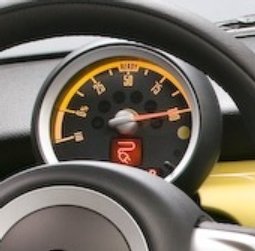
The center gauge appears to indicate the "charge level". While that bit of info is absolutely necessary I wonder if a "miles 'till tow truck" gauge would be more important. Perhaps with onboard GPS navigation integration the system could determine if you'll make it to your destination (and back) or not.

1st Gear
Joined: Sep 2008
Posts: 19
Likes: 0
From: Orange County
Electric cars will completely outstrip gasoline powered cars performance wise in no time.
Nice MINI E, btw, love the S-body with no hood scoop. The color is nice as well. Wonder how much it will cost?
Nice MINI E, btw, love the S-body with no hood scoop. The color is nice as well. Wonder how much it will cost?
6th Gear
Joined: Jan 2003
Posts: 38,578
Likes: 2
Not at all. Apparently the grid produces plenty of readily available power in off-peak hours to totally support the use of electric vehicles. The juice is just sitting there. It's available 24 hours a day, but designed so that daytime peak usage needs can be met. If folks are recharging overnight (off-peak) the existing system can theoretically handle this now.

6th Gear
Joined: Jan 2003
Posts: 38,578
Likes: 2
Well I suppose issues can/will arise....the discussion I heard was based on a theoretical scenario as it currently exists. Seasonal needs and other factors (as we have seen in recent history) can severely impact infrastructure. However, the grid is comparatively dormant at night...depending on how this all rolls out I think there is cause for optimism. The experts I heard indicated that most of the nation could switch to electric and existing system could handle it. This gets even more interesting as wind/solar/wave and other means of creating power are explored. It'd be great if we could actually transition to cleaner energy...future generations would probably thank us. Whether the electric MINI is part of this or merely a step along the way remains to be seen.

2nd Gear
Joined: Feb 2006
Posts: 121
Likes: 0
i have my "name down". my lease on the cooper s is up in march '09. i wasn't planning on getting another mini as i'm not too fond of the new body style, but electric would be so cool.
so far the dealer doesn't know anything, so my name being "down" means absolutely nothing. fingers crossed.
so far the dealer doesn't know anything, so my name being "down" means absolutely nothing. fingers crossed.

OVERDRIVE


Joined: Aug 2006
Posts: 7,201
Likes: 8
From: Norfolk, VA
The center gauge appears to indicate the "charge level". While that bit of info is absolutely necessary I wonder if a "miles 'till tow truck" gauge would be more important. Perhaps with onboard GPS navigation integration the system could determine if you'll make it to your destination (and back) or not.
It's true, the stakes are a little bit higher since you can't just pull into a gas station if you find yourself far from home when the charge runs out, but it will also be nice that since you can charge the car in your garage overnight, it'll be like starting out every day with a full tank.
6th Gear
Joined: Jan 2003
Posts: 38,578
Likes: 2
I wonder if there are any procedures for cycling these batteries to maximize their overall life span....how close to "E" will owners really want to get. I'd imagine the recharging system has some sophistication, so maybe one could charge it up more often (rather than less) in order to keep range always at max.
OVERDRIVE
Joined: Aug 2006
Posts: 7,201
Likes: 8
From: Norfolk, VA
I wonder if there are any procedures for cycling these batteries to maximize their overall life span....how close to "E" will owners really want to get. I'd imagine the recharging system has some sophistication, so maybe one could charge it up more often (rather than less) in order to keep range always at max.
If I had to guess, I would think that after ~150 miles, when the gauge reads "empty", that there's probably really about 30% of the batteries' charge left.
Since the computer will never let the "true charge" get below that point, the owner is free to charge the car as often as desired, even if it's only partially-depleted, without having to worry about shortening the service life.

Lithium Ion batteries life span actually shortens more quickly when at full charge. Every battery type is a little different in where their charge level likes to stay so there is no general rule of thumb for all battery types. LIon for instance will have the greatest life span if left at a ~ 40% charge, it is also fairly quick to charge LIon to 80% but that last 20% is the topping charge and can take the same amount of time as the first 80. If some of you have new laptops you might notice that there is a "battery care" function on most of them. You can choose to only allow it to charge to 50%, recommended for those you are on power supply most of the time, or charge to 80% recommended for those who use battery power most of the time. This will prolong the life span of the LIon battery.
I'm sure Mini has done all this research, and I wonder if they put in some sort of a blocker in the charging system to only allow it to charge to 80%...Obviously you would not get the same amount of mileage out of the battery, but the battery life would be about 30-50% longer. Instead of it only lasting 2 years it could go 3.
I'm sure Mini has done all this research, and I wonder if they put in some sort of a blocker in the charging system to only allow it to charge to 80%...Obviously you would not get the same amount of mileage out of the battery, but the battery life would be about 30-50% longer. Instead of it only lasting 2 years it could go 3.
OVERDRIVE
Joined: Aug 2006
Posts: 7,201
Likes: 8
From: Norfolk, VA
Another interesting spec for the electric MINI - From this Autocar article, the energy consumption is listed as "4.4 miles per kilowatt-hour". At a nationwide average electricity cost of eleven cents per kWh, that's about 2.5 cents per mile in electricity costs.
Compare that to 8.5 cents per mile for gasoline, (assuming $3/gallon gas and 35 MPG). Not a bad start - I'm curious to see where it goes from here.
Compare that to 8.5 cents per mile for gasoline, (assuming $3/gallon gas and 35 MPG). Not a bad start - I'm curious to see where it goes from here.
It probably won't be a problem. They're working on probabilities here, if you have millions of people doing something, probabilities become quite accurate. (And this is only going to become a problem when there are millions of them.) Most people are going to find it easier to charge overnight, during the day people tend to be at work.
Now at my work we actually have electric vehicle charging stations, but only a few of them for 10 thousand people. If electric vehicles were common charging at work would probably be discouraged, except in emergencies.
Finally there's time based pricing. In parts of the world you can get a extra electricity meter on a timer, it measures your usage in the off peak periods overnight. This off peak usage is charged at a much lower rate, like about 1/5th of the daytime rate. That could be used to encourage overnight charging.
I'm not sure if there's a tariff like that in California, but I think there's a time based tariff here that's a bit cheaper in general, except during the noon-6pm hours (peak A/C usage time) when it gets a lot more expensive. I considered getting onto a tariff like that at one time, when it made sense for our usage.
Finally there's a move afoot here to remotely turn off power usage when power capacity runs low. The idea is that a signal is sent down the power line, a thermostat will see that and stop running the A/C at that time. (The user can manually over ride the override, but you have to be home to adjust your thermostat.) A similar idea could be used to turn off any car chargers which were running during the day.
A combination of economic incentives (lower night time rates), disincentives (higher daytime rates) and remote control could probably handle an electric fleet.
Now at my work we actually have electric vehicle charging stations, but only a few of them for 10 thousand people. If electric vehicles were common charging at work would probably be discouraged, except in emergencies.
Finally there's time based pricing. In parts of the world you can get a extra electricity meter on a timer, it measures your usage in the off peak periods overnight. This off peak usage is charged at a much lower rate, like about 1/5th of the daytime rate. That could be used to encourage overnight charging.
I'm not sure if there's a tariff like that in California, but I think there's a time based tariff here that's a bit cheaper in general, except during the noon-6pm hours (peak A/C usage time) when it gets a lot more expensive. I considered getting onto a tariff like that at one time, when it made sense for our usage.
Finally there's a move afoot here to remotely turn off power usage when power capacity runs low. The idea is that a signal is sent down the power line, a thermostat will see that and stop running the A/C at that time. (The user can manually over ride the override, but you have to be home to adjust your thermostat.) A similar idea could be used to turn off any car chargers which were running during the day.
A combination of economic incentives (lower night time rates), disincentives (higher daytime rates) and remote control could probably handle an electric fleet.
If anything, it's definitely going to be a gradual shift to electric vehicles as well, so hopefully all these plans of action mentioned will be fully thought-out and implemented by the time an all electric fleet rolls around.
But man, I'd be sooooo all over a Tesla if I had 120k lying around
But man, I'd be sooooo all over a Tesla if I had 120k lying around
