JCW Anyone run or running 100 Octane?


To bad your in Illinois, I would donate mine to see if their is any change from one to the other.

2nd Gear
Joined: Mar 2012
Posts: 129
Likes: 0
From: Curvy, Cali
Dyno's for timing
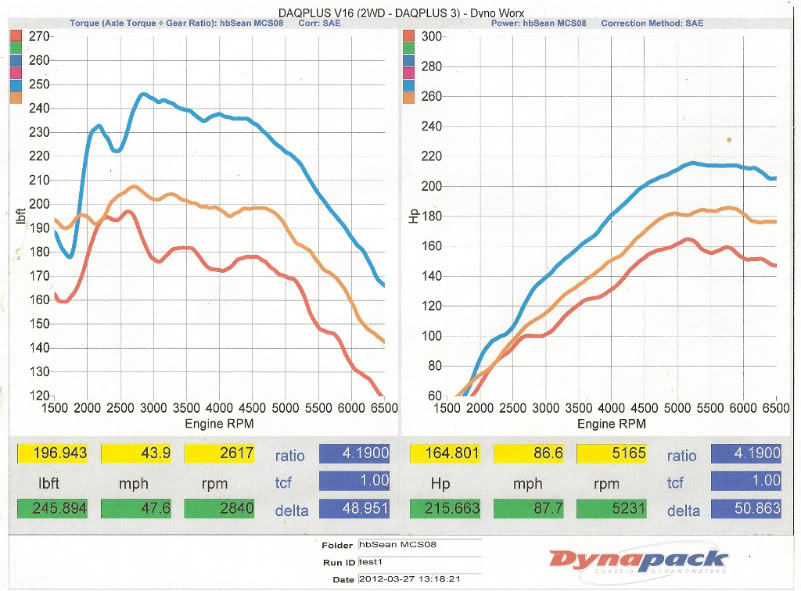
@ mrrjm. The DynaPack and the Dyno Dynamics are the absolute best tuning tools to actually steady state test and tune all your tables and maps with absolute precision and control, just depends if your planning to do lots of serious tuning or just want to show big numbers and sell parts, then a DynoJet is popular, they show numbers but hardly produce mph/et due to much lower inertia wheel, yet their steady state Eddie current is getting better, yet it's not even close to a DP or DD dyno's.
But in the end it's what you have to enjoy and make money with...
Just my $.02


4th Gear
Joined: May 2005
Posts: 485
Likes: 2
From: So CAL
etalj asked this question above and I didn't see it answered. I too ar an engineer and remember this subject in my internal combustion engines class (Cal Poly Pomona '87, go Broncos!). We tested isooctane against pump gas of many grades in that class and for the most part you are splitting hairs regarding power gains. There are enough variables present that it is nearly inconclusive under test conditions in a lab. Sorry guys, but those stating huge gains from highly calibrated butt dyno's I take with a grain of salt. You can rarely get a real dyno to repeat back to back runs.
In regards to energy content with respect to octane it has more to do with what chemical is used to raise the octane. The following is copied from Wikipedia:
Octane rating does not relate to the energy content of the fuel (see heating value). It is only a measure of the fuel's tendency to burn in a controlled manner, rather than exploding in an uncontrolled manner. Where the octane number is raised by blending in ethanol, energy content per volume is reduced.
Guys running meth: it is likely meth adds energy while increasing resistance to knocking (octane), which explains what you are experiencing. But I don't believe pump gas uses meth for octane boosting. I'll do a bit more research and we'll see what they do use now. Back in the day it was ethenol just as noted above. We were told in my engineering class that lower octane fuel contained more energy because of that reason. And that is why running the lowest octane that your car works on without pinging will give you the most power.
my .02
In regards to energy content with respect to octane it has more to do with what chemical is used to raise the octane. The following is copied from Wikipedia:
Octane rating does not relate to the energy content of the fuel (see heating value). It is only a measure of the fuel's tendency to burn in a controlled manner, rather than exploding in an uncontrolled manner. Where the octane number is raised by blending in ethanol, energy content per volume is reduced.
Guys running meth: it is likely meth adds energy while increasing resistance to knocking (octane), which explains what you are experiencing. But I don't believe pump gas uses meth for octane boosting. I'll do a bit more research and we'll see what they do use now. Back in the day it was ethenol just as noted above. We were told in my engineering class that lower octane fuel contained more energy because of that reason. And that is why running the lowest octane that your car works on without pinging will give you the most power.
my .02
Last edited by smoke05S; Apr 8, 2012 at 09:00 PM.
4th Gear
Joined: May 2005
Posts: 485
Likes: 2
From: So CAL
Here is some more supporting evidence from Wikipedia:
"It might seem odd that fuels with higher octane ratings are used in more powerful engines, since such fuels ignite less easily. However, detonation is undesirable in a spark ignition engine, and is signified by audible "pinging" or in more extreme cases "knock". . . . Many high-performance engines are designed to operate with a high maximum compression, and thus demand fuels of higher octane. A common misconception is that power output or fuel efficiency can be improved by burning fuel of higher octane than that specified by the engine manufacturer. The power output of an engine depends in part on the energy density of the fuel being burnt. Fuels of different octane ratings may have similar densities, but because switching to a higher octane fuel does not add more hydrocarbon content or oxygen, the engine cannot develop more power."
In other words if your car does not ping on 91 more power is waiting for you at lower octanes as opposed to higher octane pump gas made that way by increasing ethanol content.
Meth changes the rules because it increases octane and adds energy to the equation.
You meth guys appear to have the hot set up. That could be on the mod wish list very soon. Is it legal in SoCAL?
"It might seem odd that fuels with higher octane ratings are used in more powerful engines, since such fuels ignite less easily. However, detonation is undesirable in a spark ignition engine, and is signified by audible "pinging" or in more extreme cases "knock". . . . Many high-performance engines are designed to operate with a high maximum compression, and thus demand fuels of higher octane. A common misconception is that power output or fuel efficiency can be improved by burning fuel of higher octane than that specified by the engine manufacturer. The power output of an engine depends in part on the energy density of the fuel being burnt. Fuels of different octane ratings may have similar densities, but because switching to a higher octane fuel does not add more hydrocarbon content or oxygen, the engine cannot develop more power."
In other words if your car does not ping on 91 more power is waiting for you at lower octanes as opposed to higher octane pump gas made that way by increasing ethanol content.
Meth changes the rules because it increases octane and adds energy to the equation.
You meth guys appear to have the hot set up. That could be on the mod wish list very soon. Is it legal in SoCAL?
Last edited by smoke05S; Apr 8, 2012 at 09:49 PM.

Last edited by SooperCuperErik; Apr 9, 2012 at 12:41 PM.

6th Gear
Joined: Feb 2012
Posts: 2,264
Likes: 31
From: wisconsin, usa
i bet a larger differance is to be had (and felt) by using fuel with NO ethanol.
in the USA, in most large metro areas, the fuel MUST CONTAIN 10% ethanol.
yesterday, i drove 30 miles, to the next county, to fill the tank with fuel with NO ethanol (i put 12.1 gals in), it happens to be 93 R+M/2 rated .
i reset the MPG on the OBC before leaving and after the fill, 28MPG on the way out, 34 MPG on the way back, all on 2 lane "back roads".
the car "feels" quicker, but i am still under 1200 mile break-in, so not going into the real power zone.
but the MPG is telling.
scott
in the USA, in most large metro areas, the fuel MUST CONTAIN 10% ethanol.
yesterday, i drove 30 miles, to the next county, to fill the tank with fuel with NO ethanol (i put 12.1 gals in), it happens to be 93 R+M/2 rated .
i reset the MPG on the OBC before leaving and after the fill, 28MPG on the way out, 34 MPG on the way back, all on 2 lane "back roads".
the car "feels" quicker, but i am still under 1200 mile break-in, so not going into the real power zone.
but the MPG is telling.
scott


race gas runs leaner
2nd Gear
Joined: Mar 2012
Posts: 129
Likes: 0
From: Curvy, Cali
What's funny about this fuel and timing advance topic making more power is more of the many having little to No serious experience with a true steady state chassis Dyno such as DynaPack and DynoDybnamics where when you have a car on the Dyno many think fuel mixture controls much of the power which is just not true to a point, it does effect power a little, but timing effects power greatly to the tune of even 20rwhp with as little as 2degrees of advance with fuel to allow the advance, especially in a force induction car, it would be within the realm to say a few degrees of advance would be worth a serious seat of the pants boost in acceleration and what nobody mentioned is many fuels today are available Oxygenated which adds power all by itself, yet very little without the added timing advance and octane rating... Adaptive ECU's may in fact see better drivabilities with miles added with better fuel quality, and maybe not so much with a fresh tank right off the bat.
Get some experience and see changes on a 200hp car and how effective timing can be to actual HP improvement, this R56 has wide band O2's for a reason, similar to how cooler air allows more timing over hot air temps and why so many have gone to h2o/meth injection for boost support and detonation protection....
As for optimum afr would depend directly on how much boost each car is running and the temps the car is being driven in, yet I'm sure a bit of extra fuel is added for thermal dynamics for controlling heat soak, yet mid to low 11:1 would be sufficient for many mini engines and most would be happy in the low 12:1 range and only running close to stochiometric when map pressure is in vacuum any boost and fuel enrichment blows 14.7:1 out the window for many reasons.....
Timing advance can yield significant power gains especially in boosted cars, anybody remember old 5.0 mustangs there was a difference between 12 degrees and 14 and that was a slow mustang, not a Mini Cooper.... Timing doesn't make power it releases what's available from within the motor within its rpm range most effectively with fuel available and the most timing advance allowable controlled by fuel octane rating. economy goes out the window when full throttle is applied no matter what fuel you have, it just doesn't cost as much as the pump...
Just my thoughts on this topic
Get some experience and see changes on a 200hp car and how effective timing can be to actual HP improvement, this R56 has wide band O2's for a reason, similar to how cooler air allows more timing over hot air temps and why so many have gone to h2o/meth injection for boost support and detonation protection....
As for optimum afr would depend directly on how much boost each car is running and the temps the car is being driven in, yet I'm sure a bit of extra fuel is added for thermal dynamics for controlling heat soak, yet mid to low 11:1 would be sufficient for many mini engines and most would be happy in the low 12:1 range and only running close to stochiometric when map pressure is in vacuum any boost and fuel enrichment blows 14.7:1 out the window for many reasons.....
Timing advance can yield significant power gains especially in boosted cars, anybody remember old 5.0 mustangs there was a difference between 12 degrees and 14 and that was a slow mustang, not a Mini Cooper.... Timing doesn't make power it releases what's available from within the motor within its rpm range most effectively with fuel available and the most timing advance allowable controlled by fuel octane rating. economy goes out the window when full throttle is applied no matter what fuel you have, it just doesn't cost as much as the pump...
Just my thoughts on this topic

3rd Gear
Joined: Apr 2008
Posts: 262
Likes: 0
I do not know how accurate this is. But I do believe in the pure unleaded vs unleaded WITH 10% theory.. http://pure-gas.org/index.jsp
But if i roll up to one of these stations and its old and worn down looking with cracked pavement and tanks buried underground. I will go go elsewhere.
But if i roll up to one of these stations and its old and worn down looking with cracked pavement and tanks buried underground. I will go go elsewhere.

Thread
Thread Starter
Forum
Replies
Last Post
IQRaceworks
Drivetrain (Cooper S)
42
Jul 15, 2022 05:51 AM
Kimolaoha
R56 :: Hatch Talk (2007+)
5
Dec 5, 2020 09:32 PM
imanexcellentdriver
1st Gen Countryman (R60) Talk (2010-2015)
10
Aug 31, 2015 08:08 PM
iamcamkeenan
R50/R53 :: Hatch Talk (2002-2006)
3
Aug 10, 2015 03:31 PM