


Drivetrain DoS R55, R56, R57 Turbo/'S' W2A IC Introductory Pricing Released


Joined: May 2003
Posts: 898
Likes: 0
From: San Francisco, CA
Yes it is. . .
We dyno'ed the DoS W2A setup last week and the ECU is allowing for 1.5lbs more boost than the stock A2A IC, so there are HP and torque gains to be had. We cannot wait to tune specifically for the W2A.
As I mentioned in one of the other threads on intercoolers, the release of the R56 W2A-IC has been delayed because one of our vendors has a backlog and our barrel mounting brackets are waiting in their queue.
I'll post a dyno chart for the info noted above and some more updates next week.
-Clint
As I mentioned in one of the other threads on intercoolers, the release of the R56 W2A-IC has been delayed because one of our vendors has a backlog and our barrel mounting brackets are waiting in their queue.
I'll post a dyno chart for the info noted above and some more updates next week.
-Clint
Last edited by Mini'mon; May 7, 2010 at 01:51 PM. Reason: added phrase " . . . one of the other threads . . ."


3rd Gear
Joined: Jun 2009
Posts: 184
Likes: 0
Originally Posted by OH REALLY
ok so im still lost it it going to increase the hp or what?
W2A is more about mainting low air temps and running more consistantly as well as reducing piping lenth to reduce spool up times..
either system cannot reduce air temps below ambient.. (if it's 100* outside ur temps can't be lower than 100*)
but as a cooling method.. water is far superior to air..
the disadvantage of W2A (beside cost) is increased complication of the cooling system, and an additional potential points of failure (water leaks, pump failure etc)
depending on the strength of the pump as well, it taxes the electrical system also.
but with all that said.. a well designed W2A system is a far superiour cooling method then A2A..
but it depends on what and how u use ur car...
if ur planning on pushing the car for extended periods, at higher boost levels on the upper limit of the compressor range of the turbo (where it essentially becomes a hair drier no longer a turbo) and ur pounding on it in the track for 30-45mins for example
the A2W will keep ur Air temps much closer to ambient and as a result, u wont feel the car "losing power" the longer u romp in because the air will remain dense (more oxygen) and the car wont pull timing to compensate for higher Air temp values.. (Hot air is at a higher risk of causing detonation)
but if ur running primarily on the street, and only doing 20-30 sec WOT runs here and there and then cruising again.. you will not really benefit as much from an W2A system... (u will still benefit from the lower spool up times and faster return to ambient temps)
but if its still a boiling hot day outside.. ur still only going to see ambient temps at best... unlike Meth or water injection which can yield lower than ambient temps of your intake charge
Yeah, what Otto said.... 
Seriously, he hit it on the head. It simply makes heat soak less of an issue. Unless you're doing track days, it's pretty well useless for a daily driver. (not really useless, just MUCH less beneficial)
Mark
Seriously, he hit it on the head. It simply makes heat soak less of an issue. Unless you're doing track days, it's pretty well useless for a daily driver. (not really useless, just MUCH less beneficial)
Mark
well technically u will get a slight increase in hp, but it is more the indirect benefits of the IC that differentiate the A2A from W2A
W2A is more about mainting low air temps and running more consistantly as well as reducing piping lenth to reduce spool up times..
either system cannot reduce air temps below ambient.. (if it's 100* outside ur temps can't be lower than 100*)
but as a cooling method.. water is far superior to air..
the disadvantage of W2A (beside cost) is increased complication of the cooling system, and an additional potential points of failure (water leaks, pump failure etc)
depending on the strength of the pump as well, it taxes the electrical system also.
but with all that said.. a well designed W2A system is a far superiour cooling method then A2A..
but it depends on what and how u use ur car...
if ur planning on pushing the car for extended periods, at higher boost levels on the upper limit of the compressor range of the turbo (where it essentially becomes a hair drier no longer a turbo) and ur pounding on it in the track for 30-45mins for example
the A2W will keep ur Air temps much closer to ambient and as a result, u wont feel the car "losing power" the longer u romp in because the air will remain dense (more oxygen) and the car wont pull timing to compensate for higher Air temp values.. (Hot air is at a higher risk of causing detonation)
but if ur running primarily on the street, and only doing 20-30 sec WOT runs here and there and then cruising again.. you will not really benefit as much from an W2A system... (u will still benefit from the lower spool up times and faster return to ambient temps)
but if its still a boiling hot day outside.. ur still only going to see ambient temps at best... unlike Meth or water injection which can yield lower than ambient temps of your intake charge
W2A is more about mainting low air temps and running more consistantly as well as reducing piping lenth to reduce spool up times..
either system cannot reduce air temps below ambient.. (if it's 100* outside ur temps can't be lower than 100*)
but as a cooling method.. water is far superior to air..
the disadvantage of W2A (beside cost) is increased complication of the cooling system, and an additional potential points of failure (water leaks, pump failure etc)
depending on the strength of the pump as well, it taxes the electrical system also.
but with all that said.. a well designed W2A system is a far superiour cooling method then A2A..
but it depends on what and how u use ur car...
if ur planning on pushing the car for extended periods, at higher boost levels on the upper limit of the compressor range of the turbo (where it essentially becomes a hair drier no longer a turbo) and ur pounding on it in the track for 30-45mins for example
the A2W will keep ur Air temps much closer to ambient and as a result, u wont feel the car "losing power" the longer u romp in because the air will remain dense (more oxygen) and the car wont pull timing to compensate for higher Air temp values.. (Hot air is at a higher risk of causing detonation)
but if ur running primarily on the street, and only doing 20-30 sec WOT runs here and there and then cruising again.. you will not really benefit as much from an W2A system... (u will still benefit from the lower spool up times and faster return to ambient temps)
but if its still a boiling hot day outside.. ur still only going to see ambient temps at best... unlike Meth or water injection which can yield lower than ambient temps of your intake charge
Joined: May 2003
Posts: 898
Likes: 0
From: San Francisco, CA
Most of the comments above are fairly accurate. It looks like otto and orange get it for the most part.
Just to inform a tad more . . .
Our pump is pulling 2 amps max (1.5 average). This means very little additional draw on the electrical system. Also, we picked a compact, super long life pump from Johnson that far exceeds the performance stats of the (IMHO) large POS high-current-draw (~15 amps) Bosch pump that many companies are running for W2A setups. To sum up, we have quadruple the pump life and ~ 1/6th to 1/10th the current draw. This makes the system highly reliable and electrically efficient -- even for daily driven MINIs that still see track days and MINI Club events.
Additionally, we took a lot of extra effort on this system to minimize the use of clamps and fittings wherever possible. This greatly minimizes failure points and simplifies installation.
Hopefully this sets some minds at ease in terms of the usual cons of W2A vs A2A. We started the development of the R56 W2A system with ease of use and low maintenance in mind. I just wanted to make sure that folks know how much we think about this stuff here at DoS.
Just to inform a tad more . . .
Our pump is pulling 2 amps max (1.5 average). This means very little additional draw on the electrical system. Also, we picked a compact, super long life pump from Johnson that far exceeds the performance stats of the (IMHO) large POS high-current-draw (~15 amps) Bosch pump that many companies are running for W2A setups. To sum up, we have quadruple the pump life and ~ 1/6th to 1/10th the current draw. This makes the system highly reliable and electrically efficient -- even for daily driven MINIs that still see track days and MINI Club events.
Additionally, we took a lot of extra effort on this system to minimize the use of clamps and fittings wherever possible. This greatly minimizes failure points and simplifies installation.
Hopefully this sets some minds at ease in terms of the usual cons of W2A vs A2A. We started the development of the R56 W2A system with ease of use and low maintenance in mind. I just wanted to make sure that folks know how much we think about this stuff here at DoS.

3rd Gear
Joined: Jun 2009
Posts: 184
Likes: 0
Just to inform a tad more . . .
Our pump is pulling 2 amps max (1.5 average). This means very little additional draw on the electrical system. Also, we picked a compact, super long life pump from Johnson that far exceeds the performance stats of the (IMHO) large POS high-current-draw (~15 amps) Bosch pump that many companies are running for W2A setups. To sum up, we have quadruple the pump life and ~ 1/6th to 1/10th the current draw. This makes the system highly reliable and electrically efficient -- even for daily driven MINIs that still see track days and MINI Club events.
Additionally, we took a lot of extra effort on this system to minimize the use of clamps and fittings wherever possible. This greatly minimizes failure points and simplifies installation.
Hopefully this sets some minds at ease in terms of the usual cons of W2A vs A2A. We started the development of the R56 W2A system with ease of use and low maintenance in mind. I just wanted to make sure that folks know how much we think about this stuff here at DoS.
Our pump is pulling 2 amps max (1.5 average). This means very little additional draw on the electrical system. Also, we picked a compact, super long life pump from Johnson that far exceeds the performance stats of the (IMHO) large POS high-current-draw (~15 amps) Bosch pump that many companies are running for W2A setups. To sum up, we have quadruple the pump life and ~ 1/6th to 1/10th the current draw. This makes the system highly reliable and electrically efficient -- even for daily driven MINIs that still see track days and MINI Club events.
Additionally, we took a lot of extra effort on this system to minimize the use of clamps and fittings wherever possible. This greatly minimizes failure points and simplifies installation.
Hopefully this sets some minds at ease in terms of the usual cons of W2A vs A2A. We started the development of the R56 W2A system with ease of use and low maintenance in mind. I just wanted to make sure that folks know how much we think about this stuff here at DoS.
awesome man...
it looks likes u guys have really done ur homework on this kit.. (thank u for providing the numbers)
props to u
I look forward to seeing the final product..
well technically u will get a slight increase in hp, but it is more the indirect benefits of the IC that differentiate the A2A from W2A
W2A is more about mainting low air temps and running more consistantly as well as reducing piping lenth to reduce spool up times..
either system cannot reduce air temps below ambient.. (if it's 100* outside ur temps can't be lower than 100*)
but as a cooling method.. water is far superior to air..
the disadvantage of W2A (beside cost) is increased complication of the cooling system, and an additional potential points of failure (water leaks, pump failure etc)
depending on the strength of the pump as well, it taxes the electrical system also.
but with all that said.. a well designed W2A system is a far superiour cooling method then A2A..
but it depends on what and how u use ur car...
if ur planning on pushing the car for extended periods, at higher boost levels on the upper limit of the compressor range of the turbo (where it essentially becomes a hair drier no longer a turbo) and ur pounding on it in the track for 30-45mins for example
the A2W will keep ur Air temps much closer to ambient and as a result, u wont feel the car "losing power" the longer u romp in because the air will remain dense (more oxygen) and the car wont pull timing to compensate for higher Air temp values.. (Hot air is at a higher risk of causing detonation)
but if ur running primarily on the street, and only doing 20-30 sec WOT runs here and there and then cruising again.. you will not really benefit as much from an W2A system... (u will still benefit from the lower spool up times and faster return to ambient temps)
but if its still a boiling hot day outside.. ur still only going to see ambient temps at best... unlike Meth or water injection which can yield lower than ambient temps of your intake charge
W2A is more about mainting low air temps and running more consistantly as well as reducing piping lenth to reduce spool up times..
either system cannot reduce air temps below ambient.. (if it's 100* outside ur temps can't be lower than 100*)
but as a cooling method.. water is far superior to air..
the disadvantage of W2A (beside cost) is increased complication of the cooling system, and an additional potential points of failure (water leaks, pump failure etc)
depending on the strength of the pump as well, it taxes the electrical system also.
but with all that said.. a well designed W2A system is a far superiour cooling method then A2A..
but it depends on what and how u use ur car...
if ur planning on pushing the car for extended periods, at higher boost levels on the upper limit of the compressor range of the turbo (where it essentially becomes a hair drier no longer a turbo) and ur pounding on it in the track for 30-45mins for example
the A2W will keep ur Air temps much closer to ambient and as a result, u wont feel the car "losing power" the longer u romp in because the air will remain dense (more oxygen) and the car wont pull timing to compensate for higher Air temp values.. (Hot air is at a higher risk of causing detonation)
but if ur running primarily on the street, and only doing 20-30 sec WOT runs here and there and then cruising again.. you will not really benefit as much from an W2A system... (u will still benefit from the lower spool up times and faster return to ambient temps)
but if its still a boiling hot day outside.. ur still only going to see ambient temps at best... unlike Meth or water injection which can yield lower than ambient temps of your intake charge
Joined: May 2003
Posts: 898
Likes: 0
From: San Francisco, CA
Dyno Chart -- Stock A2A IC vs DoS W2A IC
So we decided to beat on the stock A2A-IC and the DoS W2A-IC on Irmiger's 2007 R56 MCS.
We did a test where we did 6 back-to-back pulls at 20 second intervals.
The red plot shows available hp with the stock A2A-IC after 6 pulls. The green plots show the 5th and 6th pulls with our W2A-IC. The numbers stayed nice and high.
Peak hp for the day was 164.5 and peak torque was 194.1 (at the wheels, no Bhp correction). Even when things really heated-up, the DoS W2A just didn't fall-off as much as the A2A stocker.
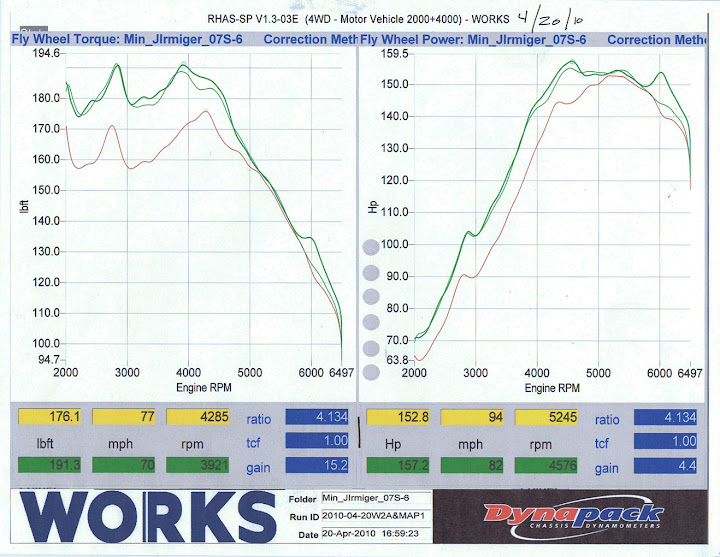
We did a test where we did 6 back-to-back pulls at 20 second intervals.
The red plot shows available hp with the stock A2A-IC after 6 pulls. The green plots show the 5th and 6th pulls with our W2A-IC. The numbers stayed nice and high.
Peak hp for the day was 164.5 and peak torque was 194.1 (at the wheels, no Bhp correction). Even when things really heated-up, the DoS W2A just didn't fall-off as much as the A2A stocker.


So we decided to beat on the stock A2A-IC and the DoS W2A-IC on Irmiger's 2007 R56 MCS.
We did a test where we did 6 back-to-back pulls at 20 second intervals.
The red plot shows available hp with the stock A2A-IC after 6 pulls. The green plots show the 5th and 6th pulls with our W2A-IC. The numbers stayed nice and high.
Peak hp for the day was 164.5 and peak torque was 194.1 (at the wheels, no Bhp correction). Even when things really heated-up, the DoS W2A just didn't fall-off as much as the A2A stocker.
We did a test where we did 6 back-to-back pulls at 20 second intervals.
The red plot shows available hp with the stock A2A-IC after 6 pulls. The green plots show the 5th and 6th pulls with our W2A-IC. The numbers stayed nice and high.
Peak hp for the day was 164.5 and peak torque was 194.1 (at the wheels, no Bhp correction). Even when things really heated-up, the DoS W2A just didn't fall-off as much as the A2A stocker.


2nd Gear
Joined: Jul 2009
Posts: 127
Likes: 1
Just to be clear, there was no "increase" per se. What his test looked at is the effects of multiple back-to-back runs on HP/Torque. What the plots show is that the A2W IC MAINTAINED normal HP/Torque better than the A2A after successive runs.
Clint, let me know if I screwed this up...
Joined: May 2003
Posts: 898
Likes: 0
From: San Francisco, CA
That being said, we've found that the R56 MCS will actually make 5-to-10 hp gains in sections of the powerband and will smooth its torque and hp curves if you can get the intake charge much closer to ambient under high RPM loading periods and stably maintain that temp drop. It's more like finding horsepower thanks to the ECU adjusting to the cooler air instead of making power with this bolt-on by providing denser, cooler air.
Also, a dyno fan can in no way replicate the amount of air that's actually flowing over and into the front grilles of a car (and into the heat exchanger). Once we realized that DoS can get results like this with a dyno fan, we knew that our job was pretty much wrapped-up for this product.

Joined: May 2003
Posts: 898
Likes: 0
From: San Francisco, CA