


Suspension Who makes the BEST swaybar links?


Thread Starter
|
4th Gear
Joined: Dec 2006
Posts: 558
Likes: 0
Who makes the BEST swaybar links?
I've seen a few different kinds, solid, helm type, pivoting bolt, etc.
Who makes the best one, the one that will last longest, make the least noise, take the most abuse?
Who makes the best one, the one that will last longest, make the least noise, take the most abuse?

Thread Starter
|
4th Gear
Joined: Dec 2006
Posts: 558
Likes: 0
powergrid...right.
pricey foockers aren't they! Anyone sell them any cheaper?
http://cgi.ebay.com/ebaymotors/03-06...spagenameZWD1V
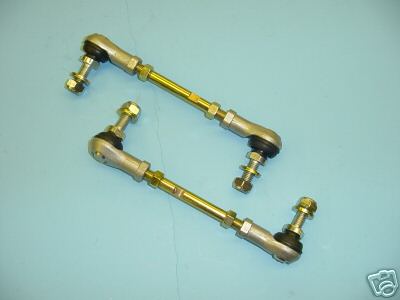
pricey foockers aren't they! Anyone sell them any cheaper?
http://cgi.ebay.com/ebaymotors/03-06...spagenameZWD1V

Banned
Joined: Oct 2006
Posts: 483
Likes: 0

Banned
Joined: Oct 2006
Posts: 1,299
Likes: 0
From: Tejas
We've punished them for quite some time now and still swear by them...


Yea, these are about the best choice for the fronts for sure, but they are not necessary for the rears. Altas or the like are fine for the rear, so there you can save some money and some weight.
Trending Topics


4th Gear
Joined: Jun 2006
Posts: 585
Likes: 0
From: Somewhere that no longer exists
Ive been running altas for a year (25000 km), with one candian salty winter on them, no noise, can still turn the unit on the heims, so they arnt even siezed. I dont like the powergrid, if you check out some spec lists, the female ends are not nearly as strong as the male style threads (like alta or webb). As for angle of movelment, you dont need it, the things go up and down and that is it, going by the look of mine, mine have never moved (road film on the center heim is never wiped clean, which means the heim ball has never siwveled), and i have autoxed my car, and won my class, so i was pushing it, and i take a very twisty section of road to school almost every day, and pretend it is a clsed track, so my suspension gets a work out. I dont recall how much the powergrid ones are, but in my opion (based on me looking at fail points of heim joints from when i was going to build rear control arms) the powergrids arnt as strong in the ends, not to mention the fact that their center shaft is solid, not tubular, like webb or alta, and a tube is much stronger than a shaft (for refrence, i can flex my stock rears with my bare hands). I would suggest you buy the webb or the altas (alta is the cheaper, mostly because they dont use as expensive heim joints, but you really dont need super high quality heim joints (like what webb uses for this operation (or like say the $100 per units (ie 400 worth of heim joints for one pair of endlinks) from hrtc or hmbc or whatever their initials are). Hope this helps
Beecher
Beecher
This is close to true with the rears only. The fronts go through a huge amount of articulation to which most hiems can't cope with. I ran altas and they bent at the hiem, as many others experienced.
These ones that are pictured are no where near stock in strength. They are much stronger. I believe they were originally designed for the Cobalt Grand Am team. They are very strong and provide enough articulation to handle the front fine.
4th Gear
Joined: Jun 2006
Posts: 585
Likes: 0
From: Somewhere that no longer exists
hmmm, i just had a revelation about these things. Webb and Alta make the best design endlinks, but seeing how onasled said powergrid was the best for the front, i had to put more thought into them, because they are an inferior design in my opinion (especially after seeing the 35 or 40 degree kink in one of my friends factory end links, i now have no faith what so ever in the rod type end links, and the fact that you have to spend alot more money on female endlinks to get the same strength as its male counterpart). But anyway, it was mostly the articulation that was really confusing me as to why PG make that a selling point, the only reason i could see was if the endlink was flexing, or you had catastrophic failure of your control arms, but then it occured to me that that was on the rear. If you take altas marketing seriously, and from i heard it is acurate, as far as how much the front wheel moves about durring accel and turning and everything, all that movement has to be taken up by the endlink, but cause the wheel is moving all over the place, and the sway bar is not. Now, considering that the PG's are more likely to flex, but the altas or webbs may not possibly have neough articulation (which i doubt, cause they have those funny spacers in, and can move a hell of a lot, then you have one on each end, so they should be fine, but assuming their not, for arguments sake) would we not be a hell of a lot better off putting better bushing in our front end than putting new endlinks on the front? Such as the altas new psrs (which is the reference for the marketing bit i said earlier), and some powerflex for the other ends of them or something. Ive wanted front end links for a while now, but now that i have realized this, they would seem to be a waste of money until you actually have the front end tied down? Onasled, what do you think? Money better spent on new bushings? I do however know that i noticed a difference when i put my rears on, and like i said, no difference in sound at all, not when i put them on, and not now.
Beecher
Beecher
I'll take a picture of my Altas tomorrow.
No matter how many spacers you put between the hiem and the strut pickup point, there still is not enough articulation ( I know I'm using the wrong wording here) in the hiem itself.
Me, I would never run the Altas again in the fronts in my racecar, nor even before it became a race car being that I tracked it more then streeted it. The last thing I would want is for that link to finally snap as I was apexing the downhill at LRP at 100 MPH. OUCH!
No matter how many spacers you put between the hiem and the strut pickup point, there still is not enough articulation ( I know I'm using the wrong wording here) in the hiem itself.
Me, I would never run the Altas again in the fronts in my racecar, nor even before it became a race car being that I tracked it more then streeted it. The last thing I would want is for that link to finally snap as I was apexing the downhill at LRP at 100 MPH. OUCH!
4th Gear
Joined: Jun 2006
Posts: 585
Likes: 0
From: Somewhere that no longer exists
really, that much movement (i htink articulation is the right wording, fwiw, hahah). I know when i was playing with them, i was amazed at how much they moved with those funny curved spacer things in, but that was like 18 months ago or so, and come to think of it, i think that spacer only went on one side, which would severly limit the amount of articulation, as compared to having one on both sides, which there probably isnt room for anyway. I suppose that the shaft in the PGs is mighty thick, especailly compared to stock, but i still dont like a shaft, where a tube could go, or that notch they have in it, perhaps i would have to replace their shaft with one with out the big notch in it, that would at least make me feel better. And perhaps the excessive price (what are they anyway, i seem to remember 150, which is the same as webb, but maybe i dont know what im talking about here) is caused by the more expensive just as strong female rod ends. Perhaps i jumped to conclusions..
But if all that is the case, dont you think that better front end buchings would be a better way of going before replacing the front end links? I would think that if there was that much movement, that eliminating the movement would be better than a bit more stiffness in the roll department? But then again, ive never been known for my practicallity or sanity. I like lots of horse way up where you dont need it on the street, and the ride to be stiff, hahah. I would love to see the pics, im kind of shocked the alta bent, i kind of figured it failing point would be passed in a fracture rather than a bend, or perhaps a bit of a ben then a brake, didnt think they would take bending with out snaping.
Beecher
But if all that is the case, dont you think that better front end buchings would be a better way of going before replacing the front end links? I would think that if there was that much movement, that eliminating the movement would be better than a bit more stiffness in the roll department? But then again, ive never been known for my practicallity or sanity. I like lots of horse way up where you dont need it on the street, and the ride to be stiff, hahah. I would love to see the pics, im kind of shocked the alta bent, i kind of figured it failing point would be passed in a fracture rather than a bend, or perhaps a bit of a ben then a brake, didnt think they would take bending with out snaping.
Beecher
Yea, both fronts are bent at the hiem.
It's not the movement you may be thinking about here. Take a front wheel off and have someone turn the steering wheel from lock to lock while you watch what that droplink goes through. That's the huge movment I'm talking about.
Oh, and about strength. There is actually not that much stress on the rods themselves, especially if they have good freedom of movement. Those rods are way more then strong enough.
The biggest, and maybe only drawback to these links is that they weigh about 3 times as much as the altas. But, they are worth that in safety alone.
But if all that is the case, dont you think that better front end buchings would be a better way of going before replacing the front end links? I would think that if there was that much movement, that eliminating the movement would be better than a bit more stiffness in the roll department?
Oh, and about strength. There is actually not that much stress on the rods themselves, especially if they have good freedom of movement. Those rods are way more then strong enough.
The biggest, and maybe only drawback to these links is that they weigh about 3 times as much as the altas. But, they are worth that in safety alone.
Banned
Joined: Oct 2006
Posts: 1,299
Likes: 0
From: Tejas
Wait - 3x as much? I just shipped a full set of Powergrids to someone and they were 5 pounds including the box and packing material... That's not exactly "heavy". Unless the others are less than 2 pounds a set, they're no lighter than the Powergrid links...
4th Gear
Joined: Jun 2006
Posts: 585
Likes: 0
From: Somewhere that no longer exists
i could see them being 3 times heavier, the tube would only be a couple ounces, and the male rod ends are probably about half the weight of the females. Of course this is really one speculation, and only half that weight would be unsprung, so idont htink it would really matter
Beecher
Beecher
 Well, maybe not 3x. What I will do though is weigh them and then we will have the facts straight.

Banned
Joined: Oct 2006
Posts: 1,299
Likes: 0
From: Tejas
Sweet... The fronts do weigh a bit more than the rears... Would be good to compare!

6th Gear
Joined: Jan 2003
Posts: 3,301
Likes: 1
I set up an appointment to meet Chip Minik, Power Grid owner and ex Roush suspension engineer, at LRP last Memeorial Day weekend with Onasled. I've also talked with Chip at length about swaybars and endlinks and how these components are supoosed to work. Chip is also an OEM endlink manufacturer. I trust his experience and judgement and shared much of his thinking here in the past.
The Mini's front endlinks require 51 degrees of articulation. Hiem joints give 22 degrees. I removed my Alta front endlinks after one track event - they were indeed binding. Greg - Onasled may have a point with regard to the rear.
As far as endlinks breaking...if a swaybar is improperly installed, the ball end of the endlink and the bushing/braket become loaded is ways they were not designed for. Bar ends should be horizontal for a number of reasons, but since we're discussing endlinks...endlinks work in TENSION only!!! They, along with the swaybar, pull the car down. If they do not work in tension, they bend or break. They will also bend or break of there is not enough articulation. In this case, the car sort of skips thru a turn - not a very comforting feeling...but not nearly as bad is riding on bumpstops...
With regard to the Minis' rear bar end, it obviously cannot be oriented in a horizontal position, but I beleive the angle of the subframe and therefore the bushing/bracket decrease shear load on these.
The hiem joint, by the way, was invented in 1927, according to Chip...not really applicable to today's needs.
The Mini's front endlinks require 51 degrees of articulation. Hiem joints give 22 degrees. I removed my Alta front endlinks after one track event - they were indeed binding. Greg - Onasled may have a point with regard to the rear.
As far as endlinks breaking...if a swaybar is improperly installed, the ball end of the endlink and the bushing/braket become loaded is ways they were not designed for. Bar ends should be horizontal for a number of reasons, but since we're discussing endlinks...endlinks work in TENSION only!!! They, along with the swaybar, pull the car down. If they do not work in tension, they bend or break. They will also bend or break of there is not enough articulation. In this case, the car sort of skips thru a turn - not a very comforting feeling...but not nearly as bad is riding on bumpstops...
With regard to the Minis' rear bar end, it obviously cannot be oriented in a horizontal position, but I beleive the angle of the subframe and therefore the bushing/bracket decrease shear load on these.
The hiem joint, by the way, was invented in 1927, according to Chip...not really applicable to today's needs.
4th Gear
Joined: Jun 2006
Posts: 585
Likes: 0
From: Somewhere that no longer exists
the overhead camshaft was invented about the same time, should we say it doesnt apply?? hahaha, sorry, but i couldnt resist throwing that one out there. As far as automotive things go, there really isnt anything invented in the last 60 years new to cars, and only moderate improvements. EFI is the only vast change, and i wouldnt necesarrily say it was an improvment anyway, needs depending i suppose.
Beecher
Beecher
Just a follow up on my Alta links.
Front weight is just over 10.5oz
Rear weight is just over 9oz
Pictures are of the fronts. The lower hiem bent badly and the upper hiem is very slightly bent in the opposite direction.


Front weight is just over 10.5oz
Rear weight is just over 9oz
Pictures are of the fronts. The lower hiem bent badly and the upper hiem is very slightly bent in the opposite direction.