


R56 Conflicting Info on Driving Stick


4th Gear
Joined: Feb 2010
Posts: 372
Likes: 0
From: Seabrook, TX
Best practice is at a stop, put the car in neutral, clutch out.
Otherwise the throwout bearing may fail prematurely. Find any post with one failing and you find a driver that keeps the clutch in at red lights. It isn't guaranteed, so folks can post "I do that with no problem" but it isn't a good habit, so don't learn it.
Otherwise the throwout bearing may fail prematurely. Find any post with one failing and you find a driver that keeps the clutch in at red lights. It isn't guaranteed, so folks can post "I do that with no problem" but it isn't a good habit, so don't learn it.
I heard a noise one day and thought i blew my main seal because i was loosing oil from the bellhousing, when i pulled the tranny there was metal everywhere. a hunk of steel on the throw out let go and went to town beating everything all to hell, took out aluminum fins from the tranny, beat up all of the inverted torx bit bolt heads that hold the clutch, and dug two pinholes into the transmission where it leaked out all of the transmission fluid.


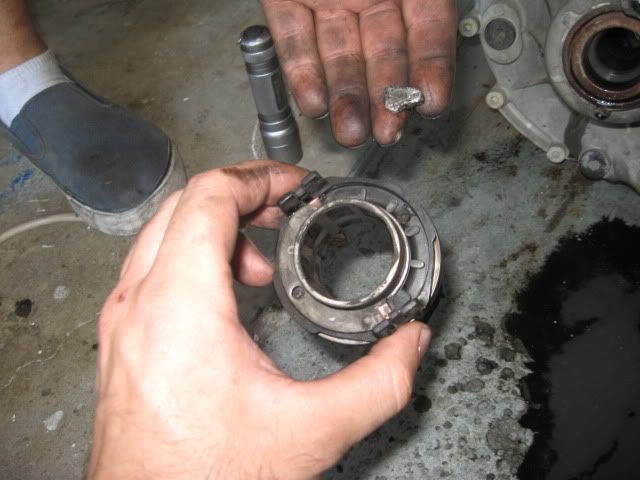

here is one of the holes
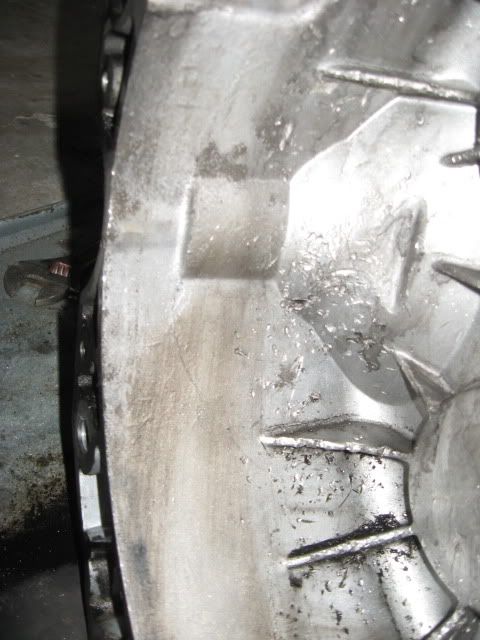
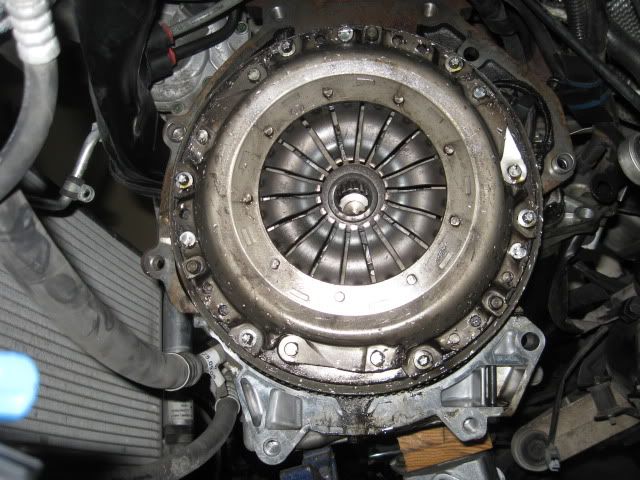
luckily my buddy is set up for aluminum

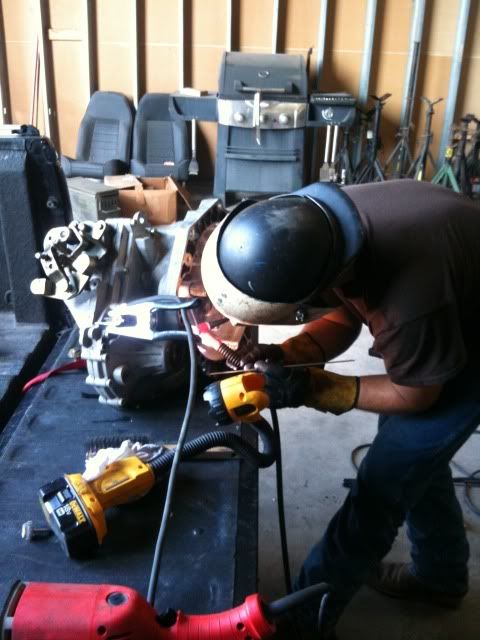

welded up the holes new clutch and have good for another 20k miles now
So keep for foot of the clutch at red lights, because pulling the tranny by yourself sucks...


1st Gear
Joined: Jan 2012
Posts: 43
Likes: 0
OK, so let me really break it down how I shift up just to make sure.
1. Clutch in
2. Shift
3. Release clutch half way really quickly, no gas yet
4. Apply gas, and possibly releasing clutch more slowly
5. Release clutch completely while applying more gas
So the clutch stays half engaged/disengaged for one second or two total for step 3 and 4. I's not like pedaling a bike or duck paddling--the leg on the clutch will move first before the leg on the accelerator. Is this wrong and I need to initiate both legs at the same time?
1. Clutch in
2. Shift
3. Release clutch half way really quickly, no gas yet
4. Apply gas, and possibly releasing clutch more slowly
5. Release clutch completely while applying more gas
So the clutch stays half engaged/disengaged for one second or two total for step 3 and 4. I's not like pedaling a bike or duck paddling--the leg on the clutch will move first before the leg on the accelerator. Is this wrong and I need to initiate both legs at the same time?

6th Gear
Joined: Aug 2011
Posts: 2,064
Likes: 15
From: Silly-con Valley
To me, the point is to always have the revs match. That meaning, when you shift to a new gear at a given speed, there is one RPM that the engine would run in that gear at that speed. The engine should be at that RPM while you're letting out the clutch, or at least close to it.
This implies that there is a little pause when upshifting, because hopefully you let the clutch out when the revs fall to just the "perfect" speed. It also implies that you blip the throttle when downshifting, to raise the revs to the correct RPM.
It does require you to have some idea of what the RPMs should be at typical shift points for your driving style. (Note that the RPM drop is not the same between all gears, nor is it the same at all revs.)
Ideally, you would have the RPMs at the "right" level before you put the lever into the new gear, and maintain them at that level while you're letting the clutch out, but that's not worth the bother in the real world. (If you have driven a non-synchro "crashbox", though, this is exactly what you have to do to shift gears!) That will minimize wear on the clutch and the transmission, but modern transmissions and clutches are more than good enough to tolerate some mis-match.
The final thing: Be smooth. If you can push down just right on the gas while letting up the clutch just the right amount, the car will not jerk. And that means you are doing things just about completely right.
This implies that there is a little pause when upshifting, because hopefully you let the clutch out when the revs fall to just the "perfect" speed. It also implies that you blip the throttle when downshifting, to raise the revs to the correct RPM.
It does require you to have some idea of what the RPMs should be at typical shift points for your driving style. (Note that the RPM drop is not the same between all gears, nor is it the same at all revs.)
Ideally, you would have the RPMs at the "right" level before you put the lever into the new gear, and maintain them at that level while you're letting the clutch out, but that's not worth the bother in the real world. (If you have driven a non-synchro "crashbox", though, this is exactly what you have to do to shift gears!) That will minimize wear on the clutch and the transmission, but modern transmissions and clutches are more than good enough to tolerate some mis-match.
The final thing: Be smooth. If you can push down just right on the gas while letting up the clutch just the right amount, the car will not jerk. And that means you are doing things just about completely right.

1st Gear
Joined: Dec 2011
Posts: 34
Likes: 0
HRM's post was pretty good. One thing I would note is that manual cars, at least from BMW and, by extension, Mini, will hold the brake for a few seconds when you first take your foot off the brake pedal but before you get on the gas & off the clutch. I forgot what they call it, but it's basically the short term equivalent of the old e-brake technique. Kind of annoying since I can't disable it, but I understand why they do it.
For anyone that trains/trained martial arts, particularly anything with ground techniques, an equivalent, if off-beat, analogy for this would be: if you're on bottom (mount of side-mount), it's not a matter of getting hit, it's how much you'll get hit until you escape or reverse. In the case of cars, wear will happen regardless and it's only a matter of managing it. In this case, it's a tradeoff between wearing your syncros (option A) or clutch (option B). Personally, I think I'd rather wear the clutch, but neither option is cheap to repair/replace.
IMHO, it is crucial to commit the clutch engagement point to muscle memory. The easiest way to do that is to have your car in on a relatively level surface (not in traffic!), slowly let the clutch out just until the car starts to creep, and then quickly clutch back in.
I feather the throttle a little when letting out the clutch when the plates are nearly touching. As someone already pointed out, you don't need to give it a lot of gas to get going. If you're on an incline, you may need to give it a little more gas once the clutch and pressure plate hook up so that you're vehicle doesn't drop too quickly in speed (due to the grade of the incline) and you stall out.
For anyone that trains/trained martial arts, particularly anything with ground techniques, an equivalent, if off-beat, analogy for this would be: if you're on bottom (mount of side-mount), it's not a matter of getting hit, it's how much you'll get hit until you escape or reverse. In the case of cars, wear will happen regardless and it's only a matter of managing it. In this case, it's a tradeoff between wearing your syncros (option A) or clutch (option B). Personally, I think I'd rather wear the clutch, but neither option is cheap to repair/replace.
IMHO, it is crucial to commit the clutch engagement point to muscle memory. The easiest way to do that is to have your car in on a relatively level surface (not in traffic!), slowly let the clutch out just until the car starts to creep, and then quickly clutch back in.
I feather the throttle a little when letting out the clutch when the plates are nearly touching. As someone already pointed out, you don't need to give it a lot of gas to get going. If you're on an incline, you may need to give it a little more gas once the clutch and pressure plate hook up so that you're vehicle doesn't drop too quickly in speed (due to the grade of the incline) and you stall out.

1st Gear
Joined: Sep 2007
Posts: 37
Likes: 0
I'll give my take on this...
Minimal clutch wear is all about "matching revs" between the engine and transmission. When the clutch uncouples the engine from the transmission on an upshift (going from say 2nd to 3rd) the engine's RPM will then be dropped to a new RPM as dictated by whatever gear you're going in. In a perfect world, if say at 40MPH, you knew that 3rd gear would put the engine's RPM's at 2400RPM, you would clutch in, shift to 3rd, wait for the RPM to sweep by 2400RPM, and clutch out. This would be a seamless friction point because the transmission (and the clutch) would not be forcing the engine to drop RPM, which is done first through friction (wear) of the clutch. However, in doing this your shift time is slowed down so much you could probably eat a ham sandwich between shifts. But....
This leads us to "double-clutching". The purpose of double-clutching before the days of synchros in transmissions was to line the gears up in the transmission and to match revs between the transmission and engine before dropping into gear. This means on a shift from 2nd to 3rd...clutch in, shift to neutral, clutch out (now the engine and transmission are both turning at wheel speed, the exact speed you'll be at in 3rd gear), now push the clutch in AGAIN (hence, double clutch), shift to 3rd, and clutch out. My 55' Jeep has no synchros in 1st, so you have to shift into 1st this way...fun.
Anyways, to double-clutch in todays vehicles is the ultimate way to keep wear off of clutch because you are ALWAYS matching revs between the engine and transmission before shifting into the next gear and if done properly is quicker than waiting for the engine to drop to target RPM. But...it takes longer than a standard shift and takes a good mastery to be able to do it well under acceleration. I've seen many a good double-clutcher. A good friend of mine has owned a 91' Audi 200tq that has over 350,000 miles on the original clutch - double clutches everywhere he goes.
Basically, what it means if you don't want to double clutch (which most don't...but it's fun sometimes) is that as long as the revs are minimal on the engine inbetween shifts, you'll lessen the clutch wear as much as possible. You should clutch in, foot off the gas a split second, shift to next gear and your clutch should be at the friction point the moment you hit the gas pedal again. Your RPM needle should only sweep down, never "blip" up on an upshift. Now that you're confused enough...onto downshifting.
Here's where clutches go to die if you don't understand how to "throttle blip" on downshifts. Say you're in 4th gear on a road and at low RPM (2000) where you'll need to downshift to pass a car. If you just clutch in, slam it into 3rd and accelerate you are doing the opposite of upshifting in the sense that the transmission is forcing the engine to a higher RPM, and in doing so, when you clutch out, you are creating a TON of friction as the rotating mass of the engine takes alot of energy to speed up, even more so if you skip a gear, which can be common on the track (4th to 2nd). So...enter the throttle blip, which is the absolute correct way to downshift. From 4th....clutch in, as you shift to 3rd, you give the gas a quick "blip" of the throttle to bring the RPM's up to approx 4000 RPM (right where you'll likely be when you downshift), then clutch out and stomp on the gas at the same time - seamless. This way, the revs between the engine and transmission are matched perfectly before you clutch out. You are controlling the engine speed - not the transmission. On the track, this is very common with heel-toe braking, as going into a turn (where you'd downshift), you brake with heel, blip throttle, clutch and shift at the same time. You can really bake your noodle on the track when you combine heel-toe with "left foot braking" which is intended to keep the turbo under boost pressure through the turns so there is no lag coming out...That would be heel-toe, throttle blip, downshift, left foot brake when needed through the turn, constant gas. (You can tell I come from the land of Audi) Go out and practice the throttle blip on downshifts...its fun...and your clutch will thank you.
Oh and....never ever ever ever leave foot on clutch at lights, and never downshift to slow your vehicle down unless ABSOLUTELY necessary. Never downshift when coming up to a red light or stop sign - neutral and use brakes! Brakes are MUCH easier to change than a clutch. Much. Much. Much.
Minimal clutch wear is all about "matching revs" between the engine and transmission. When the clutch uncouples the engine from the transmission on an upshift (going from say 2nd to 3rd) the engine's RPM will then be dropped to a new RPM as dictated by whatever gear you're going in. In a perfect world, if say at 40MPH, you knew that 3rd gear would put the engine's RPM's at 2400RPM, you would clutch in, shift to 3rd, wait for the RPM to sweep by 2400RPM, and clutch out. This would be a seamless friction point because the transmission (and the clutch) would not be forcing the engine to drop RPM, which is done first through friction (wear) of the clutch. However, in doing this your shift time is slowed down so much you could probably eat a ham sandwich between shifts. But....
This leads us to "double-clutching". The purpose of double-clutching before the days of synchros in transmissions was to line the gears up in the transmission and to match revs between the transmission and engine before dropping into gear. This means on a shift from 2nd to 3rd...clutch in, shift to neutral, clutch out (now the engine and transmission are both turning at wheel speed, the exact speed you'll be at in 3rd gear), now push the clutch in AGAIN (hence, double clutch), shift to 3rd, and clutch out. My 55' Jeep has no synchros in 1st, so you have to shift into 1st this way...fun.
Anyways, to double-clutch in todays vehicles is the ultimate way to keep wear off of clutch because you are ALWAYS matching revs between the engine and transmission before shifting into the next gear and if done properly is quicker than waiting for the engine to drop to target RPM. But...it takes longer than a standard shift and takes a good mastery to be able to do it well under acceleration. I've seen many a good double-clutcher. A good friend of mine has owned a 91' Audi 200tq that has over 350,000 miles on the original clutch - double clutches everywhere he goes.
Basically, what it means if you don't want to double clutch (which most don't...but it's fun sometimes) is that as long as the revs are minimal on the engine inbetween shifts, you'll lessen the clutch wear as much as possible. You should clutch in, foot off the gas a split second, shift to next gear and your clutch should be at the friction point the moment you hit the gas pedal again. Your RPM needle should only sweep down, never "blip" up on an upshift. Now that you're confused enough...onto downshifting.
Here's where clutches go to die if you don't understand how to "throttle blip" on downshifts. Say you're in 4th gear on a road and at low RPM (2000) where you'll need to downshift to pass a car. If you just clutch in, slam it into 3rd and accelerate you are doing the opposite of upshifting in the sense that the transmission is forcing the engine to a higher RPM, and in doing so, when you clutch out, you are creating a TON of friction as the rotating mass of the engine takes alot of energy to speed up, even more so if you skip a gear, which can be common on the track (4th to 2nd). So...enter the throttle blip, which is the absolute correct way to downshift. From 4th....clutch in, as you shift to 3rd, you give the gas a quick "blip" of the throttle to bring the RPM's up to approx 4000 RPM (right where you'll likely be when you downshift), then clutch out and stomp on the gas at the same time - seamless. This way, the revs between the engine and transmission are matched perfectly before you clutch out. You are controlling the engine speed - not the transmission. On the track, this is very common with heel-toe braking, as going into a turn (where you'd downshift), you brake with heel, blip throttle, clutch and shift at the same time. You can really bake your noodle on the track when you combine heel-toe with "left foot braking" which is intended to keep the turbo under boost pressure through the turns so there is no lag coming out...That would be heel-toe, throttle blip, downshift, left foot brake when needed through the turn, constant gas. (You can tell I come from the land of Audi) Go out and practice the throttle blip on downshifts...its fun...and your clutch will thank you.
Oh and....never ever ever ever leave foot on clutch at lights, and never downshift to slow your vehicle down unless ABSOLUTELY necessary. Never downshift when coming up to a red light or stop sign - neutral and use brakes! Brakes are MUCH easier to change than a clutch. Much. Much. Much.
Last edited by repeater8; Mar 14, 2012 at 11:50 AM.
1st Gear
Joined: Jan 2012
Posts: 43
Likes: 0
This leads us to "double-clutching". The purpose of double-clutching before the days of synchros in transmissions was to line the gears up in the transmission and to match revs between the transmission and engine before dropping into gear. This means on a shift from 2nd to 3rd...clutch in, shift to neutral, clutch out (now the engine and transmission are both turning at wheel speed, the exact speed you'll be at in 3rd gear), now push the clutch in AGAIN (hence, double clutch), shift to 3rd, and clutch out.
6th Gear

Joined: Oct 2008
Posts: 4,965
Likes: 393
From: In the here and now, for now.
Why is double clutching even a subject of discussion? 70 years ago Bubba had to double clutch that logging rig just to get it up off the log road onto the highway. Syncromesh solved all that when Porsche intoroduced their version back in the early 50's. If you're 83 years old and want to double clutch for nostalgia's sake, have at it but otherwise, what's the point?
1st Gear
Joined: Sep 2007
Posts: 37
Likes: 0
The only thing I can think is that the shift is too slow...the RPM's of the engine are dropping below where you'd be when put it into that gear, hence, the jerk. That's the only thing I can think of.
1st Gear
Joined: Sep 2007
Posts: 37
Likes: 0
Why is double clutching even a subject of discussion? 70 years ago Bubba had to double clutch that logging rig just to get it up off the log road onto the highway. Syncromesh solved all that when Porsche intoroduced their version back in the early 50's. If you're 83 years old and want to double clutch for nostalgia's sake, have at it but otherwise, what's the point?
75 years ago, everyone had to double-clutch, not just Bubba.
 .
. I imply that yes, it is pretty impractical to double-clutch everywhere you go, but if you do, and do it properly, it will vastly prolong the life of your clutch. Is that worth the trade-off? That's subject to debate as most people probably won't keep the car long enough anyways and the extra step is kinda annoying. To me, personally, changing a clutch isn't difficult anyways to have to stomp a clutch twice on every shift. Like I said...I know quite a few avid double-clutchers that have gone insane amount of miles on their original clutch. But as I also stated, there's lots of other things people can do "wrong" to ruin clutches and throwout bearings, things that they usually aren't taught when learning to drive manual. Usually it's just "don't stall the damn thing." Personally, I save the double clutching to my Jeep which has strait-cut gears in first, and occasionally do it for kicks...but that's about it.

Driving a manual transmission car, you should ALWAYS be in gear unless you are at a complete stop.
I always downshift into lower gears approaching a red light, stop sign or slower traffic.
You never know when you need accelerate, be it to avoid a collision or whatever. But, when your instinct is to step on the gas and GO, you'll be sadly mistaken when you realize you're simply pegging the rev limiter and going nowhere. If you were in the proper gear for the speed, you would have easily avoided any potential bad situation.
Now you can return to your regularly scheduled unnecessary conversation about a meaningless topic.
1st Gear
Joined: Sep 2007
Posts: 37
Likes: 0
When we had this topic on an Audi forum several years ago...it went on for days, flame wars, opinions from everyone, cats and dogs...living together...mass hysteria.
Meaningless, yes. Everyone will drive the way they drive. But someone will get something out of it.
Meaningless, yes. Everyone will drive the way they drive. But someone will get something out of it.
4th Gear
Joined: Feb 2010
Posts: 372
Likes: 0
From: Seabrook, TX
I don't understand
rev match, every thing is smooth = Good for tranny and clutch. end of discussion, no?
double clutch if it makes you happy.
also i always down shift as i slow down, 1 for safety, 2 for fun.
rev match, every thing is smooth = Good for tranny and clutch. end of discussion, no?
double clutch if it makes you happy.
also i always down shift as i slow down, 1 for safety, 2 for fun.
1st Gear
Joined: Sep 2007
Posts: 37
Likes: 0
As for downshifting...I do so if I know I'll be speeding up again...otherwise...if coming to a solid red light...I just neutral. I know how to put it back into gear if I need to...once again though...matters of opinion.

Thread
Thread Starter
Forum
Replies
Last Post
Gil-galad
Eastern Iowa MINIs
63
Nov 17, 2016 02:54 PM

