


R56 help! Carbon build up issue


1st Gear
Joined: Feb 2011
Posts: 29
Likes: 0
From: DC metro eurria
Originally Posted by Seafoam Website
Spray the Sea Foam® Spray into the engine from in front of the throttle plate.

4th Gear
Joined: Aug 2010
Posts: 340
Likes: 0
From: DFW, Texas
I was speaking only in regards to adding it to the gas tank. However, I remain skeptical that even spraying it in that manner would do much, if anything. From what I gather, you have to get in there and give it some elbow grease.
Take a look at these threads:
https://www.northamericanmotoring.co...-cleaning.html
https://www.northamericanmotoring.co...e-seafoam.html
Take a look at these threads:
https://www.northamericanmotoring.co...-cleaning.html
https://www.northamericanmotoring.co...e-seafoam.html

4th Gear
Joined: Aug 2011
Posts: 440
Likes: 0
From: Chicago
Thanks, guys, for all the info regarding the carbon buildup issue!
The only thing that I am unclear about is what the root of the problem is. I know it's kind of common, at least on this forum. I may have missed it and I also don't really want to read through pages and pages of countless carbon threads.
Is this caused because by not driving at WOT (wide open throttle) enough? I don't drive like a grandma, but at the same time, I probably don't drive as spirited as some of the MINI drivers.
Could I prevent this by occasionally driving a bit at WOT? If so, often should I do practice this? I only have 15k on my car, so I really would like to develop good practices as early as possible before it's too late.
Thanks for your input,
Chris
The only thing that I am unclear about is what the root of the problem is. I know it's kind of common, at least on this forum. I may have missed it and I also don't really want to read through pages and pages of countless carbon threads.
Is this caused because by not driving at WOT (wide open throttle) enough? I don't drive like a grandma, but at the same time, I probably don't drive as spirited as some of the MINI drivers.
Could I prevent this by occasionally driving a bit at WOT? If so, often should I do practice this? I only have 15k on my car, so I really would like to develop good practices as early as possible before it's too late.
Thanks for your input,
Chris

4th Gear
Joined: Apr 2009
Posts: 506
Likes: 30
From: UK
If you've the time, check this link out, https://www.northamericanmotoring.co...m-effects.html
This will explain pretty much everything regarding seafoam treatment and other chemical agents, introduced to the intake tract through the rear PCV hose.
This will explain pretty much everything regarding seafoam treatment and other chemical agents, introduced to the intake tract through the rear PCV hose.
4th Gear
Joined: Aug 2010
Posts: 340
Likes: 0
From: DFW, Texas
Thanks for the link czar. There was some good info in there.
I'd like to know if the theory on WOT is true as well. I practice this theory at least once every time I drive. Gotta have a little fun with it!
I'd like to know if the theory on WOT is true as well. I practice this theory at least once every time I drive. Gotta have a little fun with it!


4th Gear
Joined: Aug 2008
Posts: 470
Likes: 1
From: Harleysville PA
Yes, I agree...but operating the engine at normal operating temperature does.
When I purchased my Mini, I worked 6 miles from home. My commute was local suburban driving. I put on about 18k miles on the Mini before changing jobs.
I now work 29 miles from home. Most of my commute is now expressway driving. My Mini runs much better now that I am the longer commute.
I have since installed a temperature gauge so I can see when the engine reaches operating temperature. My Mini barely reached operating temperature with the short commute. I suspect this contributes to the carbon build-up problem.
When I purchased my Mini, I worked 6 miles from home. My commute was local suburban driving. I put on about 18k miles on the Mini before changing jobs.
I now work 29 miles from home. Most of my commute is now expressway driving. My Mini runs much better now that I am the longer commute.
I have since installed a temperature gauge so I can see when the engine reaches operating temperature. My Mini barely reached operating temperature with the short commute. I suspect this contributes to the carbon build-up problem.

4th Gear

Joined: Feb 2008
Posts: 500
Likes: 3
As a guy who has extensively studied engines, worked on engines, and talked to people with 20+ years experience, I respectfully disagree. A WOT run for a warm engine will clean out some carbon and clean the valve train out some. Is it the miracle solution? No. But will it help some, yes.

Neutral
Joined: Nov 2010
Posts: 2
Likes: 0
I've been following the carbon build-up issue for a while but haven't seen a definitive answer about build up issues after they redesigned the valve cover. Will 2012 minis suffer from the build up issues or is it only minis build around 2007?
4th Gear
Joined: Apr 2009
Posts: 506
Likes: 30
From: UK
As a guy who has extensively studied engines, worked on engines, and talked to people with 20+ years experience, I respectfully disagree. A WOT run for a warm engine will clean out some carbon and clean the valve train out some. Is it the miracle solution? No. But will it help some, yes.
The N18 engine, will still suffer from carbon deposit build up, just like any DI (direct injection) engine, that doesn't have a secondary set of fuel injectors, spraying into the air intake, Lexus (Toyota) have implemented this system where they have a secondary matched set of fuel injectors, and this will stop the excessive build up of carbon, as we currently see on DI (direct fuel injected engines) as for just how much the N18 engine will suffer, when compared to the problematic N14 engine, time will tell.



6th Gear
Joined: Nov 2008
Posts: 2,194
Likes: 2
From: Washington
Hello,
I have a 2007 MCS whose yellow check engine light came on, when I took it to a dealer(not mini dealer) it had some misfire codes caused by carbon buildup. My warranty expired in June 2011 and the car has 28K miles on it. I read some of the threads on here about this being a common problem with the Mini. Is there anyway the Mini dealer will take care of this? Can you please help me understand how to go about this issue?
Thanks!
I have a 2007 MCS whose yellow check engine light came on, when I took it to a dealer(not mini dealer) it had some misfire codes caused by carbon buildup. My warranty expired in June 2011 and the car has 28K miles on it. I read some of the threads on here about this being a common problem with the Mini. Is there anyway the Mini dealer will take care of this? Can you please help me understand how to go about this issue?
Thanks!
Personally I think you are wasting your time with sea foam.
6th Gear
Joined: Nov 2008
Posts: 2,194
Likes: 2
From: Washington
My wife asks that all the time or another of her favorites is "are you on your way to a fire?", same answer for both. Nope I just like to drive fast as well. LOL


6th Gear
Joined: Jan 2006
Posts: 1,808
Likes: 3
As a guy who has extensively studied engines, worked on engines, and talked to people with 20+ years experience, I respectfully disagree. A WOT run for a warm engine will clean out some carbon and clean the valve train out some. Is it the miracle solution? No. But will it help some, yes.
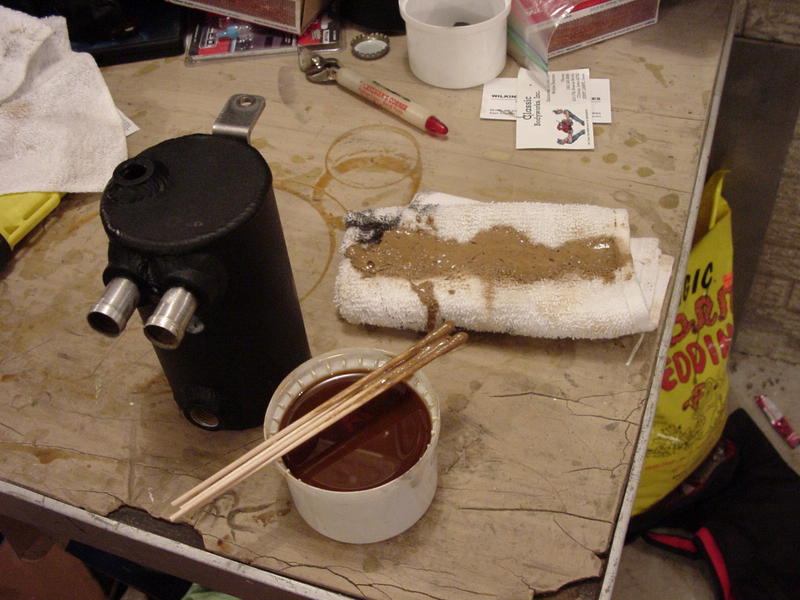
no, they are cotton swabs , I stuck them into the drain hole, and gave up trying to clean the can out that way.The rag had the same stuff on it.Pulled the can off and washed it out.

5th Gear
Joined: Mar 2009
Posts: 835
Likes: 5
From: Atlanta, GA
We all love the power, efficiency, and low end torque of our direct injection engines in our MINIs but this build up is an industry wide problem. The back of the valves never gets "washed" by the fuel as with indirect injection - the older style fuel injection.
Just google "direct injection engines + problems" and the results will light up like a Christmas tree. Audi, BMW, GM, Ford, Mercedes, etc.
I will be adding a catch can. These separate the normal oil vapors from the positive crankcase ventilation (PCV) system from reaching the valves where it forms these dreaded deposits. It is these oil vapors that become the deposits.
Amazing that auto manufacturers have not adequately addressed this. We, the unknowing "early adopters", pay the price. However, much of the power and low end torque of our MINI engines is attributable to direct injection.
Just google "direct injection engines + problems" and the results will light up like a Christmas tree. Audi, BMW, GM, Ford, Mercedes, etc.
I will be adding a catch can. These separate the normal oil vapors from the positive crankcase ventilation (PCV) system from reaching the valves where it forms these dreaded deposits. It is these oil vapors that become the deposits.
Amazing that auto manufacturers have not adequately addressed this. We, the unknowing "early adopters", pay the price. However, much of the power and low end torque of our MINI engines is attributable to direct injection.
4th Gear
Joined: Feb 2008
Posts: 500
Likes: 3
http://www.youtube.com/watch?v=RX5J5kZLTw4
Just saw this too. Make of it what you will.
But I agree as well with the previous poster who said a catch can is critical to reducing carbon build up.
Just saw this too. Make of it what you will.
But I agree as well with the previous poster who said a catch can is critical to reducing carbon build up.
4th Gear
Joined: Feb 2008
Posts: 500
Likes: 3
None taken. As your RPMs increase and your engine has to work harder and faster, it gets hotter and opens your valves up that many times more per second. This tends to heat them up, knock them around a little, gets them moving, and cleans some carbon off. Is it a cure all? No, but it does not hurt either.
6th Gear
Joined: Jan 2006
Posts: 1,808
Likes: 3
Ok I see what you mean, but yeah it might help like 10% but I'd say a good catch can is more effective, because the amount of oil deposited will outweigh however much you can knock off with some aggressive driving